
I was on the stern of the Princess, lying across the stern stoop cushion stretching from one side of the hull to the other, a vortex of gentle winds blowing across my body. The aroma of sea brine and the faint, tiny drops of moisture created by the boat’s passage were the only similarities to the previous time I’d spent before somehow ending up on the deck of the boat. I turned my head toward the bow to see Kingsley’s back, with Nash at his side and Nguyen facing me on the port side, staring into my eyes, a faint smile, invisible to anyone else but me, played briefly across his lips. Kohler was no doubt still inside the cabin.
I nodded toward him, but he made no motion to move or respond, his singular and intent stare emanating from his nearly unblinking eyes.
Kingsley held the radio to his ear and then turned to face me before speaking into it and putting it back on the transom. He handed the boat’s controls to Nash and walked back to where I was still lying down, using my right hand to massage my forehead, which didn’t hurt. It just felt very strange.
“One of the 53’s is coming in to check you out, as you’ve been down for quite a while and were closer to the event than the rest of us, and we were only farther away because you made that happen.”
“I’m fine,” I replied, wondering what he was talking about.
“Here comes the chopper,” Kingsley said, shading his eyes with his right hand to see across the water better. “Kill the throttles,” he yelled up to Nash at the console, and the engines instantly died. “A nuclear medical doctor is coming aboard to check you out and bring some medication,” Kingsley went on, “and don’t bother saying you don’t need any. Trust us when we say you need all the medication you can get.”
“I really don’t,” I replied, moving to sit and get to my feet.
Kingsley pushed me back down with some force, so I went down, frustrated but trying to be patient.
The chopper’s whirling blades suddenly took over with their roaring sounds, and then the blowing of surface water all around and into the boat when it began to remain stationary, hovering less than twenty feet above.
Two men came rappelling down a cable or rope that was hung from the side of the giant chopper’s fuselage, at which point, in only seconds, the big machine generated even more noise and spray in pulling straight up into the air before leaning and heading back to the nearby cruiser I hadn’t even noticed while lying down,
A young man dressed in combat fatigues worked his way past the raised cabin and approached where I was, as Kingsley retreated and headed back up to the console.
“Get us underway,” he said to Kingsley’s back. “We want to have the availability of a trauma center if one is called for. The ship’s medical facility and equipment aren’t suited for nuclear issues. Don’t go to flank speed unless I order it, however, as I want to be able to be able examine the patient, and if we need real stat speed, we can always get one of the helicopters to come back.”
I had noted the second man from the chopper clambering about near the bow, using parts of the exposed .50 Caliber for balance and to unload some canvas sacks around. He came forward to join his companion, who finally went down to one knee to talk to me, although he didn’t touch me, which surprised me until he began to talk, but not to me. I noted that the second man was Marcinko, who smiled and nodded at me but didn’t speak, instead handing the doctor a small package.
“You’re Kingsley!” he yelled forward, commanding Kingsley’s attention,
who turned but didn’t answer. “Commander, give the man this package of iodine, and have him distribute two tablets to everyone except our team leader here,” he ordered, as Marcinko immediately responded, taking the small box back and moving up toward where Kingsley stood.
“I’m Captain Horace Johnson,” the doctor said, without using his medical title, which immediately seemed strange to me. Almost all medical doctors on earth, in my experience, used the medical title as it carried so much weight with almost everyone.
“Nice to meet you, Captain,” I replied, “you seem pretty young to be a full naval captain.”
“You seem a little young to be a team leader of some mission commanding just about all of this huge operation.”
I grimaced, but then asked a question. “Why the iodine?”
“You already know, since it’s your mission, and with your history,” the captain said, before going on, “now tell me your experience previously with Iodine.”
“Experiences,” I corrected. “I’ve had to use it four times before.”
“You’re aware that nuclear radiation exposure can be accumulative?”
“Not really,” I replied, surprised, not by the information but because I’d never been informed before.
“When? “ the Captain asked.
” A year or so ago in Los Alamos, and then three times over the past five years.”
“What, where and when were the other exposures?”
I thought for a few seconds, not assembling the geographics or times in my mind, but thinking about what I could tell the man.
“I’m not at liberty to give you that information,” I said.
“Like hell,” the too-young captain said back. “This is all top secret, or quite possibly even more secret than that. I’m trying to save your life here.”
“I understand that, and I much appreciate it, but we are victims of our circumstances, and if you want that data, then you’ll have to go a lot higher than my pay grade.”
“God, but I hate the phony macho of you spooks,” the doctor whispered.
Marcinko had returned to his side and laughed out loud.
“With this one, there’s no phony whatsoever, not when it comes to macho. If we had the time, I’d ask him to demonstrate that on you.”
“And I don’t much care for you either,” the captain replied.
“Hey, can we get back on point?” I asked.
“You’re right,” the doctor said. “What do you remember of the event?” he asked, looking me straight in the eyes.
“What event?” I asked back, which seemed to stop him in his tracks, and his expression changed.
“Damn it,” the doctor said. “I wasn’t expecting this, not from that small an event, but here we are. You must remember something so why don’t you start telling me what you can go back to. Do you remember setting the explosives down the tube on the island?”
“Why is my memory affected?” I asked, worry layered into the tone of my voice.
“Gamma ray infusion,” the doctor replied. “Commonly called EMP, or electromagnetic pulse emission. Generally, it’s caused by the emission of intense gamma rays in high-altitude blasts but can also be produced very locally from an underground blast and has different effects. The high-altitude blasts of rays affect electrical and electronic equipment but not humans. The underground, if close enough, has neurophysical effects, as likely here.”
“You mean like cars not being able to run or start?” I asked, delaying while my brain raced, trying to remember anything at all of what had to have been an atomic blast.
“That’s mostly myth,” the captain replied. “The electrical wires in cars, or even boats this size, are too short to absorb enough of the rays for that to happen. Now tell me what you remember.”
I sat up, leaned forward, and put both of my hands up to the sides of my head, and began to recite, as if reading the memory text from a book.
“The Princess beat into the waves, spume, droplets, and tiny parcels of water, feeling more like shotgun pellets than the rain across the surface of the water that they really were. I wasn’t under attack nearly so much as being exposed, layer by layer, my thought process worn away. Not torn away. Worn away. The boat at speed was alive, not in, but atop its element. Force of life somehow had been annealed and sealed into the inanimate wood by the stunning power of my own physical existence, which I knew was impossible. My huddled mass of collected electrons racing around nonsensical nuclei, melding into a God-lattice of particle reality, was surfacing my consciousness; awareness spearing its way first inward to my center and then outward from my very core. Consequential speed was demanded of the shambling mess of engines, boards, cushions, and more as we, or I, sped from the slight touch of water reaching, but never holding on, to arrive in the air, as a cushion for what was to come.
Everyone was gone. Money paid in cash. Mission turned to undersea ash. The boat. The Princess was to be scuttled, but the forces in power were unable to scuttle me along with the boat, so I took possession to sail toward the Florida shore and find a home for her. The boat demanded usage and, as it had kept us alive under near impossible circumstances, it wanted to be. No identity, just position. Position in a world where position and placement automatically determine usage.
As we raced through the air, touching water from time to time, the ocean a giant cat toying with little paw thrusts and strokes, I thought about my unwillingness to surrender the assembled mess of metal, wood, plastic, and glass parts. Was I, myself as I am, not the dame, an affinity twin to the boat in my magnetic need to be used, to run on all twelve of my own mental cylinders, which could only happen under extreme demand and duress?
I held the beating heart controls, or throttles, gently in one hand, so close together, just like the thrumming engines they controlled. An astronaut would have said the speed for conditions was nominal or maybe even optimal, but for me it was about life itself. There had to be a place for the Princess, and there had to be a place for me with the Princess in it.
There was a tape sitting under the cover of the small radio center, an amalgamation of knobs and tiny levers on the dashboard. I pushed the ‘play’ button and waited as the boat, of which I was a part, raced across the tops of the white caps, bouncing first one way and then another. A voice began to sing out from speakers mounted I knew not where, but all around me: ‘If I listened long enough to you, I’d find a way to believe that it’s all true…knowing that you lied straight-faced while I cried, still I look to find a reason to believe,’ my career, my marriage, my life was playing out all around me as the boat arrowed intently toward no destination. I had the music inside me, but I had no idea why, and, as with the boat, it seemed as if the entire world was inexorably compressing itself down around me, forcing, against my will, to absorb and make me a part of it.
As the Princess approached the shoreline, I noted a channel ahead likely allowing access to the inland waterway. The buoys lining the channel were red to my left and green to my right. Keeping the ‘red right return’ rule in mind, I wanted to steer the boat close to those buoys but not too close as i glided in until the markers for the intercoastal would appear. At that point, I had to pay attention to the other rule, which was the ‘red dirt green sea’ memory reminder.
The DEA facility I’d come upon was only identifiable as such because of an alert message that came out of the speaker, indicating that the multi-tiered structure was U.S. government property. How the Icom radios were programmed to provide such data was beyond me, much less sense the locality to warn. Authority was being built into machinery and software that was fast-becoming nearly overwhelming in taking control.
It had been the sand, the sand stayed with me and would forever, I knew. I could not breathe sand any more than I could meld myself into the molecular structure of the boat, but there I’d been, face up under a covering of sand so loose it seemed like I could see the radiance of the sun trying to beat its way through to me. The coarse nature of the grains would not pack or tighten to strangulate and kill, but instead, they hid what lay beneath as I waited for what I did not know. My mind was in shock, not from the baseless loss of acuity but from the massive shift of matter that had taken me in, covered me, and then allowed me to lay down near lifeless beneath its comforter cloak.
My back pushed upward, thrusting my chest up and out as the granular bits and pieces of the ocean’s bottom fell away, and my face rose to want to be cleared, brushed, and reworked back into what it had enjoyed.
I opened my eyes and the world reappeared in blue, a sky colored by refracted photons striking endlessly into and out of the water nearby.
I lay breathless because there was no air left in my lungs, my clinging to consciousness more imagined than real, an out-of-body experience but without the body. My eyes opened to reality and then shut again. The scene, taken in, was the same with eyes open as closed, and that simply could not be. Like the kick-starting of a Harley motorcycle, my mental containment cylinders rattled, sank back, and then rattled again. No start. I coughed out a crunching, wretched collapse of escaping air, followed by a long, slow, and painful inhalation. My body, not I, drew a breath. And then again. My mind fought for reorganization, for symmetry, for anything that might allow for a return to a place lost in sanity.
I coughed again and went right on into full idle, my chest rising and falling rapidly in shallow takes, my breath mere puffs of sand blasting debris, my thoughts finally coming together to form some homogenous total. I was alive, as some ancient philosopher so correctly stated: ‘I am alive, so therefore I am.’ Never had those long-ago studied words impacted me as I rose from the sand protecting me from what I didn’t know I needed to be protected from.
Oxygen flooded my system to the point of dizziness. I sat up and then lay back again to recover from my recovery. What had happened? How had I come to be so all alone? Where was everyone? Where was everything? The Catholic notion of some sort of place where babies’ souls went to wait to be taken to heaven shot through me like a laser beam. I was in Limbo, but if I was in Limbo, then why did my back, stomach, hands, feet, and head hurt?
I rolled over but could only crouch, not rise. I truly felt myself to be the motorcycle imagined, so who was going to mount and ride me? I pulled my right hand in close and opened the fist it formed. I was holding a rock, but it wasn’t a rock at all because when my fingers weakened, the sand poured down until there was nothing to be seen. I was hallucinating and quite possibly hallucinating hallucinations.
I heard a voice. ‘Steady,’ was all it whispered, its sound familiar and just high enough to penetrate through the soft, wavering blanket of wind blowing across the sand hill I was ensconced upon. ‘Steady,’ came again. I knew that voice, and the knowledge brought a brief, sharp spear of fear with it. It was my own voice. Part of me was trying to steady the rest of me. But what part of me was doing this?
My shoulders came up, and my back straightened, like I’d taught it to do when I was a child against my bedroom wall because Dad wanted me to be as stiff and straight as a Marine could be.
‘Hello,’ I deliberately said up into the sky above me. It took all the energy I was building to say that simple word. I wanted to go on with ‘hello, darkness, my old friend,’ the lyrics taken from the song, but I lacked the strength.
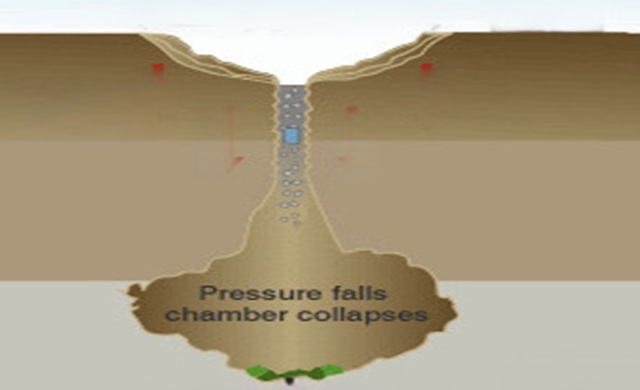
Breathing deeply again, I felt the expansion of my thought process begin to explode. I hadn’t been struck with a shock wave of normal atmospheric pressure phenomena, no, I’d been hit with a shock wave of electromagnetic force that could have been generated by some gargantuan source, which meant the device had not been detonated. No, the device had detonated itself upon reacting to a causal disturbance. Our objective to destroy the device had been that causal disturbance which brought about ignition, and then fission. I opened my eyes again, without fear holding me back, and saw my circumstances. The island as I’d known it, Murder Island or Murder Kay, was gone. The Quonset huts were gone. The tower and the air strip, all gone. There was only a spot of sand, a pile, with the sea actively encroaching or eating its way into taking the sand back to the bottom of the sea it had sprung up from.
Disengaging myself was easier as I climbed to my feet, using the sea water spilling about me to wash the sand from every part of my body except my feet. I stared down at what I had. Mephisto walking shoes in gray leather, whitish socks rolled too far down, as my wife hated, Ocean Pacific shorts of baby blue, and a Ralph Lauren Polo shirt I’d picked up off a stand that likely only sold counterfeit goods in white. Nice little horse covering or indicating where my heart was.
Was there anything else? I craned my head around before turning to look in every direction. What was I to do? My body answered that question. I sat down, bent my head down with closed eyes, and tried again. I was unconscious or asleep because when I awoke or came to the scene, it was all changed.”
I stopped talking and brought my hands down to stare over into the Captain’s eyes.
“Marcinko,” the Captain said to the Commander. “You were a part of all this. Tell him what is true from his memory and what isn’t.”
“Well,” Marcinko began, “most of it is pure fiction. He set the explosives, that much we know. He retreated back to the boat, got everyone aboard, and then turned, from the farthest part of the island from the tube, and gave the signal to the cruiser for detonation. Although it was thought possible, nobody really expected an atomic blast, but that’s what happened. Fortunately, it was what’s called a fizzle, and involved incomplete fission conversion, or likely nobody at the island at the time would be alive or even in existence here. The others dug him out of the sand and pulled him onto the boat, which then headed back toward Key West as the Naval ships dispersed.”
“The sand,” the doctor repeated, his voice low and quiet. “The sand probably saved your life. Sand is used around nuclear plants to absorb radiation.
“Give me the detector, Commander,” the doctor ordered.
Marcinko moved back to the bow of the boat.
“I can’t believe it,” I said, more to myself than the doctor. I knew that Marcinko was telling the truth. If he wasn’t, then Nash, Kingsley, Quincy, and even Nguyen would be chiming in. But it had all been so real.
Marcinko returned with what was obviously a Geiger counter. The doctor took it from him, pushed on a switch, and the machine instantly started clicking away, which caused me immediate concern and a bit of worry.
“You’re fine as far as roentgen detection is concerned, the doctor said.
“Sure is clicking away,” I noted, back to him.
“Your watch, Japanese with hands you can see in the dark?” he asked.
“Well, yes,” I replied.
He ran the counter over my wrist, and it went crazy.
“Your watch emits a very low level of roentgens from the radium that makes the hands visible in the dark. The rest of you is emitting less than that. Way less. You’re fine with that. The memory is another issue. You may never get the real memories back, or they could return over time, or all in a rush. We have no idea.
I came to my feet and looked back in the direction we’d come.
“How far back is the island?” I asked, staring out over the stern.
“There’s no island,” Marcinko replied. The base of the thing was most likely coral, shells, and broken-up metamorphic rock. The blast took out the column holding the upper mantle, and only minutes after your team left, the whole thing went under.
‘That’s still an international incident,” I said to everyone there. Other countries have detectors that record any nuclear event.”
The doctor laughed for the first time. “No doubt the Secretary of the Navy was on the phone to the Chairman of the Joint Chiefs and Department of Defense, who then called the president, who then called the leaders of a whole lot of countries to report an accidental incident.”
“How is it that I can remember what I remember so clearly when almost none of it’s true?” I asked, taking the Iodine tablets Marcinko held out to me.
“When you get home, they’ll be calling you to head on over to Lovelace Medical Center for some testing,” the doctor said. “I’ll be flying in for that occasion,” he finished.
“That’s nice of you,” I offered, although not forgetting his comment about spooks. I was merely a spy while he was a world-class doctor, and no matter what I’d just done for the Navy, the CIA, and my country, almost paying with my life and that of my best friends and team, I would only ever be a lowly spook.
“Okay,” I replied, but do I get to keep the boat in real life?”
“Depends on how you define real life?” the doctor replied.
“No problem,” I answered, “I’ll leave that to my wife.”
The Captain laughed out loud. “I don’t suppose this boat will be in your future then.”
“Are they flying you out of here?” I asked, looking around but not seeing any choppers or any evidence of the Navy at all.
“No, Macinko and I don’t rate that kind of expense,” he said, his shoulders slumping slightly. “Besides, we have to get to Albuquerque and clear you for your next mission.”
I sat thinking deeply for a few seconds, trying to come to terms with some impossible questions. Why had I called for ignition of the explosives before we were well clear of the island? Had I really done that or was I attributed to have done that? Part of my totally flawed memory had me buried in that awful but wonderful sand, which hadn’t been imagined because the doctor confirmed the fact in his diagnosis. What else was real of those memories that I was now to take as totally imagined? Suddenly, my brain kicked in and realized what the man had said.
“What mission?” I asked in surprise, the bad taste of the chewed-up tablets making me lisp slightly.
“The island is missing, not your coming mission,” the captain replied, laughing once more, joined in by Marcinko.
I looked up and met Nguyen’s unblinking gaze. Real life, I thought, only the people I was so close to were in my true reality, and I could never forget that. I kept surfacing from the valley of no return only to keep returning to it, but at least I was soing so with my ‘men’ alive and intact.








Finally got to read Chapter XXXIII – and what a chapter! Still hunting for XXXII – but I’ll get it sooner or later.
Had no idea my best friend had been through a close-range nuclear blast! Very good luck having all that nice Keys sand absorbed all the electrons that were zipping everywhere!
And happy to hear that a world-class doc just happened to be on scene. Did Mary have any comments about your new ability to glow in the dark? Save you some money with that self-powered night light!
Truely enjoy reading your work, as it distracts from the physical nastiness wandering through the old bod.
Dear Craig. Chapters I II, and III will be up in the morning tomorrow on Volume VII on the website and then ‘later in the day on the
Facebook sites (there are ten of those!), The last short story, We’ve Come to Mombasa is also up now.
Semper fi, my great friend,
Jim
Sorry it took me so long to read this last chapter. I had to repeat the previous chapter before I could attempt this one. Can’t yet grasp all the ramifications of the events and whatever down stream effects they had on you. Thank you for bringing me along on all the chapters of your life. Semper Fi
My pleasure Joel and much appreciate the well thought out and complimentary comment too….
Semper fi,
Jim
Crazy times for sure Jim. Hope you draw a better mission in the future,as always cant wait for another chapter.
There were seldom better missions. I wasn’t in the game, apparently, to get those. I was like a reliever in baseball that they
send in when the chips are down, two outs, bases loaded sort of thing. Oh and the ‘real’ pitcher is tossed out with two strikes on that hopefully last
batter. I wonder what happened to the B-52 at Edwards. Nuclear aboard? Hmmm. Sounds familiar. Noticed a solid clump of debris just ahead of the crash on the runway.
Nuclear material is extremely hard and difficult to destroy.
Semper fi, and thanks for sticking with me.
Jim
Jim,
Well, to put it mildly – Are you f___ing sh__ing me?
My lack of knowledge vs the earlier chapters – I need to fix that this week. I’ll come back to this chapter to add any brilliant blather I can come up with.
I do know this – I’m glad ‘enuff’ of you came back to grab my attention so long/short ago. Saluting you with an adequate amount of Crown Royal.
As always, most sincere regards my friend,
Doug
Doug Danko, great friend, much appreciate the usual rough-edged great comment.
Semper fi,
Jim
LT, your sure find a way to put yourself in danger or let others do it for you. Way too close for a man with a family. I do wonder if your memory of this event came back. Kind of like the last unexpected battle in Nam.
Yes and no, JT. Some bits of it. The feel and taste of the special sand. The feeling of not being able to understand anything going on around me. My
‘mating’ with the boat and other objects that cannot be joined physically. What was all that? I have little clue to date. The trust in the people you have to have provide you with the stuff you know you missed? Tough stuff.
Thanks for the great in-depth comment.
Semper fi,
Jim
Jim,
Great read.
Always so suspenseful…and informative.
Looks like you had good people to come and be Johnny on the spot.
Not sure I understand how you got more of the effects of the blast than did the rest of your team….
Keep writing…
THE WALTER DUKE. The team was getting the boat off the sand and preparing it for sea while I was forward of it doing god knows what.
That small amount of ground was sufficient to absorb the gamma rays as they do not penetrate solids well. Atmosphere, yes, but ground or sand not so well.
Why walls of sand shield nuclear plants. Still have no explanation of why I supposedly called for the detonation when we were so close since it
wasn’t necessary. Hmmmm. Marcinko comes to mind. Thanks for the compliment my great friend,
and Semper fi,
Jim
Gamma Ray infusion, why is this almost like info on UFOs? Your LSD like remembrance makes me wonder about how your crazy mind remembers it! Did they have any of that during exposed bomb testing?
Good way to end Vol
Homan
Colonel. Yes, Gamma ray infusion occurred before they figured out, after a few underground blasts, that the ground was not sufficient to protect from
the even shorter range rays, and the experimenters all had to move much farther away from the blasts. Blast and thermal damage were mostly contained underground, like on the island. Assembling lost memories is usually a function of time and the strength of the electrical charge. I experienced a similar event when struck by lightning. Thanks for the usual pertinent and accurate comment mu great friend,
and Semper fi,
Jim
This one had me getting closer and closer to my monitor as I read .. Well done !!
It was some kind of a time and not to distant from todays handling of such stuff I get the feeling from the current adminisration’s actions
and presentation. Thanks for the compliment.
Semper fi,
Jim
Whoa!!!
The readers like you on here are pretty generous with short but very meaningful compliments and I don’t blow past any of them
like your own. Thank you most sincerely,
Jim
but at least I was soing* so with my ‘men’ alive and intact. (doing*) The only typo I found !!
True reality may be a struggle for some time to come after the trip you just took in your mind, I could only imagine the conflicts in your head after this !!
I tip a glass to you sir, and to the island that once was..
Semper Fi
The whole mission remains a fog in many ways even to this day,
and it is always hard to fill in such gaps with the words of others
as they can be so different and varied…and many times doubted.
Great compliment and I thank you SgtBob,
Semper fi,
Jim