
I stood still outside the hotel lobby exit to the harbor, looking at the boats, gently bobbing in their slips, only one boat of real interest to me. We’d all worked into the night on getting everything loaded and ready, like I was loaded and ready. There was no sleep for me, and the fact that the hotel kept lobby lights, inside and out, so brightly lit was a real benefit to me.
I was ready, although there was no way I could imagine being ready for what truly lay ahead. Would all the Naval and Marine elements be in place by the time we reached the island of our intent? Fuel was a big deal because the choppers I was depending on to fly support for us were limited in range. The Navy had agreed to have two CH-53’s on site and in the air, either rotating or hovering for the entirety of the mission, along with the Marine Huey Cobras. We would be going in hot, which meant that I was making certain that the island was strafed several times over before we ever got our feet onto the sand. Momentarily, in reverie, I wished that the Gunny was there, and we were smoking some of his Marlboros and ‘talking story’ as Hawaiian locals called it. But there was no one about in the night. The wind was just right, the temperature too, and my feelings about the mission were beginning to settle a bit. I could not stand to lose any of my team. I knew that deep down in my center. How I could even risk them was beyond me, but I had to do something to have continuance in my life. Where was I going and how was I going to get there? I could talk to Mary about stuff like that, but not anybody else. I missed my relationship with Bob Elwell and Bro, the lifeguards, as well as Mike Vanni and Nancy, his wonderful wife, Tom Thorleson, and Chuck Bartok
The landing, operation, and extraction weren’t going to be done quietly.
Time went by, and I relaxed somewhat, sleep not being an issue, going all the way back to the valley. I could go for two days and nights without any sleep at all, a regular feat Paul, my therapist, had said wasn’t truly healthy or possible. It helped when I learned in my anthropology courses that sleep was not the restorative everyone thought it was. Not moving was the functional reason for sleep. Either to recover from sickness, injury, or because diurnal animals were always at risk from nocturnal animals whose talents were maximized in the dark. Moving when injured or ill in the forest or jungle was a recipe for predation of the most painful sort.
Everyone assembled automatically just before dawn, at least everyone except for Nguyen and Kingsley, which silently surprised me until I went aboard the boat and down into the forward cabin.
“Good morning,” Kingsley said, turning to face me, and seeing the surprised look on my face. “We slept aboard, just in case,” he said as Nguyen folded up the blankets they’d use atop the cushions, the outside temperature warm enough not to need covers.
Nash stuck his head through the cabin door.
“Six actual is on the line in the lobby for you,” he said.
I wondered what Tony had up his sleeve, or what bad news would come before crossing the line of departure. We were to sail at dawn, which I’d never truly understood about most missions. Would any alert enemy or other source of intelligence not be aware that dawn was always the departure or the attack time, but there was no place to ask my question or offer my advice. The Navy had picked the day and time, and they were all we would have for backup, not that such full force coverage wasn’t worth any trouble or orders at all.
I walked into the lobby, which was brightly lit, as it always was, no matter what the hour. There was no one behind the counter or anywhere to be seen. Anyone wanting room service in such a many-starred hotel just dialed for assistance or, if counter help was needed, then dialed for that.
The counter was made of thick, rough-sawn cedar or some other wonderful and expensive wood. I leaned forward and looked at one of the phones and spotted the telltale blinking red light so evident on my own system back at the insurance office.
I looked around before picking up the receiver and holding it to my ear without saying anything.
“You going to say good morning?” Tony asked.
I sighed audibly, wanting to know how he knew it was me, but then looked up to see a video surveillance camera right up on the wall near the joint where the ceiling began. I didn’t bother asking anything.
“You are calling for a reason, which has little to do with our departure, I presumed,” I said.
“Well, it sort of does, as your departure will be a few minutes late as you delay,” he said.
I waited. There was no question, so there was no reason to say anything. The answer to my unasked question would come in time, I knew.
“There’s a fly in the ointment, at this point,” Tony replied.
He said nothing more until I thought he might be holding his breath.
What could it possibly be? Just how screwed up could a CIA/Navy/DEA mission get? I waited again, however, once more following the great training Thorkelson and Bartok had given me in my early insurance sales training.
“Peter Kohler,” Tony said.
I almost asked him to repeat the name, but I knew there was no mistaking it, no matter how nearly whispered the words had been.
“Yes,” was all I could manage to say, in shock. Shock, because I knew what had to be coming, although as long as it didn’t get discussed, I could still hold out hope that it wouldn’t be what I feared.
“He’s there. and I want your clearance to allow him to be an observer on the boat you’re going in on.”
I was even more surprised. Tony, the Agency itself, the monstrously powerful behemoth it was, wanted my clearance? The way Tony spoke the words told me we were involved in something far beyond any normal mission. Not only that, but, as far as I knew, Peter Kohler was an inexperienced civilian friend known to me only as a close neighbor living along the bay at Egg Harbor in Wisconsin, next to my own parents’ place, which wasn’t really their place at all, but my uncle’s. ‘Family,’ I wanted to whisper out, but said nothing about the odd situation.
“Why?” I finally blurted out and immediately wanted to take it back. “I’m sorry, Tony, but this is coming from backstage left when the play is already underway.
“We aren’t secure on this line,” Tony said, as if it made any difference to me.
I stopped moving, holding the receiver glued to my ear but saying nothing.
“There was an enormous adjustment made,” Tony said, even though I could tell by the tone of his voice that he knew I didn’t have a single clue about what that phrase might mean. Some powerful political move? Some monetary contributions? Thoughts raced through my mind as I tried to figure it out, even though I knew in my heart that there’d be no figuring it out before we hit the beach on Murder Island.
“Can we just pretend,” I said into the receiver, stopping and starting again, “that this is a Marine Corps operation, since it is a beach assault onto the shore of a hostile island?”
“What are you talking about?” Tony came back as I went silent again.
Minutes passed.
“I think I understand,’ he finally said.
I waited.
“You load the boat with everyone, three agents on first assignment, two players of your own, and the baggage. I don’t know how the knowledge of what’s there will be transmitted to you, but it will be, and then you take the measures necessary to see that this whole problem goes away without indicating to anyone what the hell the problem really was.”
I breathed in and out rapidly. I was finally getting somewhere, even if where that somewhere was wasn’t necessarily a place I wanted to go.
“Will I know?” I asked, hoping Tony understood the depth of the word and the vital importance of my understanding what the hell was going on.
“Yes, you will know,” he said, and hung up.
I walked out of the lobby and moved toward the boat, wondering at what point the Agency would transport and then arrive with Kohler in tow, but that thought evaporated almost instantly when I saw an aging man sitting on a nearby bench that had a full view of the harbor. I walked over.
“Peter,” I said, holding out my right hand, which he took with a solid grip, although I noted a slight haziness reflecting from his eyes.
“Parkinson’s disease,” he said, somehow reacting to my conclusions forming about his health. “Don’t worry, I see fine except for the gray outs.”
“What’s a gray out?” I asked, disengaging and dropping my hand to my side.
“Sometimes, with this terminal disease, things go gray, and I have to sit down and remain still for a few minutes until everything comes back.”
“Oh Lord,” I wanted to say, at the idea of Peter dying and then about the fact that I not only had a civilian on my hands for the mission but a handicapped one, as well,” but I said nothing.
“What time do we depart?” Kohler asked, surprising me and coming to his feet, appearing spry and steady as a, before you lose me for a bit,” Kohler said, but with a big smile, as if his gray outs were humorous.
I couldn’t help but like the man all over again as the making light of his impending doom made me feel better about things, somehow.
We climbed aboard the boat, Nash at the bow and Rosley manning the stern lines, both waiting.
Kingsley was at the helm, the twin Lambos idling away, shaking the boat but not making nearly as much noise in the morning air as I thought they might.
“Nice boat,” Kohler said, mildly struggling to get aboard. “Be better with sails, of course.”
I made no move to help him as I thought it might diminish his ability to navigate himself even more. My wife and I’d sailed in Lake Michigan out of Sheboygan harbor, where the Kohler plumbing plant was located, as well as Peter and Nancy’s estate. Peter was a master sailor although Lake Michigan could be problematic in any rough whether conditions because of its variable depths, ranging from over nine hundred feet in the northern part to less than a hundred in many places in the south, which meant that huge waves could be generated over where it was deeper to come barreling down the narrows of the lake and crisscrosses over one another making it a sailor’s hell and taking so many to their graves in the deep, no matter what kind of power was used to propel them.
I took Kohler below after pulling an Icom radio from its charger on the transom. It was time to let the Navy know we were departing and there would be no porting again until we made Murder Island.
“You’ve got some things to fill me in on,” I said to Kohler, having assumed that the source of information I was supposed to receive had to be coming from or through him. It certainly wouldn’t be over the radio or delivered in any way I could conceive of.
Nguyen eased through the cabin door with Quincy right behind him. Both men remained standing as Kingsley eased the boat from the dock and out into the calm Inland waterways area.
I hit the transmit button on the radio, which was preset to talk to the Navy at the push of the button without changing the frequency. One of the other radios was set to be able to contact the Marine helicopters; the Navy had no communications with that we knew of.
“We are en route and would like the 53’s to fly cover all the way in and then hover at a hundred meters for the duration,” I said, without using the word ‘over’ as the system allowed for instant two-way discussions, like the car phones in my vehicles back home.
“The choppers are still at Key West on the tarmac waiting for orders. Make direct contact.”
“Roger that,” agreed. “What about the Cobras? Do you have them aboard?
I knew the Hueys had a range of only about a hundred and twenty miles compared to the over three hundred miles of the much larger and more powerful 53 models made by Sikorsky. The Cobras had to be held aboard the cruiser as there was no way they could make it back and forth from Key West and still provide the necessary loiter time to cover us with real fire. The 53 models had side guns of some power but nothing like the nose-mounted and helmet-aimed rotary cannons of the Cobras.
“Contact upon arrival. Will discharge from the deck, fueled and ready. Communications transferred to your source.”
I brought the hand-held down to my side, looked over at Quincy, and made the slightest nod to the cabin door. Quincy got the message just as quickly as if I’d verbally instructed him, impressing me again. He carefully and noiselessly closed the cabin door.
“He stays,” I said to Kohler, “and I imagine this is the part where you tell me what you can of what’s going on.”
I went to sit down on one of the bulkhead cushions in order to relax and take in whatever it was that Kohler was to tell me, until I noticed that the bench and cushion only looked a bit like what they had been before. I felt the material that had replaced it and noted that the same was true of the other disguised bench and cushion.
“What the hell?” I said, turning to Nguyen. “Get Kingsley in here,” I ordered, and he was nearly instantly out the door and gone. Kingsley appeared only a slight bit later, to my embarrassment. In calling him to my side, that meant somebody else, not as equipped, was driving the boat. The look I gave him said it all, however.
“Nash is at the helm, as we’re still inside on flat water,” Kingsley said. “I’m sorry, but I was so busy reading the boat for sea I forgot to tell you. They came in last night and worked for hours replacing the benches and cushions.”
“Who’s ‘they’ and what did they replace them with?” I asked, befuddled.
“I believe those are containers made to look like that but filled with special plastic explosives.”
I pulled away from the supposed cushion and stood in the middle of the small cabin area.
“Take the boat back,” I said.
“I imagine there’s some climbing ropes and a kit to go with it in one of those lockers,” Kohler said, moving to sit on one of them.
“We’re headed for a nearly totally flat island, so what the hell good is climbing stuff?” I asked and then waited to hear what had been kept from me, and I just knew I wasn’t going to like.
“There’s a tube under the second Quonset hut, and that tube has got to be scaled,” Kohler said, before stopping and staring at the bulkhead across from him.
After a few seconds, I realized I was experiencing one of his gray-outs with him. I eased down on the cushion that wasn’t a cushion, wondering if I was sitting atop some of the explosives themselves. Nguyen moved forward to bend and examine Kohler before withdrawing and then turning to withdraw something from one of the zipper pockets on his pack. He stepped forward again and pushed something into the side of Kohler’s mouth before stepping back again.
I’d never seen Nguyen act that way before, and then I wondered if I should stop him or at least inquire as to what he was doing.
He turned to me and whispered two words before Kohler began talking again, like he’d never been gone.
“Pan ginseng,” he murmured, “short sleeping, will not sleep for what we do.”
“You always carry that?” I asked, mystified, before I had to turn and listen to what Kohler was saying.
“The island is no longer mine, as I gave up ownership to the government. There’s a tube down the center under the far-right Quonset hut, which we will approach if we come in from the north. The tube is four feet in diameter and goes down a hundred feet or a bit further to a large cover dug out from the bedrock. There was to be a desalination plant there to make the island habitable, back when I had asked you to take over living on it for a while to rid it as a stopover from the drug runners.
“Why are they allowing you to be here for this?” I asked, “My control officer could have told me all of this. I’m going to have the Cobra gunships strafe the island so there’s nothing left alive when we hit the beach there, but that doesn’t fit exactly with some sort of tunnel complex, much less how such a ‘tube’ and then a facility underground was ever built down below. What are we walking into and what’s the real story since there’s evidently enriched elements down there, and the desalination plant story seems totally implausible?”
I held the radio but made no move to contact anyone. I just didn’t know enough as the boat began to heave and roll noticeably. We were at sea, which meant our time was running out to make properly well-grounded decisions about the landing.
“What did this man give me?’ Kohler asked, looking over at Nguyen.
“Some kind of Asian powder that supposedly provides energy, although I don’t think there’s any kind of scientific proof for that. His name is Nguyen. We served together in Vietnam.”
“I haven’t felt this kind of clarity in a long time,” Kohler replied, staring at Nguyen with a faint smile on his face. It was the first emotion I’d seen appear on Kohler’s face since he’d shown up, and I was glad, as I needed him to be able to tell me what was really going on, which I sensed I still didn’t know. I placed the Icom radio down by my side. I couldn’t give any orders until I knew more.
“The enriched uranium down there is from Oak Ridge,” Kohler suddenly said, his tone matter-of-fact.
I was stunned. American material. There was no way that any such material could be released from Oak Ridge by being slipped out the door, so to speak. “Is it organized into a device?” I asked, afraid of what the man might say and still mystified about why Kohler was with me on the boat to say it.
The tube has to be used to discover that,” Kohler replied, faintly fading out again.
I nodded at Nguyen, who promptly approached with his little sack of Asian wonder drug.
I pulled back a bit, wondering how I’d gone down Alice in Wonderland’s rabbit hole to end up out at sea, fighting my way toward an island and trying to make sense out of the most hopeless mission I not only was participating in but could never have imagined happening in even the worst of espionage novels.










Never forget that an ambitious Boy Scout built a nuclear reactor in his family’s garden shed with readily available components delivered by mail! As much as we would like it isn’t always rocket science! Love your writing!
Yes, it might take a bit more than mail-order parts to build a warhead today, given how surveillance has become so
penetrating and sensitive, but the concept is pretty simple…the hard part being the acquisition of enriched elements.
Thanks for the factoid and your comment here David.
Semper fi,
Jim
My squadron, HMM-364, was at Johnston Is. last atmospheric atomic tests in 1962. The Thor had 3 instrument pods on them we had trained to pick up after they parachuted through the atomic cloud. The Russians were there in the mix with their equipment. At first light after a blast we launched to search for their radio signal. We would attach a cable to them flying them to a lead lined container on Johnston. Our Geiger counters pegged. Years later I was able to have my dosimeter and film badge reading sent to me. I sent them to my PhD Bio-Physics daughter for review. She said I had a number of incidents . I asked what is an incident and she told meI had received more radiation in a short time than most people receive in a year. The good news was damage usually takes place within 10 years following.
Yes, my Dad was at Johnson Atoll as well, although far enough distant to not take much
in the way of radiation. Detonations over, in or under water generate a huge amount of
radioactive condensate because of the nature of radiation penetrating moisture and then
lying there inside it, awaiting ingestion.
Thanks for the well-written and accurate comment.
Semper fi,
Jim
Funny, that you used a “cartoon” of an old A Bomb. My first duty station was a Nike Hercules missile site. Eventually I witnessed the removal of a nuclear warhead. which was a round device, like a basketball, with multiple detonators installed all over the exterior. I will not, further discuss, how it was constructed due to an old DNR.
We were discussing the use of such devices the other day because of what’s happening in Iran.
Alan
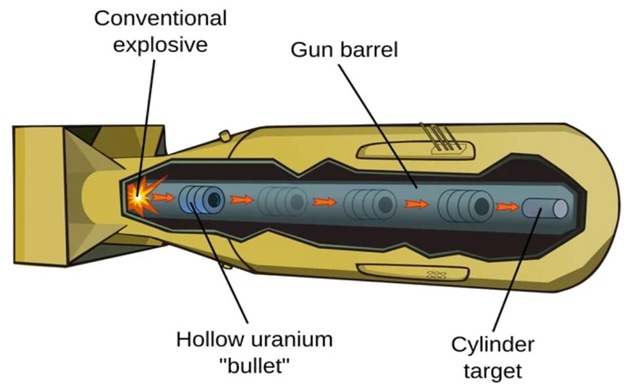
Implosion is one way to form a plasma that then allows for fission to take place.
An atomic bomb can be constructed using both systems of forming the plasma.
I used the cartoon because it so accurately and simply demonstrated the
principle I was discussing.
Semper Fi, and thanks for an interesting comment and your own experience at this sort of thing
Jim
Complex chapter, Jim – a bit eye-opening. Recognized the drawing right off.
If what is down that tube is what has been drawn, I’d be headed a different direction entirely.
I do not know how many such instances have happened – I am sure more than one.
I’ve seen a few evacuations for hurricanes, with both US 1 and I-95 bumper to bumper from Miami to Jacksonville. Not a pleasant thing to witness – and probably much worse if a nuclear situation occur.
Thanks for another excellent chapter.
Evacuation for nuclear would probably never be announced as such
because of the systemic fear that would run through everyone trying to get
the hell out of proximity. You, of course, understand that kind of stuff.
Semper fi,
Jim
Wow what chapter keep em coming LT
Thanks a lot, Robert, and I am hard at work doing exactly that.
Semper fi,
Jim
You have a NMark48 loaded and hopefully not armed; Cuba?
I suppose Kissinger got to tell JFK
🫡🤔
Dear Colonel:
Ostensibly, the explanation for the warhead given to me by Kohler but never confirmed by the Agency,
and I didn’t ask, ever, was Israel but Cuba makes more sense because of the poential for usage,
although why the device was left virtually unattended was never explained either.
Thanks, my great friend,
Jim
Subterfuge, twists and turns. Another day with the agency. Nothing is ever as it seems as you peel back another layer of the onion.
Dear TomL The disorganization but efficiency in spite of that, was astoiunding to me during my service with CIA.
They depended much more on bringing in people for field work that were exceptinal in many different ways so the work
was less a function of training as it was about adaptation, acting, lying, language, and innate depth of being able to accommodate and
learn about other cultures at lightening speed. Thanks for the great comment.
Semper fi,
Jim