
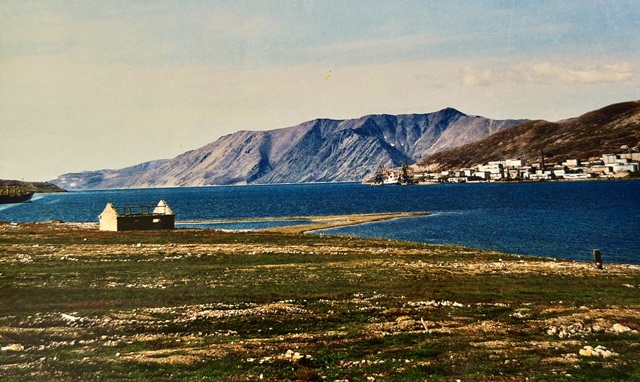
My body craved sleep, but my mind wouldn’t slow down. I pulled the Aguiak gold nuggets from my small table drawer. I rolled them around in my hand, like rough-cut dice without numbers. Then I took the Leica out of my pocket and shot some digitals. Gold was a disappearing commodity in the world I normally inhabited. I didn’t expect to complete the mission and be able to depart with the nuggets. Somewhere along that unpredictable trail ahead, they’d probably find a home in someone else’s drawer.
At least the photos would go into my journals where I could one day review them. Maybe one day, I hoped, I would even write of them. I stood, swaying with the motion of huge swells. My small cabin, so far forward toward the bow, was more like an elevator than a room at all. An elevator which moved up and down with great vigor, but also from side to side while it did so. I imagined never sleeping deeply again, on water or land, without reaching for safety straps to hold myself to a bed.
I slipped the nuggets (fourteen in number, ranging from the size of my thumb to that of a little fingernail clipping), into my underwear drawer in the dresser. Absent-mindedly, I clicked on the CD player, which started back on the first song. The Man song. I lay back and listened to the music, right through Izzy’s Somewhere over the Rainbow. I waited to see what the creative mind who created the custom disk would come up with next.
“If you’re going to San Francisco…” the lyrics began. After shutting the machine down, I undressed, showered, then crawled back into bed, running through each person I knew aboard the ship, and each person’s likelihood of providing me with a CD player and that particular musical medley. I slept, clueless, with no likely characters
My Breguet read six. I had awakened because of a persistent knocking on my door. I groaned. It would be wonderful to just sleep in someday, I thought grumpily to myself. I had kept my underwear on, and I yelled for whoever was out there to please come in. Don called back that the door was locked. I unlocked the deadbolt and then went into my tiny bathroom to shower and shave.
“Big day! Big day! This is it! Are you ready?” Don was his usual clamoring of great, good cheer first thing in the morning.
I preferred to awaken slower, and I resented his clamoring at such an early hour. I turned on the shower and climbed in. There was no escaping Don’s voice, however.
“We’re in the gap. No swells, making about six knots so the passengers can all get their sea legs. Both sides of Providence Bay are gorgeous. Look out your porthole.”
I showered on, as Don continued with his litany. “We’re in the Chukotka Oblast, not that it matters. Oblast is like saying county in the U.S. Provideniya is an Okrug within the Oblast, however, which means it’s run by its own little Commissar.
I turned off the water. The shower was too small to dry off in, so I stepped out naked. I was getting used to the ‘floating nudist colony’ mindset of the staff crew, but I was still not comfortable with it. Don continued to talk, bubbling over from his place on my bunk.
“The town is a mess. Streets are mud and broken old concrete. Everyone lives in wretched tenement apartments built by the Soviets. Once, the place serviced submarines and was known for its fishing fleet, but no more. Now, it’s just kind of rotting away. Very Russian. There used to be a great bar in town, but alcohol became too expensive to make and market. No fruit up here. Anyway, the museum is up the hill a few blocks. You gotta wear Wellingtons because of the waste channels running down the roads, and the mud. It’s summer, so it’s almost all mud. What’s your business got to do with the museum?”
Time went by. Alas, blessed silence.
“That Commissar you mentioned? The director of the museum knows him well. He’s willing to introduce me.”
I dressed without speaking further. In the middle of putting my shirt on, I heard a great clunk travel through the hull of the ship. I held my breath and then begged Don for an explanation.
“That’s the Bum Boat mating up with us,” he said. “They’ll drop a ladder to bring the harbor captain aboard. We don’t need him, but we have to pay and do what we’re told. Kessler hates giving control over to anybody, though.”
I didn’t have to puzzle over that comment.
“We’ll pull into port this afternoon sometime, but we’ll not be going ashore until early tomorrow,” Don said, rising from the bunk.
I walked over and closed the door, which he had left ajar.
I turned and inquired: “How long will we be in port?”
Don sat back down as he calculated.
“Ah, do you mean how long do we have to conduct this business of yours?” he replied, adding, “At least the day. We almost always leave mid-day next, which gives us a day and a half, maximum. If Kessler wants to leave, there’s nothing to stop him, except exit immigration, which is almost non-existent, once we’ve paid the necessary bribes and fees, and collected all the passengers, of course.”
Don rose and examined my other bunk. It was made and, obviously, had not been disturbed.
“Ah, I note that this bunk has not been slept in,” Don said, running his hand over the top of the flat blanket. “How did you get rid of Benito?”
He elongated those words, his eyes falling to my unmade bed. I played along.
“No, she didn’t stay. I used a string and this.” I reached under the bunk and produced the sealed bottle of water.
Don’s face grew solemn.
“That’s Santeria stuff! Marlys. Yemaya. You used the services of Yemaya. Are you crazy?” Don questioned.
I recalled Don’s Catholic orientation, going back to my first day on board, and his fixation with the Miracle of Fatima.
Religion was such a powerful force in history. I knew better than to oppose it. I revealed to him the story of Marlys’ mother, trapped into servitude in Sri Lanka by Hathoot and his cronies, whoever they were. Don placed both of his huge hands against his temples and squeezed.
“So, what did you promise her? Gold? Citizenship? Sex? What?” He let his hands fall, limp against his side.
I composed myself before addressing his concerns. “Her mother, of course, and some freedom.”
Don stepped to the CD player. He examined it before looking me in the eyes.
“Like in the song”, he said, without either making it a question or making light of it.
We breakfasted in the Filipino mess. Half a dozen eggs, plus fish they had caught over the fantail, once we’d hit calm water and a slower speed. The eggs were over easy; the only way they served them. Filipe entered while we were still eating. He approached, and then looked for approval before sitting. Don and I both nodded back. Filipe drank black coffee. He did not attempt to engage us, as we discussed the layout of Providenya and its surroundings. I was particularly interested in the Commissar’s home, which was located about forty kilometers outside of Providenya proper. In one of our few silences, Don reached out to Filipe.
“We need assurance that once we’re in Providenya, the World Discoverer does not leave port until we get back aboard and give the okay.” Filipe listened to Don’s plea without expression.
A minute went by while I finished my fish and eggs. Filipe nodded. Twice. He smiled very slightly, and then nodded more vigorously, over and over again. I wondered if my ground assault team was not just a little bit too enthusiastic about the coming mission.
I drank from my cooling coffee and addressed both men.
“Well, at least the doctor will be remaining aboard. We don’t have to worry about any prized carving being light-fingered from the anthropology museum in town.” I smiled at the old doctor’s expense.
Filipe leaned close to Don and confided something, a confidence which Don quickly shared.
“Filipe says that the doctor only admires and enjoys the carvings of the natives. He doesn’t collect them.”
The doctor’s words from the night before now came back to me: “...thank you for the help you think you have given me.” Abruptly, I got up from the table, threw down my napkin and headed for the infirmary. The metal hatch was open. I entered, and then dogged the hatch behind me. The doctor reacted in surprise from behind his small desk. I paced in front of him.
“The carvings,” I began, and then hesitated. “Where do they go?”
I decided to accuse him of nothing. That he had taken carvings was beyond question to me, especially after finding his bag stuffed with them after Little Diomede, but I was after bigger fish. The old man looked down. He withheld an answer. I continued to think and pace.
“What do you earn for being this ship’s doctor?” I asked, taking a different tack.
“Three thousand a trip,” he said, his eyebrows raised. I calculated. Three thousand a trip, which meant about four or five thousand a month, gross. Not much for a doctor.
“Who is it?” I said, stopping next to him, my hands on my hips. “Who’s paying you to take the stuff? How much morphine is going out of Russia and into those same hands? No ship carries enough morphine to medicate its entire crew, three times over, not even a combat ship.”
I tracked a tear running down the man’s face. He took off his glasses and wiped his cheek with a tissue. I waited, feeling sorry for the old man. I was not aboard to investigate for the DEA or to represent native law enforcement with respect to missing native art.
“I don’t care,” I assured him. “Nobody is going to know. You owe me. Let me help you.” I spread my arms in exasperation and frustration.
The doctor focused on his desk, his head bent down until his forehead almost touched its surface. He uttered one word, unintelligibly. I leaned down so my head was next to his.
“Once more,” I prodded.
“Hathoot,” he whispered back. I stood straight up. It made so much sense. Why had I not thought of it? Hathoot, the master manipulator. He always operated at arm’s length, with people in between himself and every evil act. I paced for a bit, then stopped. I patted the doctor on the back.
This is good news. Things are going to be just fine from now on, doc.” I undogged the hatch and left.
I headed for Benito’s cabin. It was time that she and I came to terms about many things.
Our cruise director’s office door was slightly ajar. Her cabin was as before, stark, although not as severe as Captain Kessler’s. Benito was at her desk. Her cabin was huge, compared to what I was assigned, but then, after the Captain and the Purser, she was the most important crewmember on board. Her overnight bag, left unpacked, was by the side of one of her bunks.
Benito did not raise her head from working on whatever occupied her, pen in hand, so I sat in her single chair and waited. She told me to close the door. I realized I had left it gaping behind me, not intentionally, probably subliminally. I did as she ordered.
“What do you want?” she demanded, finally putting her pen down, then sinking into her executive-type chair.
She stared at me with her ‘no expression whatever, but I’m pretty damned terrifying’ look.
I reciprocated. I had not come either to crawl or to apologize. I had no idea why she had stayed in my cabin the night before; just as I had no real hint as to why she had left so abruptly.
“What is it you want?” I shot right back; my eyes locked with hers.
We both reflected for a moment. Her shoulders actually fell a small bit, and then her breath came out in a sigh before she said anything.
“You’re different. I’ve been doing this for twelve years. I’ve never had anyone come aboard even remotely like you.” She went on, “I don’t know what it is. You have some sort of strange life force. Everyone aboard feels it too. You have changed the chemistry. Nothing on this ship is as it was before you came.”
My eyes widened a little at her statement. In my view, the ‘Lindy’ housed the strangest collection of bizarre characters I had ever met in one place, in my entire life. And I had been around. The woman in front of me was acting like they had all been mild-mannered and boring before I had entered their lives. She read my disbelief.
“No, don’t deny it. I’m not asking you. I’m telling you. I’m telling you because I wanted to explain why I came to your cabin last night.”
I drew closer. I needed her, in her capacity as cruise director. I did not want to get dumped at the first port when the ship pulled out of Provideniya. My prize cargo would require something else entirely of me, if I ended up getting that cargo aboard.
“I wanted you in my life. More of you. I know you can’t understand, but I sense that you’re going to leave this ship soon. You’re going to leave our lives, and things will be as they were before.”
My face remained blank at her obviously logical conclusion, even if it was tinged by the usual strangeness I had come to find normal on the ship.
“I don’t want you to go. I want you to stay. I want things to go on like this. All this adventure and all this life. You bring life where there wasn’t a lot before.”
She stopped, rose from her chair to stand behind the desk. She opened a drawer, took out a bottle of wine and two glasses. She pulled the cork loudly from the bottle and poured. Carefully, she recorked the bottle, holding out a stemmed glass to me.
I walked to the porthole near her left side and accepted the glass. We drank and shared the passing coast moving slowly by us. The shores of Providence Bay were something to behold.
“What do you need from me?” she asked, staring over the lip of her glass.
I was startled by her question and showed it. She warmed to my weakness.
“You came here to accomplish something. That something is not to make me feel better or mollify me. What is it?” she asked.
I drank to stall for time. I really had come to the cabin to mollify her. For some reason my thoughts turned to our Purser.
“What is this collecting thing with Hathoot?” I blurted out, more to change the subject than to actually learn anything.
She pursed her lips at my question.
“That slippery Lebanese character? He looks like a rolly-polly, doddering doll, but he’s tough as nails. His collections- are you talking about the carvings, the snuffboxes, or the people he holds in financial bondage?”
My eyebrows shot up. I drank some more, just to think. Hathoot’s bondage business was common knowledge. I was surprised by that disclosure, but I tucked the fact away for further analysis later. Snuff boxes?
“What snuff boxes?” I pressed her.
Benito shrugged her broad shoulders.
“I don’t know much about it. He paid a lot of money last time we ported here for one. There was some discussion about its provenance; the museum there thought it had been stolen from their collection years earlier. Old ones, like the one he got, can be worth thousands of dollars.”
I pondered what she had said, another idea forming in the back of my mind. I put my empty glass down on her desk, as she did.
“Thank you,” I said, sincerely.
She nodded stiffly and then relaxed. It was a quick little smile, but it changed her whole face for an instant. Somewhere behind her façade, inside her developed demeanor of fierceness, was a little girl starved for the joy of life itself. I walked to her door.
“Anytime,” she said, still standing, then looking away to stare out her porthole at the world.
Moments later I was in the bilge, examining the old workout room where all of our luggage was stored. The place was about fifteen feet by fifteen feet. Some old Nautilus machines were piled in one corner. Stacked about as high as my waist, our bags took up fully half of the rest of the space. I dug into the mess and searched for my duffle. It took twenty minutes for me to uncover it, and then pull it free. I rolled the nearly empty bag up as tightly as I could. When satisfied, I made my way back to my own cabin, where Don was smoking, and Izzy was just finishing Somewhere Over the Rainbow, when I clicked the CD player off.
“Why do you smoke in my cabin?” I asked him, petulantly, tossing my duffle onto the spare bed.
Don put the cigarette out in my toilet, then pontificated.
“I smoke here because you don’t really care whether I do or not.” He sat back down, and then crossed his arms, waiting for an argument.
I didn’t give him one. I unrolled my duffle on the deck at his feet. I took out its false bottom. One by one, I brought out small packages stored inside. Three belts of gold coins, three plastic-wrapped radios, each the size of a pack of cigarettes, a sheaf of rubber-banded documents, and one paper-wrapped handgun. Only the gun’s shape registered on Don’s face. His eyebrows shot up. He inched further down the bunk.
I unwrapped the paper taped to the weapon. A small Kel-Tec .32 Caliber handgun fell out onto the blanket. It too was barely larger than the palm of a normal man’s hand. The last item was a cylinder, twice as large as the gun itself.
“Oil suppressor,” I said, offhandedly. “It’s good for about ten rounds, then the oil and baffles are shot out. It’s about as loud as a good solid handclap.”
Then I picked up the small automatic and removed its magazine. “It only holds seven rounds though, so no problem.”
I re-inserted the magazine, and very softly clicked it home. I had always hated movie junk where the protagonist slammed the magazine of an automatic home, and thereby, most probably bent the feeding tang at the top of that magazine, making it a one-shot-only automatic. The round in the chamber would, in the real world, be the only one that ever fired.
“What do we need a gun for?” Don asked, his voice and facial expression sending a message of anxiety mixed with fear.
I stared back at him, deadly earnest, then said, “We don’t need a gun. We won’t have a gun. I will. This is not some mission to trade our stamp collection for theirs. You signed on. The Basque gets her permanent visa, you get to be a player in the gold mine, remember?”
I put the blue-steel instruments in my underwear drawer with the nuggets from Aguiak. I didn’t check to see if they were there. I cracked open the leather pouches holding the gold coins, made certain that all forty-eight ounces were intact, then put them in the drawer with the other stuff. Each radio I unwrapped and checked, without turning it on. They’d either work or they wouldn’t. Testing them didn’t matter. There were no back-ups.
“Who gets those?” Don pointed at the tiny devices, their spring wire earpieces dangling. “I’ve never seen real radios that small.”
“Secret Service issue,” I answered. “If you’re lucky, you’ll never see any like them again. One for the Basque, one for you, and one for me. Tomorrow, though.”
I gently nestled them back into the drawer.
“What’s she going to do with a radio? Where’s she going to be? You haven’t told me anything about who’s doing what!” Don exclaimed.
I undid the rubber bands holding the documents together before opening the satellite maps on the bunk next to him. He held down one side of the Provideniya shot.
“Son of the Living God,” he roared. “These are NRO shots. Big Bird shots.” He looked at me in near shock. “Secret Service, NRO, my God!” I looked back at him without expression, but he wasn’t done. “You work for the U.S. government! Business, my ass! This is a spy mission. We’re spying on the Soviet Union!”
I held up the hand that wasn’t holding down the other side of the map.
“Hold on there, Botany Bay, the Soviets have been gone for many, many years. I just have this stuff. I don’t necessarily belong to the club.” Don ignored me, pointing at the map with great animation.
“Why does it say Provideniya instead of Providenya?”
I smiled. At least I had done my homework. “Russian spelling, not our interpretation. Like ‘Beijing’ instead of ‘Peking.” He grunted.
“Fascinating,” he murmured, as he paged through the shots. “You can see the cracks and holes in the steps of the Commissar’s house out there on the tundra. Pretty amazing. How can they be this clear? What about clouds?” I stopped him with a query.
“You’ve been out there? To the Commissar’s residence?” I inquired, with some hope. Don smiled, and I felt a sense of relief. The intelligence was correct. The Commissar did live all the way out there. I had found that part of the mission intelligence hard to believe. “Why does he live way the hell out there?” I asked.
“Ha,” Don laughed. “He’s got to live out there. That’s the house built above the gulag. The gulag is underground. Great sewer pipes run under the whole plateau there. The prisoners, thousands of ‘em, lived down there, in the pipe, under the tundra itself. The prison is much smaller, but it’s still the greatest source of income to the whole Okrug. Outside of our occasional visits, I mean.”
I studied the satellite shots. “Yeah, but why doesn’t he just put one of his minions out there and live in town? In a bit more comfort?”
Don puffed up, like one of his beloved Tufted Puffins.
“Okay, Doctor of Ethnology. You figure it out. The money comes for the operation of the gulag, which has to have prisoners. This is Russia. He puts an assistant out there, and… well, very, very soon that assistant is the Commissar. You follow?”
“I see,” I admitted. It made sense.
“So, that’s the target? The house itself? It’s just an old Victorian-style place built fifty years ago. What are we going to do, blow it up?” Don spread his hands out, pretending he was portraying a big explosion.
“Not even close. But we’ll discuss that further tonight at the Mouse Club meeting. Tell the Basque not to raise that damn flag when we run into port, either. She’s staying aboard. She gets a radio so she can tell us what the damn Germans are up to on the ship. Günter is with us, but I have a feeling that they aren’t telling him anything anymore. By the way, I assume that both you and she speak Spanish?”
Don gave me back a simple shrug, which I took to mean yes.
His gesture was not a full assent, however, and I thought for a moment. The Basque.
“I know, I know, she has her own language, but most Basques speak Spanish. Your file says you do too. Most Germans, and most Russians, don’t. The radios are of an ultra-high frequency, so it’s not likely the transmissions will be picked up, but it’s better to be safe.”
I wrapped those satellite maps up and put them under my mattress. The drawer was full.
“Tonight, I’ll lay out the plan for going ashore in the morning,” I promised.
Don nodded, then stood up and walked over to my dresser.
“What’s the next song? he asked, with a twinkle in his eye.
I shook my head, about to tell him not to push the small button, but instead I just leaned back. What was the next tune, anyway, and who was sending the strangest of messages through it? Don hit the button. We listened attentively as the music began: “...when you see your ship go sailing, when you feel your heart is breaking, hold on tight to your dream.”
Both of us listened to prophetic words of the Electric Light Orchestra come out of the machine.









Don't Miss any Updates or New Chapters
Join our mailing list to receive the latest news and updates from our team. You can easily Opt-Out anytime
You have Successfully Subscribed!