
When the last lyrics in You Light Up My Life faded away, I got up to click the CD player off. Erect, I decided on impulse to replay the songs I had received from my secret admirer. I pushed the counter button to ‘one,’ then laid back down with my eyes closed. After all, I had a few hours to prepare for the afternoon lecture and then the Mouseketeer meeting. A good night’s sleep would be a rational asset to whatever the morrow might bring, I thought lazily, as the music washed over me.
I was not sleepy, just yet. My mind drifted to Joseph Campbell, and how much his teachings on mythology had helped me understand my fellow man and forgive. Society needed lots of forgiving, as did I.
I sensed the arrogance of my reflections. Then I sat up quickly, my body going rigid. Mythology. What was it about myth? Something occurred to me, putting me on high alert. I stared at the CD player, its digital readout blinking the number “1” at me.
The myth of the Trojan horse had ever so briefly streaked across my mind, like a very tiny, but very bright, shooting star. I moved the machine to my bunk, noting that, although there was a two-prong plug socket on its back, there was no cord. I roughly examined its outside, which seemed normal enough. “AIWA” was printed on the front, in large silver letters. On the bottom there was more printing: “stereo radio cassette player,” with ‘Made in China’ in much smaller letters underneath. I breathed inward more easily.
The player was a common commercial machine. Perhaps pre-mission paranoia was overcoming me. Maybe it was just my own inability to figure out who had put the thing in my room, and who had burned songs onto the disk with such poignant intent. After all, the Trojan horse was a myth created and passed through time with scant foundation of fact to back it up.
The recorder must run on batteries, I calculated. I checked the back closely. Two small levers near the top could be pushed down. I pushed down. A plastic panel, hinged at its bottom, cracked open. I could see many small batteries inside the box, which the panel covered. And something else. Small wires ran along each side of the ‘something else.’ Having suspected something, but not being ready for the something to materialize, I stared between the wires that completed electrical contact with the other batteries and saw a black rectangular object. It was almost the same size as the accompanying “C” cell batteries.
“A Transmitter,” I announced to my empty room. On the outside of the object’s shiny black exterior were inscribed the words “TinyTek.” The bug was a commercial piece, from some faux ‘spy shop’; not a custom-engineered design, which another intelligence agency would surely use.
Carefully, I pulled the object out and set it aside. I reassembled the machine, folding a nearby envelope into a sufficiently rectangular shape to provide the distancing the object had had. I turned the player on. The CD came to life. I turned it back off. I examined the small object I’d removed. It had small buttons on its side that had been faced down while it was in the machine. I breathed another sigh of relief. It was a recorder, not a transmitter.
A recorder could only gather and hold information for a period, and then it had to be downloaded. Something as small as the one I was holding could not have a tape drive; it had to be solid-state. To get information, the recorder had to be removed, downloaded, and then returned, or another substituted in its place. I sat, thinking deeply. At what point had the recorder begun recording, I wondered. There was a small red light, which shone dimly, just beneath the buttons. There was also an earpiece jack, a small hole.
“Please God,” I prayed, as I reached into my small bunk-table drawer. I drew out the earpiece and wire from the Secret Service radio, which was anything but a commercially manufactured device. I prayed that the people who had built that had used a standard-sized jack. I plugged the earphone wire into the hole. It fit. I looked at the four buttons above the hole. I presumed the top one to be ‘fast-forward,’ the middle one to be ‘stop,’ and the third one to be ‘rewind.’ That left ‘play’ for the fourth one. I pushed the third button. The small red light turned to green and then blinked madly. There was no tape in the recorder’s design, but there was a functional access feature to older data. The green light went out. I pushed ‘play.’
Thin, scratchy, and distant was a female voice, talking about gold. I wished for a volume button, but there was none. I concentrated. It was Gloria, Filipe’s woman, talking. I remembered the conversation. She had told me of her interest, all of the Filipinos’ interest, in being part of the gold’s recovery. I pulled out my earpiece, took it from the recorder, and then put it back in my table drawer. I had heard enough. Whoever had put the small spy recorder in my CD player had nothing from the time Gloria entered my cabin until the present. Unless I gave it back to them.
I re-examined the device, marveling over its small size, and how it had been able to pick up conversations inside the cabin, even though it was packaged into the back of the big player’s battery box. I had no way to erase the data, not that I could think of anyway, so I could not replace it. I went to my porthole, undogged the four screw levers, opened the glass, and dumped the little device into the sea. I re-dogged the porthole and then lay back down on my bunk to consider.
I had thought the mystery of the CD player to be a thing of fun. Playful emotion expressed. Which it still might be, but the recorder added a sinister element I could not ignore. I went through every relationship I had aboard the M/S World Discoverer. Every contact I had had or made. I kept coming up with only one good suspect. Kessler.
“Go for the money,” I had learned long ago. Who had what to gain? Who had the greatest need for intelligence? Who was technically capable of such an act? Who had the power to control other people to get them to plant and monitor the equipment? Who had all the access in the world to keys and locks everywhere on the ship? I cringed at the thought of the other conversations I had had in the small cabin. At least he had not gotten my confession to Don about the Agency. That would have been ruinous. Or my comments about the potential for his own, or Hathoot’s demise.
God, I’d been careless. Did I really think I was the only spy in the world? I shuddered at my own gullibility. And good luck. Someone had once said that if you had to pick between high intellect and good fortune, always pick good fortune. “Yes,” I seconded the adage. I jumped from the bunk and spent the next hour scouring the cabin for other listening devices.
I locked the cabin behind me, checking my pockets, once again, for my small radio, the Kel-tec automatic, and the folded-up documents, which covered our mission target. I’d need data for our Mouseketeer meeting, and I wanted to take no chances of having anything go missing before we hit port the following morning. My cabin was not safe. It was anyone’s guess, at that point, as to what was known about what I carried or stored there. I would have to take my chances and hope that not enough was known. At least not enough to interdict the mission.
I knocked on Dutch’s door, entering without waiting for any welcome. Dutch was getting cleaned up for our lecture presentation. I was astonished that he looked clean and fresh. There was no sign of his heavy drinking at all. Maybe the permanent Visa meant enough to him to control his demons. I didn’t know. Alcoholics were hard to figure. They could have the strongest motivations in the world not to drink, then ‘poof,’ deep into the bottle they dove. Many people who spent entire lives in prison spent them there because out here, in the real world, they were alcoholics and drug addicts. Period.
I took out the small Kel-Tec and put it on the bunk. Dutch walked in, buttoning his shirt. He stopped when he saw the gun. I spoke, my voice unmodulated and serious.
“Tomorrow, the possibility of violence is high. Commander Hathoot, even Captain Kessler himself, could become targets. And then there is the Commissar, and the possibility of collateral damage.” I assessed the man-child.
He thought for a moment, still staring at the piece, before speaking.
“Do you have any real guns?” he said. I couldn’t help blinking rapidly in surprise at the exhibition of his humor. The gun went into my coat pocket.
“No, if we need ‘real’ guns then we’ll accommodate ourselves to what we find at hand.”
Dutch would do, I thought to myself.
Possibly, the kid was a natural ‘knuckle-dragger,’ as the Agency referred to ‘wet-workers,’ or those who worked in blood. I was a team-leader, even though I lacked a team. The violent stuff was supposed to be left to the lower class, of which I did not have any aboard, so Dutch would have to pinch-hit.
“I’ll meet you in the Lido, then we’ll head to the Mouse meeting.”
Dutch grunted, which I took to be his version of a yes.
I let myself out. My place was available at the bar. Marlys was behind the counter. She wore a blue sheath. Her figure was spectacular to behold, especially when she turned, and the dress spun with just the right movement around her. I doubted I would have my reserved seat after our encounter with Günter in the corridor. I had suspected Marlys of being the person who gave me the CD player, but the recorder had changed all bets. I now realized it simply was not something she would do. The Filipinos had always been my second choice.
“Follow the money,” I reminded myself, while drinking from my coffee bowl. They had plenty of motivation. I hoped it was they. To be spied on by allies was quite acceptable in the business, even if it was never discussed in such terms. Dutch showed up at my elbow.
I wanted to ask Marlys if she liked me, cared at all, or even recognized me as a man. I wanted to know if she thought I was too old for her. I wanted to reach out so badly I felt it on the ends of my fingertips. I longed physically to reach out across the bar. But I could not. And God had blessedly sent Dutch to help me stay the course, without even so much as an act of contrition.
I would not take, or have, Günter ashore. He had to be kept in a state of completely paralyzed romantic tension. I would also have to keep Dutch busy. He was best when he was in action. Moving. In pursuit of a goal. Don was different, I reflected wryly. He was my thinking operations agent. I needed him at my side, all the way. “Up the hill,” I murmured, then turned and got ready to make my presentation.
Benito didn’t grab me. She simply beamed when it was my turn to speak. Her warmth made me uncomfortable in a different way. I felt, as I began to discuss the practices of the Russian Orthodox Church, that she was carefully positioning me so that I’d miss her when I left.
When I was done, the passengers clapped with enthusiasm. I was puzzled, looking out over them. What had I said that struck their fancy? My mind had been on the coming meeting with my team and the mission. And a small bit of fear, I admitted to myself. Not actual physical fear, but the dread of not being able to produce. Not being able to come through. What if the mission was a success, but the Agency did not support my immigration override requests? I had made promises and given assurances. What would I do if they did not back me? What of my own honor? I retreated from the microphone, unmoved by the applause. I headed for Don’s cabin, but he grabbed my shoulder before I got very far.
“Out here,” he said, gripping my bicep as well, then leading me beyond the covered portion of the Lido deck.
We stood, one foot on the lower railing cable, gazing at the wonders of the snow, ice and pitilessly harsh rocks of the Providenya Bay shoreline.
“What are you feeling?” he began, and then stopped for a few seconds before continuing, “I can see it in your every move.”
“You can see what?” I asked, uncertain as to what the big Canadian was driving at.
“I spoke to Benito briefly, before we went up,” he disclosed. It didn’t slake my curiosity.
“It’s called ‘Élan Vital.’ She says it’s what you have.”
My mind raced. I had heard the French words somewhere, but I could not quite recall when or where. French was not one of my languages. I loved the French, but had never mastered their tongue.
“It means life-force, or the vitality of life. There was a philosopher named Bergson in the eighteen hundreds…” I held up my hand.
“Henri,” I said. Don was impressed.
I got it, but Don went on, “While we’re headed into this like a ship driving into a category five hurricane, you’re already thinking about after.”
I looked at the shoreline. I wanted to give away nothing. Certainly not any kind of weakness, emotional or otherwise. Don tapped me lightly, and we headed to his cabin.
There was no drinking at the Mouseketeer Meeting. An air of expectation and tension was fully evident. There was no singing and no banter. The Basque was in her accustomed place. Günter sat on one bunk with Don and Dutch on the other. Filipe stood behind the door, with Gloria wedged halfway into the bathroom. When Marlys entered, moments later, the room was filled. I lowered myself down next to Günter. I intended that he remain apart from Marlys. I then took the papers from my breast pocket.
“The target is a man. More like a boy. He’s in his early twenties. He’s an American by the name of Kenneth O’Donelly. Outside of Providenya, and around the mountain, is an old Gulag. It once held thousands of political prisoners. Not as big as Magadon, but big nevertheless. Currently, there are about eighty prisoners held there. This man is serving an indeterminate sentence for drug possession. We don’t have any other details about that. He’s been there for almost six months. Commissar Igor Kasinski runs this entire Providenya region as his own. He’s set himself up as a separate independent entity of the Oblast. Nobody’s been able to get through to him. Moscow doesn’t care. The Oblast doesn’t care. All contact efforts have failed. It’s up to us.”
I finished the mission statement, then looked around and waited
My mission statement had been short. I concluded the situation report and then waited for my team to begin the questions and cross-examination. I expected the silence to be brief, and I wasn’t disappointed.
“This whole thing is over getting some drug-addled kid out of legal custody?” Don asked.
I took the measure of the others. A full minute elapsed while everyone thought.
“Warum?” Günter demanded.
“Why?” I repeated, in English, glancing over at the Mate. He obviously understood a whole lot more English than he was able to speak.
“He’s the nephew of a United States Senator.” I said and then continued, “That Senator sits on the appropriations committee. The Department of Defense runs on appropriations.”
I translated, as best I could for Günter. He nodded curtly, instantly seeing the larger picture.
“I still don’t really get it,” Don said. “It just seems like a whole lot of trouble for one kid who will probably be let out soon, anyway.”
I had been ready for the parry. Most people considered intelligence missions were all about the most exotic circumstances or about national security, when most missions were driven by things of much less emotion. The acquisition of information, the passing of some object or data, making an appearance somewhere, or just providing marginal protection were common missions. But nobody ever wanted to discuss those.
“Did you all expect that we were after a nuclear warhead?” I asked the whole group, looking from one to the other, as I finished. “This is the real world. They sent one guy. Few assets, not much funding, and little likelihood of success. Our patrons are going through the motions, so that afterwards they can say they tried. The kid is a throwaway. I’m a throwaway. And so are you. This is, however, a mission that has a sound foundation. Nobody needs to get hurt unless we need to hurt them, and, oh yes, a boy’s life would be saved.”
That I had lied about that one thing, I believed to be forgivable. Once we were on hard ground, working toward an objective of such intensity, anything could, and probably would, happen. It would be Murphy’s Law in action.
Any one of us, including the target, could get hurt or killed. We could plan with the most minute of detail, but in my experience, the mission would succeed more on our ability to adapt in the field, rather than our readiness to apply pre-ordained plans or prepared or pre-supplied equipment.
“How are we going to break the kid out of there?” Dutch asked. “I’ve never even been back there before.”
I thanked him for the question.
“Don has, and he’s going to give us the layout. Only three of us are actually going to go out there. We’re not intending to break our target out. We’re going to bribe him out of there, then run like hell.” I gestured to Don.
I removed rubber bands from my sheaf of papers. I passed the photos of our target around while Don began his talk.
“The prison is underground. There’s about a hundred prisoners still there. Only special political prisoners get as far out as this outpost, so they’re mostly literary, critical types. They don’t write anything anymore. They exist today to make gravel. The gravel they grind and process goes for the roads that run atop the tundra in the summer. Without the benefit of hibernation, they live underground in huge sewer pipes, which were laid long ago. Up top, only the old Victorian Commandant’s house and some outbuildings of wood still stand. All those above-ground structures are gradually falling to pieces.”
I gathered the photos back together and then tucked them into my coat pocket.
“We’re going to do this in two parts,” I explained slowly, making eye contact with each of them. “Tomorrow, as soon as we’re cleared by whoever clears us, we do the reconnaissance. Don and Marlys will go to the museum, ostensibly to set up the passenger visit there, but in reality, to arrange a meeting between Professor Khromov, our asset, and me. I’ll be at the cemetery with Dutch. I want Filipe to launch one Zodiac to give some passengers a tour of the harbor. I also want him to check out the grounds below the cemetery when he’s doing that tour. Günter can ride with him if Kessler doesn’t invent some other duties for him. Is everyone still on board?”
I sensed Marlys’ question before she even voiced it.
“Why am I going to the museum?” She finally said. I looked over to Don.
“How old’s Khromov?” I replied.
“About fifty,” Don answered.
I turned back to Marlys. “That’s why.” She glared at me but said no more.
“The day after tomorrow is operations day. One way or another, we bring the target aboard, get everything and everyone secured, and then we sail for the U.S.A. God willin and the creek don’t rise.” I stopped talking to observe my co-conspirators.
We weren’t done yet.
“How do we manage to get him out of there?” Dutch asked.
I smiled with confidence before answering.
“We won’t know how until we know the situation. We won’t know the situation until the Mouseketeers meet tomorrow evening again. This is the reconnaissance meeting, and that’ll be the operations meeting. Tomorrow is the key to understanding what we’re going to do.”
“And the passengers?” Don inquired. “What of them? They can’t just run about town on their own. Usually, we act as their guides.”
“So guide them part of the way. Leave them at the museum. We’ve got a bar tab here. Marlys, you break out a case of Vodka. See if you and Don can get them to re-open the old Sarda drinking establishment. Give out shots for a buck a shot. Ask for payment in the worthless local currency. Maybe you can even do it at the museum. The passengers can stray everywhere, especially if everyone’s drinking. They won’t care what we’re up to, or at least, they haven’t so far. Benito will be ashore. She can guide some, as well.”
I confided nothing further, although I feared that Benito could prove to be a problem. The woman was not going to like being ordered about or left out of anything. And I had yet to see her take a drink.
“Three radios. Tomorrow, I’ll carry one, Don will have one, and the other will remain here with the Basque. The batteries are good for about twenty hours. They go on from when the team leaves the ship, until we all return. Then they get turned off. We don’t have any chargers or spare batteries. We need the radios for the operation. Don’t forget.”
Everyone nodded, even Günter.
Don reached down by the side of his bunk and brought out a pitcher of the Mouseketeer drink mix. Glasses appeared from somewhere.
“Two drinks and that’s it,” I ordered, realizing I was probably talking to myself. “And get some sleep. Tomorrow may be a long day.”
I was drowned out by the Mickey Mouse Club song. I pulled Don from the room and then closed the door behind him. The song easily penetrated to the outside.
“The CD player was bugged. My room is compromised. I want to leave the gun, gold, and papers in your cabin when we go ashore tomorrow. We won’t need them until we kick operations off.”
Don was shocked.
“Who?” he asked.
I shrugged.
“You’re guessing. I think it’s Kessler, but I don’t know. Come to my cabin when the party’s over to get the stuff and some money. I want Hathoot ashore on operations day.”
Don had a question written on his forehead yet said nothing. We shook hands. He went back into the party, and I went to my own cabin. When the door was opened for Don’s re-entry, I noted that Günter had moved into position right next to Marlys on the bunk. She spotted me through the crack, before fluttering her eyelids sweetly at the German boy. It was payback time.
I readied for bed, which meant stripping to my underwear and then climbing into the top bunk. My bunks were one atop the other, while the larger cabins, like Don’s, had them arranged across the cabin from one another. I had learned, in prison, that inmates prefer bottom bunks. After discovering that, whenever I was offered a choice, I took the top bunk. I wrapped the automatic, gold nuggets, and papers in a dry bath towel. Don appeared, to my relief, for I was tired to the bone. I was also pre-mission in foresight. I might not sleep for a while, and I knew it. I pulled out ten of my last twenty hundred-dollar bills from their paper wrapper.
I handed Don the heavy towel and the money.
“Pay the museum Professor as much as you need to for a couple of the better snuff boxes. I want those to go to Hathoot tomorrow night. With the promise of many more at bargain basement prices. I want that man ashore on operations day.”
Don turned off the light. I went right to sleep.
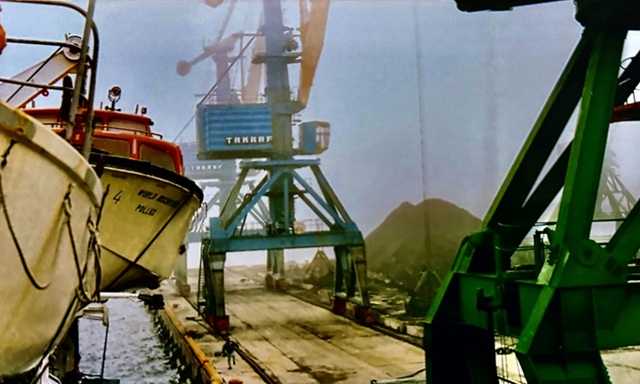
In the middle of the night, I was awakened. I opened my eyes in total darkness. I felt a gentle bang. I knew then that the ship was docking against the wharf in Providenya Harbor. I had finally made it to Russia. I hopped down, went into the washroom, and relieved myself. I went to climb back up into my bunk but stopped. Someone was in the bottom bunk. I bent over. There was very little light. It didn’t take much light to pick up Benito’s profile.
I sighed and then vaulted into my own upper berth. It was too late to lock the door, and I no longer had Marlys’ magical Santeria string.
“If only I had left the water under that bunk,” I muttered. It was also a mistake.
“Are you awake?” Benito called softly.
“No,’ I whispered back. There was a lengthy silence.
“Did Botany Bay tell you about Bergson?” she asked.
“Yes,” I answered, wearily.
“That life force Bergson was talking about? It applies to inanimate objects, as well.”
I didn’t know what to say. I should have said “Oh great, the ship itself is going to miss me when I’m gone,” but I thought that threatened to extend our conversation.
I said nothing instead. I was tempted to click on the CD player to see what the next song was. I smiled myself back into sleep, guessing that the song was probably “Tea for Two,” or maybe even “The Tennessee Waltz,” or something even more insane.
When I awakened in the morning, I leaned over the side of my bunk. Benito was gone. The bed was made. It was like she had never been there. Had I hallucinated? The ‘Lindy’ was not necessarily a place where Euclidean physics always worked correctly. My Breguet said it was seven. I shaved, showered and dressed, putting on my crew sweater. Boots, not Wellingtons. I remembered the radio, and my last thousand dollars. By the time I reached the Lido, most passengers were already congregating. Those on expedition ships arose early, and all consumed huge portions of breakfast, which I had discovered earlier in the cruise. Marlys was at the bar, dressed in a mini-dress and heels, as she had been ordered. My coffee bowl was ready and steaming.
“When do we get cleared?” I asked her, taking a small sip of the boiling hot java.
“They’re working down there on the dock now. Probably half an hour, or so. And thank you for introducing me to Günter,” she said, offhandedly, like she was giving a tourist directions. “He’s really quite sweet.”
I was about to say something sarcastic when a large man stepped up to the bar, then jostled against me. I looked up at him in stunned surprise.
“Shocked?” Borman said. I did a double take. “I’ve been feeling a little low since I accidentally bumped my head,” he said, acidly, in his extremely German accent, with an odor of alcohol so strong it wrinkled my nose.
“Captain Kessler says that you and I are brothers. The Russian Brothers Kasimaroff, I think it is. We are to stay with each other for all our time in Russia. The Captain says that you will keep me from being hurt again.”
I had no ready quip. In fact, I could not speak. The mission had just run into its first, and possibly its last, big obstacle.










Don't Miss any Updates or New Chapters
Join our mailing list to receive the latest news and updates from our team. You can easily Opt-Out anytime
You have Successfully Subscribed!