
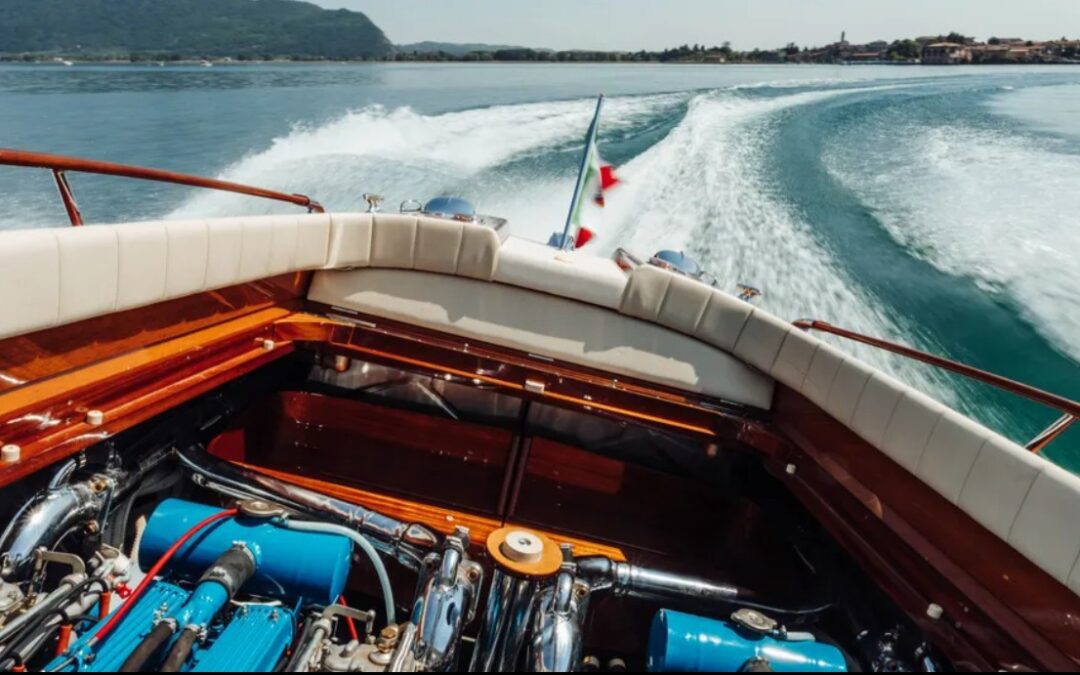
Fairey. The boat was built by a company called Fairey, and in spite of its origin, it looked perfect. It was forty feet long, twelve feet wide, and drew almost five feet when not on plane. I was curious about looking at the masterfully built hull, just how a boat so big and heavy could get up high enough atop the water to reach plane, until I walked to the stern and looked into the engine compartment. Two long doors and a raised transom took up almost the entire stern area of the boat. It was obvious that the thing hadn’t been built as a yacht, although in looks it was about as yachty as a boat could look. At a distance, it looked like a well-made Chris Craft or one of the other family weekend outing yacht builders across the whole world produced in numbers.
Open as the doors lay didn’t allow for more than a few feet of clearance between the deck railing chains and the edge of the pneumatically driven door edges. I finally stood at the center of one of the doors and marveled. I was staring down at two engines. Each had lettering in red that said Lamborghini. Each was fueled by twelve two-barrel Weber carburetor sets, which added up to twenty-four in total or 48 throats. That was impressive, but more impressive was the art of the work I was looking at. All of the twenty-four were operated by stainless steel bars, fittings, and levers to adjust the amount of fuel going into each carburetor throat. The engines were more of a work of art rather than just a set of two powerful boat engines. I understood immediately how the boat got up on plane.
The salesman climbed up the ladder leaning against the side of the craft, the boat not having been in the water for several years, ever since it had been shipped down from Michigan, where it was used to smuggle cigarettes from Canada to New York to avoid the high excise tax.
“They never caught her,” the salesman commented as I just stood and stared down.
The Coast Guard has some fast cutters, but not in the sixty-mile-an-hour range and certainly not when this thing would only go out on rough seas runs. Sixty miles an hour in a five-to-six-foot swell with white caps? No problem, but a regular cutter would be lucky to do eight to ten knots.”
“What kind of horsepower?” I asked.
“About eight for each engine,” the man replied.
“So, this thing weighs what, about six tons?” I said, musing to myself, checking the boat out from bow to stern.
“Maybe a shade less,” the man replied. “More like five, given the lightweight wood for the deck and heavy use of aluminum for the fittings.”
I calculated in my head. A ten-thousand-pound drive at maximum with those engines would give the boat a power-to-weight ratio of about seven pounds per horsepower generated. The latest Corvette engine, I knew, developed four hundred and five horsepower and weighed almost four thousand pounds. Only a ten-to-one ratio compared to the boat’s much greater punch.
“What about fuel economy?” I asked, dreading the answer.
“Carries eight hundred gallons,” the man replied, “therein lies the rub because it all depends on how fast you run it. Just burbling along on one engine, and you can go about three hundred miles, but at full ‘Katy bar the door,’ speed then forty miles tops.”
I thought quickly. Twenty gallons per minute, or a gallon every three seconds. The fuel consumption was astounding for a relatively medium-sized yacht, but of course, it wasn’t a yacht at all.
I needed Kingsley with a calculator and then to check the National Reconnaissance Organization for distances to the Hospital Island that had no hospital but certainly an airstrip and run down warehouse. Ingress would be easy, but coming out might be hard indeed, and the weather could be a factor if there might be pursuit. We might want the worst weather Florida could offer short of a full-blown hurricane.
“What are you asking?” I finally asked, knowing the man was there not so much as a salesman as an order taker.
“Eight-five and worth every penny of it,” the order taker said.
“Why’s that?” I wondered aloud, more to myself than the rangy, tall cowboy-like without the hat and boots.
“Those Lambos, a man came down here a couple of months ago and wanted to buy the engines alone for fifty. But my boss told him that we’d want twenty-five just to get them properly removed and shipped. That was the end of that sale.”
“Why was that, if he really wanted them?” I asked, truly curious.
“He was from Northern Alaska,” the order taker said, as if that explained anything.
I walked across the asphalt landing to where I’d left Nguyen and Kingsley.
“This has to be a cash deal,” I began, before Kingsley stopped me.
“This is a depot, not a boat harbor storage place,” he whispered to me, bending over slightly.
“Yes?” I asked, surprised.
“They’ll internalize the payment,” he went on.
“What are you saying?” I said, dumbfounded.
“This is a DEA warehouse of repossessed boats,” Kingsley said, looking me straight in the eyes….and then I got it.
We’d been directed to a DEA storage facility, a depot. The guy I’d talked to wasn’t an order taker or a salesman. He was a DEA agent.
“They’ve covered this place up nicely,” I answered, looking all around. “They confiscate these boats and then what? Store them? Sell them? Rent them out? Or what?” I asked, having no idea what Kingsley had learned from the workers while I was examining the boat.
“They can’t,” Kingsley replied, his rapid response taking me by surprise. “They can hold them for up to two years, awaiting court action,n but then must send them off to be destroyed. In the meantime, they loan a boat or two out to other agencies that might need one.” Kingsley smiled an Indian smile of guile and humor combined.
“So, we have a boat for free?” I asked, in amazement.
“Yes…well, not exactly…” Kingsley said, frowning. That boat doesn’t take regular gasoline, unless it burns it at a much lower power rate. Aviation gasoline, called Avgas, costs about four times more.”
“Eight hundred gallons of Avgas costs how much?” I asked, having no idea in the world.
“Gasoline comes in different refined states,” Kingsley said, sounding like he was talking to a class of college students. “Regular, Super, Ethyl, Premium, and Avgas, while jet fuel, or diesel, comes in Numbers one through four, with one being the purest and sweetest.”
I tried not to sigh as he finished, instead simply breathing in and out and waiting.
When Kingsley stopped talking, I asked my question differently.
“How much?” I said, staring into the little black pools of Ben’s eyes.
“Four thousand, they think,” Kingsley intoned.
“We need to take the boat down to Miami and dock it so we’ll have ingress and egress on the mission, but we don’t have a budget yet. Jesus H. Christ.”
I moved from Kingsley back toward the boat and the agent I’d left standing on the planking of its stern.
The cowboy who was not a cowboy climbed down the ladder to meet with me next to the port side of the hull.
“What’s your decision?” he asked with a big, broad smile.
“You’re DEA,” I replied, nodding my head and smiling back at the joke he’d been playing on me.
“We need to get this thing down to Miami to a dock there for some work, and we don’t have four thousand for the special fuel,” I said, telling him the exact truth.
“What’s the mission?” the man replied, the smile on his face fading.
I stared at him, trying to decide what to do. The DEA and the CIA were going head-to-head for domination of the world in a manner of speaking. The Agency was supposed to be about intelligence gathering and political running of interference, or more while the DEA was strictly limited to stopping drug shipments and enforcing drug-related laws. Knowing that brought me to the pinnacle of the problem. I had no idea why I’d been assigned to the mission since it was almost self-evident that the entire affair was well within the province of the DEA. I had to lie.
“There’s no competition here,” I lied. “This is all about national defense and politics.” I stopped. I didn’t know what else to say, and I knew that what I had said was way too weak to pass inspection. Tony would have to go up the chain to get the DEA’s cooperation, which would be unlikely, and then either scrub the mission or turn it over to the DEA itself. Either way, I didn’t see a future in any mission to Murder Island for myself or Kingsley and Nguyen. When the agent didn’t answer, I turned to rejoin my men.
“Take it,” he said.
I was floored to the point where I violated an old sales instruction, which is never to talk about the deal once the client agrees. Just do the paperwork.
“How can we do that, given the circumstances?” I stupidly asked.
The agent told me what had to be the truth about the boat.
“The C.O. of this operation down here wanted to part the engines out when it came in. The guy who wanted to pay a small fortune for them faded out, so the boat was never put into inventory. It basically doesn’t exist. The Michigan registration was terminated, but no other was submitted for authorization to go afloat.”
I looked over at the boat and then back at the agent. His expression was contrite. I got it. His boss wanted to take the cash. The boat had never gone into inventory, and if it was put in now, then the time differential might be questioned. The agent was covering for his boss.
I nodded and turned away.
“I’ll be right back,” I said.
Walking over to Nguyen and Kingsley was quick, as they’d never left their lookout position. I filled them in completely.
“What do you guys think?” I asked when I was done.
“Take the boat, use it and then sink it,” Nguyen stated with his usual brevity.
“What if we’re stopped somewhere along the way?” I asked, with concern in my voice. We were and would be operating on U.S. soil, which meant that the system of jurisprudence could rise and toss all three of us into a federal prison.
“We still must call the home office,” Kingsley said, his tone stern and formal. “We will need a letter of marque to proceed.”
“What the hell is that?” I asked, shaking my head and wondering where a man who had spent most of his life in a foreign country might learn of such detailed nautical details.
“The letters were first issued during the Revolutionary War when privateers were permitted to take unflagged or enemy ships on the high seas. They could use the letter to justify bringing the ships to American ports and selling everything in them, and then the ships themselves for a huge profit. A letter of marque would protect the boat from any inspection by any U.S. authority. They are issued by your Secretary of the Navy.”
“Why do I think there haven’t been any issued since that revolutionary war?” I asked, more to myself than Kingsley.
“Let’s get the thing in the water,” I finally said, hoping that what Kingsley said was not only true but possible. Presenting this mission to Mary would get an instant no if my being abandoned by the Agency for committing a crime on home soil was at all a possibility.
I walked over to the cowboy and asked him if he could see to launching the boat.
“Nguyen drives the car back down to Miami, and we take the inland waterway in gentle protected water to get there without wasting too much expensive gas and not getting ourselves killed on the high seas either.” My plan had only two holes, and those were that we didn’t have a place to dock the boat in Miami or to tell Nguyen where to drive to.
The boat was quickly prepared to be put in the water, which was an amazing feat as it was all done by giant forklifts with extended and padded arms in front of them. There was no need for a trailer, and any trailer would have had to carry the wide yacht tipped up on one side anyway. While the boat was launched, I got an idea. The name of the hotel Mary was going to stay in was the Fontainebleau Marina Hotel. Expensive, but it had its own marina near the end of the Intracoastal Waterway. I went into the office to use the desk phone there.
The Fontainebleau answered, although I had to go through three operators to reach the marina. The freight for the 40-footer would be four hundred a night, which was a fortune since the rooms were only three-fifty. Maybe people slept on the boats, which was possible with the Fairey, but would not be once the fifty was installed. The fifty would be in a pod that would turn and swivel up to the deck, plant itself, and then be ready to open up. Nine seconds from hitting either the deck button or the one below. That mechanism would not be installed until early in the following week, which meant the boat would have to be moved at some point and then taken up out of the water on dry land in a secluded setting to have the work completed. The ammunition would be an uncharacteristic triplet load. One round of tracer, one round of anti-personnel, and one round of armor piercing. Five belts of one hundred rounds apiece would have to do. I didn’t have any idea of what the weight of the weapon would be, pod and ammo, and all, and if that weight would affect the performance of the boat in high seas.
I called home to ask Mary if she wanted to stay on a luxury yacht we’d have in the hotel marine but that got shelved immediately. She wanted room service, the beach at her doorstep, and the many shops that she’d found lined the halls of the first floor of the place. There was no way I could stay at the hotel with her and not violate the rigid rule about no family or friends along on the mission. I would have to stay nearby with Kingsley and Nguyen, which was also suspicious-looking, as there was no way a trained operative from anywhere was going to think the three of us were tourists. I’d already endangered the mission when getting the rental car, so my next call was to the insurance office in Albuquerque.
Pat answered the phone.
“Banker’s Life of Iowa, it’s your nickel, so your turn to talk.”
“Very funny,” I said, my tone one of criticism. “Who taught you that?”
“John Nash, the babysitter, make-believe insurance agent, and even more make-believe spy.” Her tone was so ebullient it was like she was on some drug, not the Pat I knew at all.
“It’s the Principal Financial Group now, and drop that nickel crap,” I said forcefully.
“I knew it was you,” she replied, “and I’ll get all over it.”
“How in hell would you know it was me?” I inquired.
“Nobody calls during the day,” she replied, “unless it’s the home office or you, and the home office doesn’t like you enough to call, or maybe they’re afraid of you like me.”
I was taken aback. I pulled the receiver from my ear and stared at it like it was the head of pit viper.
“I would never hurt you,” I said, as quiet and gentle as I could.
“See, you do that and don’t even know it,” Pats replied.
“Do what?” I replied, mystifyingly upset.
“Say things like that,” she whispered more than spoke out loud.
“I don’t get it,” I finally said, “put Rosley Ryan on the line.”
“Normal people, normal humans don’t go around telling other humans that they won’t hurt them. It’s extremely threatening because it means that you hurt other people, but you won’t hurt them…maybe.”
`Rosley Ryan came on the line.
“How’s tricks, oh great leader, bwana of the forlorn tribe here.”
“Have all of you gone nuts?” I asked, trying to calm myself and get back to being mission-oriented.
“Yes, boss,” she said, making her voice low and serious and giving me a hint that it wasn’t John Nash that was screwing up Pat Boman’s mind, it was her.
“Get on a plane, have Pat book it using petty cash, and get to Miami. When on land, call the Fontainebleau Hotel and find a message for yourself. If you lose contact, then come ot the Fontainebleau Marina and hunt down a forty-foot Fairey boat, “The Princess.” I realized when I said it that the name printed in gold across the back of the boat made the whole thing sound really strange, but it was too late.
“Of all the things I might have guessed, I would not have guessed that about you,” she said, and hung up.
I knew I should have immediately gone to a paint store and purchased something to cover up that name, but there was just too much to do. Joan might even make it to the marina before we did if we didn’t get moving. We needed Rosley Ryan for cover. Vivacious, pretty, and expressive as all get out. Miami was her playground, and that would help insulate us even if some people might feel sorry for me being with her.
I called Tony and brought him up to speed.
“How can you get us some cash here?” I asked right after briefing him.
“You have a car, a boat, a hotel, a marina, and then some,” he said. “Nice work. “I’ll get hold of the paymaster at the United States Coast Guard Base, Miami, which is only a mile or so away from that hotel. A Jeep will deliver twenty-five thousand in twenties later today, or at least so I hope. Meet anyone of note? Kill anyone? Hurt anyone?”
I said nothing back, almost shocked by the questions, sort of how I’d felt about Pat’s comments. I was not a killer. People just seemed to die more than they ought to around me.
I went out of the office and down to the dock where the Fairey Princess was bobbing up and down very gently. The cowboy was there. I thought of him that way, I knew, from the A Shau. My Sky Raider pilot, my Clarence, like in the movie It’s a Wonderful Life. Like King and Homan, the other ‘angels’ of the air who saved so many of us, living like mud men below, as if from the planet Mongo of Flash Gordon fiction,’
“Fire it up,” I said, handing a piece of paper with the Fontainebleau address on it to Nguyen before motioning Kingsley to take my place at the helm with the cowboy.
The cowboy hovered over the control panel before stepping slightly back.
“Two buttons here. Press and hold,” which he did. Both engines instantly began to turn over, and both caught as one to rise a little in sound and then fall back into a burble all on their own. “One lever in the center for forward, idle, and reverse,” he said, but didn’t move the lever from its center position. “Finally, two levers for throttle, left port engine, and starboard.” The shift is automatic, but don’t go from forward to reverse above two thousand RPM. The tachometers read to ten thousand, and there are no revolutions limiters on these engines, so be careful. The red line is 7000, which should be about sixty miles per hour. Black line is eight thousand, which will double the fuel consumption and begin to wear out the engines like you might not believe.”
The cowboy stepped back.
“Thar she blows!” he said, with a big laugh and his arms held out wide.
“How fast would eight thousand propel this thing?” I asked.
“Maybe just at seventy, I don’t know the man said. We only took it out once, and it was a kick.”
“What about the ten thousand?” Kingsley asked, pointing at the last number on the dials.
“Anybody’s guess, I guess,” the Cowboy replied.
“Red bag,” I whispered to myself, although Nguyen caught the words and nodded, almost imperceptively.










What a wonderful chapter, Jim. Plenty of non-injury action, a job for Rosley, extremely fast yacht. Living high is fun. I am always surprised how quickly The Agency can move when it wants to do so.
Can hardly wait to see The Fairy idling down the ICW. And yeah, that name does connote a bad impression.
Also going to be fascinating to have a Ma Deuce on a flip-over pedestal! Lots of recoil on that pedestal!
Honestly hope it doesn’t need to be used, but know, with your luck, will probably run through all s belts.
Howdy to Mary.
The 50 is a ferocious interpersonnel weapon as you know, and it’s 87.5 pounds of recoil per round are nothing to
toy with either but the pod designed was made with all that in mind, plus disguising it before it’s to be brought into play,
if it has to be, of course. Thanks for the expectation of more and better as this mission was ‘one for the books’ and then some.
Semper fi,
My great friend,
Jim
I have been worrying about that “red bag” comment all week. I check daily to see if there has been any comment about that. I wish that I remembered the news of that time. There must have been a lot of bod players afloat in the area. The only thing I remember is the nervousness over the Cuban missile crisis.
Red bag. In artillery, there are generally six bags of powder added to the chamber of the howitzer or gun to drive the projectile to a specific distance. Six bags is the maximum effective range of those guns or howitzers. Beyond that is an area where the projectiles can reach but it is unknown territory where those rounds will land. Many batteries will not fire a round that has a seventh bag added to the six maximum. That seventh bag is called a ‘red bag,’ and I refer to its usage for other things as well
Thanks for the great comment,
Semper fi,
Jim