
The Cessna was having to turn slowly and very sharply to be able to come back around and still have another decent run at us, made all the harder by Kingsley turning the boat to port to lessen the timing and effect of the Cessna’s turn.
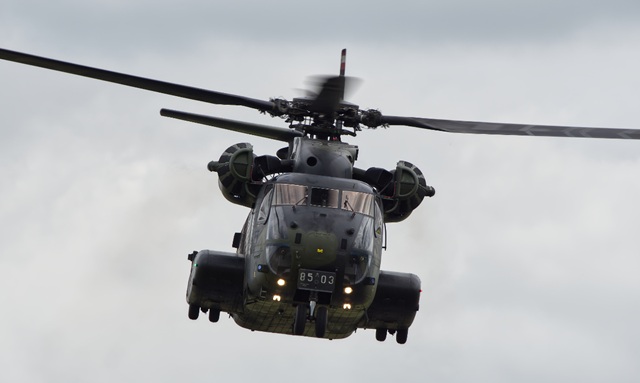
The sound of the high blades of the CH-53 rotors preceded their appearance as all of my and Kingsley’s attention was directed up toward the Cessna. I wondered about what else the plane’s pilot might have in store for us and then heard the turbine whine of the helicopter’s engine at maximum speed.
I reached for the radio handset, but Kingsley shook his head, backing down on both throttles as he did so. The result of our encounter with the Cessna was no longer in our hands, and the radio was useless as it was a commercial single-sideband rig that was meant for short-range use on only a few bands. It was unlikely that the combat ready CH-53’s would be using any commercial frequency or even capable of listening to any civilian signals sent.
The 53’s came in low to our stern, dropping to just above the now more gentle wake as the Lambo engines throttled down. I twisted back toward the bow as the Cessna had a clear opportunity to perform its banking turn and come in for another run. At first, it didn’t seem that the pilot saw the huge helicopters lurking just to our stern and no more than fifty feet above the ocean’s surface.
“They’re giving him a chance,” Kingsley said, as Nguyen came out of the cabin door, up a few steps, and stood with us, his .45 Colt hanging from one hand at his right side.
The Cessna suddenly dived toward the water, going so low it seemed like it wouldn’t be able to recover in time. The 53s, like ice skating pairs spilt and move past on both sides of our boat, the gun crews behind the deadly fifty caliber’s not waving or seeming to notice us at all. They moved in tandem toward the Cessna, now turning violently to go back the way it’d come.
Suddenly, Kingsley pushed the radio handset back into my hand, grabbing it from the control panel when I realized the uselessness of trying to communicate with the big chopper. I held the handset speaker close to my ear, my attention still glued to the strange dance of aircraft performing right in front of us all. I noted that the Choppers were Marine-marked and was surprised. Ticonderoga class cruisers, like the one they had no doubt come from, usually only carried specially prepared and much smaller M-60 Navy helicopters, which would fit into a large hangar jutting up from the deck near the stern of the big cruisers. Why were Marines involved in a Naval operation?
“We have the target in sight and weapons are nominal,” the voice in the handset said. It was a deep and commanding voice, much more capable of giving off malice and then totally acting upon it.
“It’s just a Cessna,” I replied, using the ‘over’ statement, although the newer radios, even civilian were dual band, which meant one could talk and hear at the same time, just like with a telephone.
“From our information, this same aircraft has made two attempts on your life,” the voice said, as if to encourage me to give the order to fire.
“That’s true, but…” I tried to say, but the gruff, hard voice interrupted before I could finish some sort of weak defense for whoever was in the Cessna , which could include others more or less involved.
“What is it, sir? It takes three chances before we get serious with this?
I smiled. The hard-nosed chief or lower officer had a twisted sense of humor as well as a vague ability to make me feel like I was possibly a weaker creature than the members of the Naval force, obviously on an operation to keep me and my equipment safe. My smile wasn’t genuine, and I was glad that I was not in the man’s presence. My PTSD did not take such insults easily, and “Junior,” buried way down at my core, wanted to set loose once more. That could never happen.
I’d learned hot and hard to coldly respond. If action was presented, then run; if running was not available, then hide; if no hiding place could be found, then apologize; and if no apology was accepted, then beg. In place of all that might come, the worst solution to the problem of all. Fight with a surprise and deadly ferocity that overwhelmed whatever the threatening force might be. There was no way for the other person representing the naval cruiser’s authority could know what was running through the head of such a predator as I knew myself to be. Knew but did not want to be at all.
“My mistake,” I said, breathing in and out deeply, before continuing. “What are your orders regarding this mission?” I asked, changing the subject, not one of the survival rules of Sun Tzu, but still could be effective.
“What are your orders, sir?” the voice squeezed out after a few seconds, in a tone I knew the man saying the words was uncomfortable with.
“Escort the Cessna back as far as Key West, if the pilot of the aircraft is willing to cooperate and stay peaceful.” I gave what the man considered an order, which had surprised me.
“What about the pilot and anybody else aboard that plane being a witness?” the voice asked, not quite done with me.
I so wanted to ask the officer or other crew ranking person, just what it was that the plane’s occupants might be expected to witness, but stopped short of that, again changing the subject. It’d worked the first time, and it worked again.
“We need fuel, specifically Avgas, as we’ve had to push the engines farther into the red line than we expected. Do you have any?”
I knew full well that the Ticonderoga class cruisers were gas turbine powered, and gas turbine fuel would not work in the engines we had in our boat, although Avgas could power the turbines if necessary. We might make the distance back to Key West running on one engine at low Rpm but it would take hours, and even then, we’d be near empty when we got there if we made it at all.
Gas turbines also powered the CH-53s, so it was unlikely there would be any available anywhere near us. I wanted no further dealings with the Navy until such time as I knew more, and, in particular, I was very uncomfortable not only giving a Navy cruiser orders but having those orders immediately acceded to. The Navy was acting just like Tony and the CIA, and that was not a good sign, not to mention that the DEA had simply conceded a supposed major drug operation to a competing agency.
“We will be departing the scene momentarily and recovering the helicopters as they return. Your fuel needs will be resupplied, at least to cover the distance back to Key West, in less than thirty minutes. You need to remain on station until that time, although slight variations in distance will be available to the resupply force. We have the original draft design of your boat and also the modifications made to it, so your needs are known to us, in case you are wondering about the proper fuel or other stuff you need. Do you copy?”
The voice was more pleasing when it was doing an impersonation of Sergeant Friday from that old television show called Dragnet than when it was attempting to influence the mission situation, or even give what I was sure the speaker thought was sound advice.
I looked at the handset and tried not to laugh. Did I copy? A terse form of a Naval goodbye, I understood. No answer was expected nor given.
What ‘force’ was coming to resupply us was anybody’s guess.
“How in hell can they know what we need if we, aside from the Avgas, don’t know ourselves?” I asked Kingsley before placing the handset back into its holder.
“Well, maybe they know that I could sure use a bottle of Bacardi 151 rum and a six pack of Coke,” Kingsley replied, laughing.
“Aren’t there religious laws in India against drinking alcoholic beverages?
I asked, looking at my watch to see when the supposed resupply would take place, no doubt by some Naval magic we were unaware of. I checked the sky out all over the place but ruled out an airdrop since the Avgas might be a bit too volatile for such dramatic resupplying.
“We are not in India, number one,” Kingsley replied with a laugh. “And I do not belong to any of those tiny religious sects, number two. Finally, I am Gurkha, and we warriors all drink to the extinction of our enemies.”
“Figures,” I said, almost to myself.
Suddenly, the sea around us began to bubble and then to shake, as the small swells and waves around the boat began to smooth out, as we’d entered onto the surface of a giant pond. I grabbed the control panel with Kingsley.
“What the hell,” I exclaimed as movement on our port caught my attention.
Out of the water, a gargantuan whale surfaced, a whale with a conning tower sticking out of it, the whole unreal monstrous event pouring cascades of water back into the sea.
It sat unmoving as the ocean settled around it, and our own boat.
A super-thick hatch slowly opened and unfolded itself to pull back from a sizeable hole in the top deck. Hatch was too small a word to fully describe the ornate operation of the deck’s opening to allow crewmen to start swarming out of the hole. Four sailors formed a cluster around the hole or hatch as barrels were lifted to them, which they promptly stacked on the deck. The barrels were not the customary fifty-gallon things normally seen at refineries or in seaports. They were much less than half that size, which made the sailors’ work fast and efficient.
Another hatch cover opened further astern of the first one. It was much larger and not circular, instead shaped like a thick rectangle. A Zodiac was raised somehow to a position where two sailors, also rising from the hatch, waited. A winch like assemble quickly rose automatically, engaged, and then hoisted the Zodiac out, extended its boom, and set the craft down next to the curved slope of the subs’ strangely plated hull. Once the zodiac was afloat, the two sailors slid down and across the rubberized air-filled hull of the small boat. The sailors with the mini-drums on deck began rolling them off the deck into the ocean next to where the Zodiac bobbed nearby. The two sailors on that boat are pulling the smaller drums over the side of the inflated hull quite easily.
I wondered silently about how hard it would be to decant all the barrels into the rather small opening of the fuel tank on the boat, but then, as the Zodiac pulled up to the stern of the boat, the sailors tied it off and, jumping aboard, took care of that problem. I’d already forgotten what the mean-spirited Naval officer had said in our short conversation. The Navy had the boat’s schematics and the improvements made. The sailors combined their personnel, brought forth a funnel, found the tank opening, and went to work refilling the Afgas supply.
One sailor, whom I thought to be a chief because of the many chevrons up and down his arms, commented.
“Watch your temperature at high rpms as this is 110 octane stuff, not the 104 found at boat launches and docks.”
“The difference being,” Kingsley replied.
The chief ignored him and spoke directly to me.
“The difference in the higher octane is the lowering of the flashpoint of the fuel, making it burn hotter to the point of melting the valves and piston tops if not monitored and controlled.”
“Where did this stuff come from?” I asked, truly mystified.
“NASCAR,” he said, before they finished and pulled out so fast it was astounding. In only a few minutes, the empty barrels were returned with the bit funnel to the Zodiac, the crew and boat lifted aboard by the sub’s robotic boom, and the submarine buttoned up. Nobody had ever appeared atop the center command turret or conning tower. The sub began to move forward, gaining speed at an amazing rate until it dived. It was totally gone in less than a minute, I would later calculate. I realized that there was a lot about Naval equipment I knew too little about, although I doubted that any of that would be taught at the charm school I was yet to attend.
“What might you think that Avgas would go for a gallon if delivered by a nuclear submarine, and how did they get the gas aboard the sub from NASCAR anyway?” Kingsley asked.
There was no rational answer to the question, of course, but one could spend hours trying to put together the work of forces as significant and well-funded as the United States Navy and come to no satisfactory conclusion. In a way, it was like dealing with the field results of agents of the CIA. One could imagine so many things, but the truth of real operations was seldom even reported, except for conclusions, to the Agency itself in any other detail. Spending time considering the process meant taking time from thinking about the mission ahead, and about that, I had to get my head even farther into the game.
“What now, boss?” Kingsley asked, addressing me with a more familiar leadership title than he usually did.
“We have some time,” I said, watching Nguyen expertly tie up the boat to its mooring lugs along the dock. The trip in had been relatively quick, running at about sixty knots while not worrying about running short of fuel…and even if we did, there was a nuclear submarine not far off to resupply us once more, as long as we remained as seemingly impossibly important as we evidently were.
“Let’s ease on over to the airstrip to see if the pilot managed to survive his ordeal, as I don’t really want his death on my mind, not that he didn’t deserve to get himself killed.”
“Unless he missed us on purpose,” Kingsley threw in as we gathered to leave the boat. Rosley Ryan and John Nash came up from the cabin and joined us.
“Was that really a submarine docked next to us?” Nash asked. “All we could see from the inside was a black hull of those sound-absorbing tiles.”
I understood then why the sub’s exterior had looked so strange. The entire hull and even the conning tower had been completely covered.
“What’s the plan?” Rosley asked?
“Our second reconnaissance mission was as much a failure as our first,’ I replied to the group, not that I had to admit that to any of them. Rosley had been under fire for the first time in her life, while the rest of us had taken fire and given it many times in the past. No combat veteran, however, takes such action lightly, and no combat vet ever fails to understand that a FNG conversion to combat status and surviving is no small deal.
“We’re going to venture over to the air strip while you get some rest,” I said to her, the tone of my voice deadly serious.
For once, Rosley agreed, the price of combat contact is physically shattering, and any recovery period is actively sought. The question of whether she would still be part of the operation, or even the CIA, following her first combat was also something that would have to hang in the air, waiting to see what she did while we were gone, not what might be said. The CIA was not the military in combat. One could quit, resign, or even fail to show up or run away without negative effects unless someone else was hurt or killed because of such evasive conduct.
The four of us packed ourselves into the rental and headed for the airstrip, where I, at least, hoped to be able to see the cowardly yellow Cessna sitting near its hangar like when we’d first rented it.
It was there, unmarked, just like before, and I breathed a sigh of relief. The Navy had been as good as its word, and I liked being able to trust that organization, as it was the only one we truly had for backup.
Kingsley drove the car across the small tarmac right up to the side of the plane, which I was sure was some kind of violation, even though none of us were in any mood to take what had happened at sea lightly.
There seemed to be nobody around, so we walked as a unit into the hanger, Nguyen unlimbering his .45 Colt he’d brought along. I admired his thoughtfulness and realized that I was still not fully into the mission, as it hadn’t really occurred to me to go to the air strip armed.
The small office off to one side, once we got inside the big door, was lit, and there were people there, although we couldn’t make them out.
A big, corpulent man stood up and stepped through the door.
“We’re closed,” he said, aggressively but with an aggrieved tone in his voice.
The pilot followed him out and stopped dead in his tracks once he recognized us.
“I had no idea,” he said, holding out both hands. “I don’t know who you are, but I apologize and didn’t mean any of it. The grenades were concussion only to scare you off, but I now understand that you’re not going to be scared off.
“What’s your involvement?” I asked him, directly.
“I’m going to be completely truthful with you here if you promise not to hurt us in any way,” the pilot said.
“Like the Johnny Carson show?” I replied. “The ‘now this is not a lie,’ routine?
The fat man who appeared to be the manager or owner of the business said nothing, but his face was covered in perspiration.
“Did you look way down on the runway to the north?” the pilot asked, needlessly pointing in that direction with his right index finger, which shook just a little as he held it out.
“No,” I answered, truthfully.
“Take a look,” the pilot replied. “You won’t believe it any more than we do.”
I walked the few feet back to the big door opening while Kingsley and Nash stayed put, watching the two men with Nguyen way off to one side, his Cold no longer visible.
I looked down the runway and was a bit shocked at seeing what I’d completely missed. The two CH-53s sat at the end of the runway; both of their fuselages pointed straight at the hangar. The bulbous nose of each machine sent a message of threat that could not be overlooked or ignored. No wonder the men were terrified, not of our visit but of what the choppers might be ordered to do to them. Opening fire on a U.S. boat in U.S. waters called for immediate armed response of the most fatal kind, and it didn’t have to be administered immediately on the scene.
I realized that the Navy was thinking the mission a whole lot deeper and more complexly than I was, most probably because they knew what the mission was. They hadn’t killed the pilot because I’d ordered them not to. I was now certain that they would have otherwise. I also was coming to realize, in analyzing the conversation we’d had in the heat of the moment, that the Navy wasn’t necessarily too upset with the plane’s dive bombing our boat, but had terminal intentions for what the pilot, and anyone aboard, had seen. What could the people on the plane possibly have seen that might lead to their being executed, legally or otherwise?
I walked back to the office.
‘You’re not going to be killed or harmed in any way,” I said. “You’re obviously tied up with the drug cartel running stuff in and out from Murder Island, and that’s got to stop. The dealers are not your problem right now; they are the problem of the U.S. Navy. Go home, wait a few days, and then come back and try to convert your operation into one that serves the tourists and not the drug trade. Accommodate that change, or you will meet us again, and that meeting will not go very well at all when it comes to your continuance.”
The manager or owner spoke for the first time.
“Continuance in business?” he asked, hope finally coming onto his facial features.
“Continuance in life,” I responded, not lying at all.
‘What about the helicopters?” the pilot asked.
“They do what I order them to do, and for the time being, they stay right where they are. They don’t have to kill you. One run with all four of their rotary fifties firing will reduce your planes, hangars, and office here to less than scrap. Don’t make me issue that order.”
“You have any objection to me going down there to see them?” the pilot asked. “I mean, before we go home. I’ve always wanted to go through one of those big babies.”
I stared at the man, trying to take him in. I’d written him off as a buff or a phony macho man, but there was more there. He might even be a bit stupid, but he didn’t lack courage, so I answered more gently than I might otherwise have.
“A Latin saying from the days of the gladiator fights in the Roman Colosseum: ‘Et morituri te salutamus.’ It translates into: ‘we who are about to die salute thee.’ It was said to the emperor of Rome before the death and mayhem began in the arena. If you want to go visit those men manning those combat ships, then think about using that expression as you approach.”







Jim,
I KNOW you HAD to work in a pretzel factory.
LOTS of twists and turns. And you go to the airport to confront the pilot and rub (pretzel) SALT in his wounds…
Always a highlight of my week when I get to reads another episode.
Thanks for the excitement. Stay well.
THE WALTER DUKE. You have a corrected chapter about to come to come toward you after last weeks SNAFU. That acronym, by the way,
was first used in front of me by Sister Michael Marie when I was in the 5th grade…a Maryknoll nun. In later life I ran
into her and laghingly reminded her that I’d found out what the letters meant. She said: “Jimmy, the funny thing about human
memories is that they are so very flawed, like the rest of us.” And so there it was. She never said it and I certainly did
not push the subject further.
Semper fi, my great friend,
Jim
Your cruise got real! Well done.
Thanks Michael, an apt description. Better than I got writing a vignette of it on LinkedIn, but then
my veteran readers are about ten times more accurate and more caring than the business community.
Semper fi,
Jim
Did he go? How does the navy know more than you? Very interesting chapter.
Kemp
The intertwining, competitive and lack of coordination among all the agencies, including the different millitary branches
was astounding. Is there any queston at all why the Carter rescure attempt of the embassy hostages failed so badly?
Semper fi,
Jim
Very interesting as usual James
Thanks a lot Ron, and laconic as the ccomment was, meaningful to me.
Semper fi,
Jim