

The distance from the bar to the wharf was not that far, although the rough surface of the port area was difficult to negotiate, as the habit patterns of the Inuits, who were the dominant Eskimo tribe endemic to the area, cast aside anything used or unusable without regard for aesthetics or beauty, much less comfort in walking across. The town had no taxi cabs, so one either walked or waved down a small, powered tricycle when one passed by or caged a ride from a driver who was inside somewhere, while leaving the small ATC outside, parked anywhere, and always with a key in the ignition. There were no roads out of the town, which could only be reached by sea or air service, so there was no place to take and hide anything as large as one of the vehicles.
The town did have occasional regular vehicles, almost all late model pickup trucks, but there were no roads out of town except a three-mile run to the dump. The trucks spent most of their time parked with nobody inside them. There were also no phone booths as I spotted the only ship tied up to the wharf, or rather cabled up, as the Bering Sea beyond could rise at any time to be one of the most difficult to negotiate on the planet when the weather was bad, which was frequent.
As I approached the port side of the great ship’s hull, I realized that it was designed not as a cruise ship but what I’d come to understand was an expedition ship, which meant it had winches and plenty of black zodiac boats with outboards to move from the ship to shores all up and down the entire range of coastal areas bordering the sea beyond.
At the bottom of a long gangplank, a heavy-duty industrial loading and unloading ramp, a red phone booth stood alone. I was astounded, not by its presence but by the fact that it was a classic, obviously original British red one in perfect condition, with all the small square panes of glass on every surface except the top. My fears about trying to reach Tony or my wife using the ship-to-shore radio were allayed. The new portable telephone technology was only available in parts of the lower forty-eight states, and radio traffic this far north was very likely spotty at best and monitored at all times by anyone who wanted to listen in.
I entered the phone booth, leaving my single Hartmann leather back outside, the one the Agency had purchased for me without my knowledge until it was delivered. Delivered with the leather stamped with my name for the voyage and with the title ‘Doctor of Anthropology’ burned into the leather on each side of the center-mounted handle.
My fears were assuaged when I picked up the receiver, and there was a dial tone, which was uncommon as I had put in no change to bring the phone alive. I pulled out my AT&T card and dialed the initial connection number and then CIA central in Washington. The time was off, but I knew Tony would be standing by. The importance of the mission wasn’t what the importance of the last one had been, but that was a relief, and hopefully, it would have better results to allow me to get back into developing everything I’d worked so hard to build for the Agency and myself back in Albuquerque and a few other places.
I dialed my home, and Mary picked up right away. I indicated where I was and what I expected timewise, although I was only guessing. The ship had other stops to make along the way, as the Russian town was merely a stop for refueling and visiting the rather famous small museum located there. There was likely to be no comments made at all about the gulag located about ten miles outside Providenya itself.
Mary’s concern was about my continuing the iodine tablets, so any residual radioactive residue I might have ingested didn’t kill me before I could find quality medical help, which neither northern Russia nor the small coastal communities dotting Alaska along the American side shores would be able to provide. Other than that, Mary was as cold as the driven snow, unable to accept the fact that I’d had to keep her from knowing most of everything about the last mission, even after it was over. My expressive personality, she’d learned to read like a book, mostly a comic book.
“Why did they pick you and not leave you home to do some real work?’ she inquired, before hanging up. I never got a chance to answer as I was staring at the receiver, putting out only a dial tone again.
Tony picked up on the transfer after only a few seconds.
“Why me?” I asked, without preamble.
“You were available,” he said, although his tone was way off
“I wasn’t responsible for what happened, and you damn well know it,” I followed up, knowing why I was sent on what had to be a hopeless mission to retrieve a kid sent to a gulag in Russia without any support or assistance.
“The explosives were placed improperly, although you and I both know that the intelligence for that was completely lacking, and the physical ability of placing the stuff down that hole was an impossible task, given the lack of equipment and technology to see what the hell you were doing.”
“Thanks,” I replied, after a few seconds.
“What am I really supposed to do here, other than act as a professor of anthropology, assistant to the ship’s doctor, like he needs one, and whatever else I can manage or be required to do without one shred of real credentials?”
“Your credentials are all real and will hold up,” Tony replied. “Analysis is good at what they do, just as you are good at what you do.”
“What about the kid?” I asked, “Is he simply to be written off with the CIA saying it’s sending its best man while I’m in the unlucky and unhappy position of being possibly its worst field agent right now?”
Tony didn’t reply.
“I get it,” I said, after a few seconds. “The Department of State could or would do nothing. Legal can’t touch international drug cases, and that leaves me, not to accomplish the mission, but to be blamed when I fail to accomplish it? They can say they gave it their best shot?”
“I told you that you were good at this,” Tony finally said.
“Money,” I replied, changing the subject and becoming serious. “I want twenty in cash straight to Mary, and I don’t want Marcinko delivering it, and then ten for the rest, except Kingsley and Nguyen, and they get twenty like her.”
“That’s it?” Tony replied.
“No, you go to the office and hold things together until this is over. I know you’re not a field agent, but your presence will calm things and act like some short-term epoxy glue. The kid will need a passport when I get him out of there.”
“That can work, although you think there’s any chance in hell?’
“Somebody, somewhere at some time thought I was good at this and some of the other patently ridiculous stuff I’ve had to do, so who knows. I’m not going to play host to a bunch of rich would-be adventurers who have no clue what real adventure might be, not without doing it for a damn good reason. I want some settlement time and work when this is over to recover my family, the office, the air evacuation company, as well as whatever we are doing with UFO work, and I want to be home again in ten days or less.”
“No problem,” Tony said way too quickly. There was a silence, and then we both laughed before he hung up.
I stepped out of the phone booth and carried my bag to the bottom of the gangplank. There was nobody, no crewman, no deckhands, or anybody in sight on the dock or up along what looked to be a ship of about three hundred feet in length. Across the stern was printed “MS World Discoverer.” The plank was steep but had handrails, so I made it up with ease.
I stepped aboard the expedition ship, leaving the city well behind me and wondering whether I had made a good decision. I looked back at the town once, not in any kind of wistful way — as the place, for all its Alice in Wonderland charm, was really little more than a cold, rain-swept portion of the Seward Peninsula.
A beautiful young woman, wearing a distinctive necklace, encountered me at the end of the gangplank. The necklace caught my immediate attention. I counted seven blue and seven white marble-like stones, set in a long single strand hanging just below her throat. My eyes caught a small reflection from near the deck. I glanced down at her exposed ankle. A silver string of dolphins, set nose to nose, was encircled there. The hair on the back of my neck went up as I stopped in front of her, like I’d been ordered to by some unseen and unheard drill instructor.
“Welcome aboard,” the stunning woman said. I noted that she was Dutch from her accent. Even though I had never met a Dutchman I hadn’t liked, I took her hand gingerly, then released it as quickly as I could, without making her aware that I wanted as little physical contact with her as possible.
“Thanks,” I replied, stepping back and thinking furiously.
Three months earlier, I had met a strange man at a coffee shop in Wisconsin. He’d taken a seat, uninvited, at my small table. He had been an intelligent man of Paraguayan heritage. ‘Juan Trigo — Priest of Santería,’ he’d termed himself. After discoursing lightly on some subjects, Juan Trigo had suddenly changed. His voice lowered, and his words came out dark and mysterious.
“Yemaya,” he said. “You are going to meet Yemaya.”
I looked at him across the table.
“Yemaya?” I inquired. He laughed.
“I know certain things,” he went on, “and I know this. You will meet Yemaya soon, the Goddess of the Sea, and you will know her by a necklace of seven blue and seven white stones. Upon her ankle will rest a silver ring.” Then the man had risen and walked out of the coffee shop. Once outside, he turned, before walking back and re-opening the front door a crack. I had barely heard him say, “She’s an impish one, that Yemaya, be very, very wary.” The strange hypnotic way he had spoken those words affected me deeply. They had burned their way deep into my memory.
“The cruise director wants to see you in her cabin,” Yemaya stated (her name tag said Marlys), then turned and headed through a doorway behind her. I followed, shaken to the core. I did not believe in such things. I was not religious, despite my Catholic upbringing. But if there was a religion, I might follow it; certainly would not be the Santería Voodoo cult of animal sacrifice and mumbo-jumbo that Juan Trigo represented. But here I was, I reflected, following Yemaya, as pre-ordained by Priest Trigo, down the long internal corridor on a ship as foreign and bizarre as the Gold Dust Saloon I had just left behind in Nome. Marlys and I reached the end of the corridor. We stood together at a wooden door. She knocked twice, turned to smile at me, then departed. I watched her shapely body disappear, with some relief. I sighed deeply.
I stood outside the door until a loud voice from within shouted, “You going to stand out there all day?”
I shook myself, squared my shoulders, and opened the door. I stepped in, closing the cabin door behind me. Once inside, I set my duffel down. I looked directly across the cabin to the far bulkhead. I had noted the rather substantial woman, standing with her back turned, when I had entered.
“Hello,” I offered, tentatively. Her large head turned. I almost did a double-take. She was the spitting image of a female version of Benito Mussolini. I smiled crookedly at her visage, trying to take it all in but not react.
“You’re Martin, the anthro guy,” she stated flatly.
I nodded, “Yes, I’m doctor Martin…,” but I got no farther.
“Not here,” she interrupted.
“Not here?” I replied, caught at a loss.
“We don’t use titles aboard the ship,” she said, “Not among crew staff, anyway.”
I thought for a moment before responding.
“Ah, then what’s the captain’s first name?” The question had come out of me without thought, but she did not laugh.
“Don’t be a smart ass, or you won’t last the day aboard this vessel. The captain is the captain, of course, or at least he’s the captain for now. Our normal captain is on leave, so this one is really our first mate. But I’m not talking about the crew. I mean the rest of us who work with the passengers.”
“Oh,” I said back, wondering just what hard-earned title she herself had given up in this odd bargain.
“And another thing,” she went on, “We all have a variety of tasks, based on our backgrounds, which we have to perform while aboard, other than that which we signed up for.”
My eyebrows went up, but I said nothing. I just stood, with my eyes wide and round.
“You’re also to be the Physician’s Assistant and Deep Sea Diver, if we need that.”
Again, I said nothing. In two minutes, I lost my pseudo-academic title and was assigned to tasks which I had played at but never in my life had considered doing for a living. I thought dizzily to myself about what had happened so far that day. I had just come from spending a good portion of the day working as a waiter and scullery maid, plus I had met a predicted Goddess of the Sea and a reincarnated female version of a dead Italian dictator. I was, and had been, in shock ever since landing at the airport in Nome.
“Do I call the doctor doctor?” I asked lamely. I met a stone wall.
“You’re going to be one of the difficult ones, aren’t you?” She turned from me to look out her single porthole.
After a minute of silence, I knew the interview was over. I grabbed my duffel roughly, threw it over my shoulder, and went out into the corridor. I walked toward the light I could see at the hallway’s end.
“See the purser for your berth,” her voice followed me down the hall.
“Like I know what or who a purser is, or where he might be…,” I whispered to myself, when I was sure I was out of earshot. I trudged back to th e gangplank. Marlys stood, as before.
She directed me to another corridor, which led to another numbered cabin door. The purser was not there, but some assistant was. He gave me a cabin number and directions. I found the cabin without help, after exploring a bit, as I was uncomfortable with having the Goddess anywhere near me. I went through the door to cabin 36 and was reminded of Edmond Dantes’ cell on the Island of the Chateau d’If, in The Count of Monte Cristo. A man was sitting on one of the two bunks. He was smiling as I entered.
“Donald Cook,” he said, with his right hand held out. I shook it, dropped my duffle, then sat across from him on the remaining bunk. Who was this new person, I wondered, my mind spinning, the Abby Faria?
“Are you a doctor? A real doctor? Or are you a fake doctor? I have to call a doctor, or a real doctor, I have to call Donald?”
I didn’t give him time to answer, as I rapidly continued, “There’s a Goddess of the Sea welcoming people aboard this vessel, a Captain skippering the ship who is not a captain but must be called Captain, and a woman who looks like Mussolini running the whole show. I’m the real doctor’s assistant, a deep-sea diver, in addition to being the anthropology lecturer, maybe! Is this a ship or some weird stage scene for a nautical Catch 22?”
I finally ran down and stopped. He started to laugh. Pretty soon, I was laughing too. Hard.
“Where the hell have I landed?” I squeezed out, “And is any of this real?”
“Everything you’ve said is accurate,” he finally stated, his laugh reduced to a great bright smile. “Everything you’ve seen and been told is true. But none of it is believable. This is going to be an interesting cruise.”
The ship’s great horn began a series of deep, long groans, seemingly inadequate for a ship of its size, and I could feel the deck under my feet begin to shift and move.





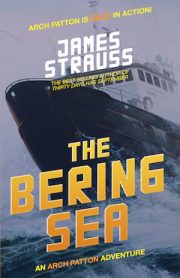




A different and strange reception on this mission for sure !!
Hope you acquire your sea legs in a short manner as those seas there can turn quickly, hanging on to see what happens now James !!
Semper Fi
I am sorry about the delay here, but I was in with a heart problem. Looks like they got it though and I’m going to live. Echo is at 55 percent and my blood pressure way down. Whew. Hte being in the hospital though, even if the VA here is great. Thanks for the compliment, SgtBob, it means a whole lot to me, especially now. The latest chapter I finished this night and will hit sometime tomorrow.
Semper fi, my friend,
Jim
A new adventure has begun.I can’t wait to see what happens now.
Thanks for what you do.
I am sorry about the delay here, but I was in with a heart problem. Looks like they got it though, and I’m going to live. Echo is at 55 percent, and my blood pressure way down. Whew. Hate being in the hospital, even if the VA here is great.
Thanks for the great comment to keep me going.
Semper fi,
Jim
Jim,
Some weird things you are laying on us… most interesting. Can’t wait until until you tell us more as this mission unfolds.
I thought Donald was going to be the ship ‘s cook….
THE WALTER DUKE.I am sorry about the delay here, but I was in with a heart problem. Looks like they got it though, and I’m going to live. Echo is at 55 percent, and my blood pressure way down. Whew. Hate being in the hospital, even if the VA here is great. Trying to catch up Walter and the next chapter is done this night finally. Chuck just put up last week’s short story ‘Ve’ve Come to Mombasa’, earlier today.
My great friend, and yours,
Semper fi,
Jim
This mission starts out as bizarre as any mission you have shared with us before. I love it!
A bit repetitive here Phil but there’s been trouble on this end. I am sorry about the delay here, but I was in with a heart problem. Looks like they got it though, and I’m going to live. Echo is at 55 percent, and my blood pressure way down. Whew. Hate being in the hospital, even if the VA here is great.
Thanks for the comment Phil, and the compliment.S
Semper fi,
Jim