
The bar on the Lido deck is where I settled in for the afternoon run out toward the Diomede Islands. Passengers were drinking like proverbial fish and talking like magpies, so it didn’t take long to learn that our speed approached nine knots. That put our arrival at about eight the following morning.
Marlys was serving behind the bar. She was attired in some sort of blue wrap and looked stunning. It’s not that tough to look fetching when you’re in your early twenties, I ruminated over my cup of coffee. But she was fun to look at anyway. She neither spoke to me nor engaged my eyes. It was as if we had never seen one another. Her necklace had disappeared, and her ankles were covered.
Because the swells were growing longer and deeper, I figured we were nearing the end of the Seward Peninsula. The passengers began to thin, inversely proportional to the growing size of the waves. Soon, I was almost alone in my corner, working on my third cup, wondering if seasickness was in the cards. I had not been exposed to any kind of real sea in over ten years.
Coffee was free at the bar for “staff crew”, as we were termed. Booze cost the same as what the passengers had to pay, except the total was deducted from our wages at the end of every month. I had no plans on drinking, though, as I knew this operation was going to be exceedingly tricky, and that it was going to take absolutely every bit of attentiveness I could muster. A big man in a cable sweater sat down on the stool next to mine. I looked directly at him. Since all the other places at the bar were empty, his choice of seating was not natural.
“You’re Anthro. I’m Dutch, but my real name is Richard, Assistant Cruise Director to Benito.” He pronounced his words without looking at me, instead ogling Marlys, who poured straight whiskey into a drinking glass placed before him.
“Benito,” I whispered, more to myself than to Dutch. He heard me and smiled, took a deep swig of whiskey, then put his glass down with an air of amusement.
“Yeah, Don told me. You sure were right. Until he told me about Mussolini, I would never have put it together.”
“Word travels fast here.” I scratched my head. I was going to have to be more careful with my expressive personality. I didn’t need the cruise director as my enemy. Not yet anyway. Dutch stuck out his hand, and I clasped it. The man was huge. The bear was actually an overgrown boy. He could not have been more than twenty-five, his age somewhat distorted by a short-cropped beard run through with white streaks. I examined his features with a glance, which he caught.
“Easter Island,” he said. “I was born there. I’ve never done anything else except ship out. Nothin’ to do on Easter Island, ‘cept drive a tour bus or wait tables.” He took out a hand-rolled cigarette and lit it between gulps from his glass. Marlys refilled him before it was empty. She didn’t seem to notice Dutch’s existence, or his need for drinks, any more than mine.
“Kinda cold, young lady,” I ventured, when she walked out of earshot.
“Cold?” he laughed gently back, looking to make sure the woman was out of earshot. “No, not cold. Hot as hell, but even more dangerous. Take your chances somewhere else, if you’d like to stay in one piece.” Normally, I would have taken this as a warning from an existent or potential suitor, but I didn’t get those feelings from Dutch at all. I looked at Marlys’s back, tightly held in her blue sheath. ‘Yemaya, the Sea Goddess,’ I thought to myself, just as Trigo had described and somehow predicted.
“What do we do until we get to the island?” I asked mainly to change the subject. I’d had enough of sitting at the bar and drinking coffee.
“We check out the passengers to make sure they’re all settled, get a bite of food from the Filipino mess below, and then you check out the diving locker for your equipment,” he responded.
Deep Sea Diver was one of my jobs, I recalled. My résumé had contained a small section about my Dive Master designation and experience with mixed gas diving. The entry had not detailed just how little time I had spent performing in that area, however, but it was less phoney than the rest of the stuff. But Dutch was right about checking the locker. Outside of training and experience, the equipment was everything if I were to have to enter the murderously cold waters of the Bering Sea. I followed Dutch down the stairwell to a lower deck.
The equipment was first-class. Dated, as I expected, but relatively unused. That gave me hope that I would not have to be using it at all. Two dry suits. A selection of many B.C.’s and plenty of ’72’ tanks, with quality U.S.-made regulators, hung from bulkhead hooks.
“We sail all the way to Antarctica in the winter,” Dutch offered by way of explaining why there were so many units. I assumed that interested passengers paid extra to dive when the ship was in tropical waters running back and forth between the poles. A five-thousand P.S.I. compressor sat in the corner of the small metal cabin; its exhaust intelligently piped to the outside. I also noted that the dive locker was the only other cabin that had a locking metal hatch I’d seen, outside of the infirmary, instead of a wooden door. We stepped out onto the back deck. Dutch locked the door with a key and then made a show of sticking it into his pocket with a wink.
“Your able diving assistant, at your service, sir,” he bowed at the waist as he spoke the words. He had a sense of humor. I smiled.
“You NAUI certified or PADI?” I inquired about him.
“None of that,” he responded, as we walked away. “Got all my experience from diving…and from people like you.”
I didn’t say the phrase “Oh, that’s just terrific!” but it coursed through my mind.
“You’re in with Don, the botanist, so I won’t come by to roust you out,” Dutch said. “Zero five hundred hours. They’ve got to get the Zodiacs winched down from up above.” He pointed up toward the top crew deck of the ship. “The Germans don’t trust us with the expensive French boats, unless it’s to run them onto rough rocks, like Diomede is made of, in high surf.” He brought his arm down. “Filipino mess is down on the bilge deck. If you want a bite, I’ll see you there.”
With that, he stepped through the open door and was gone.
“Onto rocks in high surf?” were words that I spoke out loud, but to his departed back. I was left with only a bad feeling. I had been completely wrong about everything since joining the expedition. I knew that I had to start getting things right soon or else the mission instructions I had been given would never be realized. At least not that part of them. My control had stated clearly, near the end of them, “…and don’t spend any more money or spill any blood. Not one drop, do you hear me?” I had agreed. My prior missions had all been successful, and the blood that had been spilled had not been my fault, even though there had been a lot of it. But I had kept my mouth shut instead of arguing my position.
I wasn’t hungry, so I headed toward my cabin with a sense of relief. Despite the sun, remaining eerily high overhead, I knew I needed some rest. The swells were running a good thirty feet, the hour was growing late, and not a soul was anywhere on deck or in the corridors. I knew that because it took me three attempts to find my cabin. The ship, appearing to be so sensibly laid out, was, in reality, a rabbit warren demanding considerable experience and attention to negotiate. I rapped on the door of Cabin 36 and then turned the handle. To no avail. The deadbolt was thrown from the inside. Frustrated, I then knocked loudly. I knocked twice more, until finally the door opened a crack. I could barely see Don’s face through the small opening.
“What?” he whispered.
“What?” I nearly shouted. “Let me in. I’m tired. I want to hit the sack.”
Although the door opened farther, Don didn’t move out of the way. My eyes opened wide as I noted that he was naked and that a young blond woman was in his bunk. I gaped. I just stared past him at the beautiful young woman. While she stared back at me, one hand covered her breasts with a sheet.
“Here’s your kit,” Don said, then pushed a bag through the door. “You’re going to have to find another berth. I’ve already got a bunk mate.” He closed the door, and I heard the deadbolt turn. I fought to breathe. I shook my head, still not comprehending. I opened the zipper on the bag and, sure enough, all my stuff was inside, carefully folded and snugly packed, as if by a woman. I was relieved only because I had not left the satellite maps or Krugerrands in the cabin. I picked up the bag, angrily, and then made for the purser’s office. It was closed. I went back to the bar. Marlys was cashing out when I approached. I slung the bag up onto the cleared bar surface.
“My cabin partner, Don, has found himself a new roommate,” I said to her. The purser’s office is closed. What the hell am I supposed to do?”
Yemaya stared at me without expression.
“The air’s warm,” she counseled, “The night’s bright. The entire Lido deck is yours alone.” With that, she walked to the stairs leading down to the fourth berthing deck.
“Good night,” she said, but didn’t look over her shoulder at me when she said it.
I did catch a glimpse of silver on her ankle as she departed, however, and I shivered unwillingly.
The Lido deck was covered with tables and chairs running out into a great room, which was surrounded by plastic-covered couches along all the bulkheads, inside and outside around the fantail. I muttered to myself and then dragged my bag to cover me as much as possible. It was going to be a long night. I curled up to sleep but lay there for a while thinking. Nothing had gone right. I puzzled over how to come to grips with the possibility that I had been transported to another dimension. Then blessed darkness closed over me.
The cushions were pulled from me in the middle of the night. The night that wasn’t a night, aboard a cruise ship that wasn’t a cruise ship. I reacted badly. Slipping deliberately below the cushions as they were being jerked from me, I landed on the deck on all fours, then sprang to my feet in a low crouch, sideways to my aggressor, in a long-practiced Aikido maneuver. I faced an astonished Filipino. Around his neck hung the strangest-looking clock I had ever seen. It was the size of a dinner plate but surrounded by a thick rubber bumper. Its huge numbers were nearly effervescently white. The clock swung from the Filipino’s neck like a pendulum. My thoughts of Lewis Carroll’s story returned.
“What do you want?” I demanded irately. “And who are you?”
Then I relaxed my posture and reached for my bag. I looked around the Lido deck. The Filipino and I were alone. He finally clarified matters after finding his voice.
“I’m the night deck watch. The Purser requires the honor of your presence.” He mumbled, with half of what he said in a singsong Tagalog variation of English.
I understood enough, including his pointing finger. I looked at my Breguet chronometer. It told me that it was four. I followed the Filipino, checking the sea behind us off the fantail. It was still running high, but it was down from when I’d fallen asleep.
The Purser’s door was open. The deck watch pointed at the opening, then walked silently away. A short, fat man in a ship’s uniform stood with his back to his desk, facing me. I liked the uniform. My Marine days were far behind me. The wonderful uniform memories were about all I had left. His pressed short-sleeve shirt had black epaulets. Epaulets that were clipped on, not the kind some shirts were made with. A black nametag stood out on the left side of his rotund torso. It read “Hathoot.” I squinted to make it out.
“Mr. Hathoot?” I ventured, dropping my bag on the floor, as I greeted him.
“I’m the Purser. It’s Commander Hathoot.” He beamed broadly, however, when he spoke the words. I liked him immediately.
“Botany Bay has taken a new roommate,” he remarked. “It isn’t entirely fair that you should be forced to enjoy the Lido deck’s rather public attractions because of his good fortune.”
He licked his lips, making me wonder if he was talking about the couches or Marlys, when he spoke of the Lido deck. I didn’t answer. I stood with a deadpan expression. I was mad as hell at ‘Botany Bay,’ but I was not about to show it.
“Here is the key to a suite,” he went on. “You may enjoy it alone until you take a roommate.” He stuck out his hand with a brass key in it. I took it, turned it in my hand, noted the ‘Cabin 27’ designation, and then pocketed it.
“Why?” I asked, stalling, because my mind could not get over the unlikely appearance of another great coincidental fact.
I was leaving Cabin 36, Edmond Dantes’ cell number in “The Count of Monte Cristo,” and I was being moved to Cabin 27, which, in the Dumas novel, was the cell that belonged to the Abby Faria. The coincidence was simply too improbable. The Count was the most favored novel I’d ever read, more like an instruction manual for someone who becomes suddenly and stupendously wealthy than a novel.
My mind was bouncing about like a rubber ball on a handball court. I only half-listened as Hathoot served up some mitigating circumstances: “Botany Bay has found a woman. He has been searching for three voyages. He is fifty, like me. I must reward his persistence and his success.” My jaw dropped. I couldn’t care about other people’s sex lives aboard the ship. There simply was no need, the way I looked at it, since having sex while I was aboard wasn’t going to happen to me.
“Where’s the cabin?” I pressed the commander, noting his resemblance to Jabba the Hutt. That just added more to the bizarreness of my situation.
“Same deck you were on. All the way forward. It’s the cabin that butts up against the chain locker. No passenger will stay in it.”
I was already walking out of his cabin before he finished. I didn’t say thank you, only wondered why no passengers would have the room. But I didn’t really care. I just needed a bunk on which to collapse.
I settled into the spacious cabin and immediately lay on the bunk and fell asleep. I awoke in a panic and leapt right out of the thing. The bulkhead was vibrating. The sound, in fact, was so thunderous coming from it that I had to put my hands over my ears. Then it stopped. All was silent. The ship was only gently moving. I stepped over to my single porthole and looked out. The glass was thick. It was not one of those portholes that opened. Under heavy seas, I realized, it spent most of its time underwater.
Through the thick glass, I saw a mountain in the distance rising out of the sea. A small town could be seen on what I knew to be its southern rim. The sound had been the anchor chain pouring out of the chain locker located on the other side of the wall. Both bunks were attached to the side of that metal wall. No wonder the Lebanese Purser had chuckled as I walked away. I checked my watch.
“Good grief,” I whispered to myself, tearing open the loaner bag Don had given me. I shaved as quickly as I could, dragged out my work boots, and put on my Dunhill coat. Before turning to the door, I threw on a Holland and Holland sweater under the coat, before turning to the door. As my hand touched the handle, there was a loud knock. I scowled, opening the door fully. Don brushed right by me and inserted himself into the middle of the cabin. I backed up, surprised.
“Here,” he said, roughly, thrusting a pair of boots at me. “What are you, about a size nine?” he asked. Then he added, “You gotta have Wellingtons for the Zodiacs, otherwise your feet will freeze. It’s wet inside the boats, all the time. And here’s a proper down coat, and your life preserver. All your designer stuff is useless or less so aboard this ship, or even off it.” He threw the stuff onto the lower bunk and went back through the door. He stopped outside awkwardly. “Sorry about last night. I had no choice. She’s innocent, and she needed my help.” I studied him, my eyes round in amazement. She needed his help? Instead of commenting on that rather preposterous excuse, I moved the conversation elsewhere.
“I thought you were supposed to do whatever I told you? From your note? You know, Medjugorje?” That rocked him.
I watched him twist and turn over my riposte before he answered.
“I didn’t know you were the guy. You said you weren’t. Now that I know, well, that’s different. I’ll do what you say from now on.” By the way he spoke the words, I knew he was not kidding, and a bad feeling welled up, again, in my stomach. “What trouble are we going to get in?” he half-joked, his expression indicating that he was positively looking forward to whatever trouble might overtake us.
“Good Christ, get out,” I replied, coldly, moving to close the door.
“Aye aye,” he yelled back, receding down the hall. “We only have ten minutes to get to the boats, or Benito will have our ass.”
I changed into my new boots and the heavier coat. I looked at the diminutive life vest. “What the hell do I need with a life vest?” I questioned the empty cabin. I tossed the thing onto my bunk and then made for the corridor outside.
I followed the descending passengers down. At the end of the bottom berthing deck, a crowd backed up into the hall. I eased my way through the packed mass, smiling and saying “Anthro Professor,” not having a clue as to why I was saying anything at all. A nucleus of staff crew stood near an open steel door. The water was visible just below the level of the door’s bottom. I could see Zodiac inflatables running in circles. Most of the opening was blocked by the bulk of our cruise director’s stout body, however.
“You,” her commanding voice echoed around the small area. Benito was pointing at me. “Ah,” was all I got out, my index finger pointing at my own chest, like an errant school child.
“You’re late. You’re on the first boat out. Don’t screw it up. You get twenty passengers. Orbit until you see how some of the other boats do it, and then get your charges ashore. Your driver’s Felipe. He doesn’t speak English.” She grabbed me by the arm, and then almost tossed me over the side of the waiting Zodiac’s rubber pontoon hull.
“Where the hell is your life vest?” she bellowed down at me, but Felipe had already gunned the outboard and pulled away.
Soon, we were out riding across the tops of the waves. It was exhilarating. Twenty passengers stared at me as I got to my feet in the center of the boat. It was hard to stand. The floor was made of flexible wooden slats. The entire body of the boat twisted like the rubber it was made from. I didn’t know whether to go to the stern of the craft or the prow. I looked at Felipe. His Filipino face was dark, flat, and expressionless. No clues there, I thought. I pointed at a spot near him, and then at the bow, then shrugged expressively. A great toothy white smile came over his features. He pointed at the prow, so I worked my way there, grabbing a line hanging overboard to steady myself when I arrived. I stood as best I could, rocking back and forth with the movement of the boat through the water, wondering in the back of my mind how a Filipino might come to have the name Felipe.
We circled aimlessly, while the other boats headed for the imposing shore. The sea was not raging, as it had been beyond the protection afforded by the two close islands. We entered as the fifth boat in a line toward the shore. When we crested the swells, a small village was readily apparent ahead. Its structures were made of clapboard, make-shift things on stilts. Substantial enough, but also peeling and rickety. The town’s most remarkable feature, a huge water tank, sat near the base of a small stone jetty.
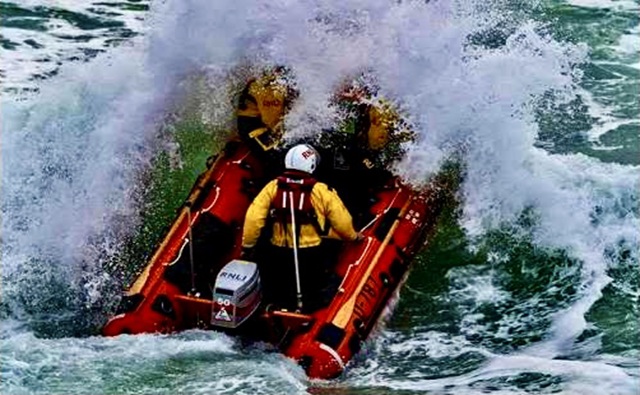
We orbited again, as the first Zodiac landed through the surf. Two flat, angled stones, huge in size, next to the jetty, acted like a wet dock for the landings. The Zodiacs rammed over a bed of stones, then on into a natural ‘V’ formed by the rocks. The pilot of each boat gunned the motor to hold it fast up against the piles of shore rocks. After passengers offloaded over the bow, the boats backed directly out into the surf, taking wave after wave over the stern. Once out of the ‘V,’ pilots swiveled their boats around, then ran hard back to the ship, their loads of seawater pouring out of the boat over the stern boards.
It was our turn. I looked back at Felipe. It seemed easy when watching from offshore. Up close, it wasn’t the same. Waves were breaking at a good four-to-five-foot height. There was to be no gentle approach. Felipe didn’t wait for my direction. He aimed the bow into the ‘V’ then hit the throttle hard. We wedged in over the top of a breaking wave and slammed into the rocks. We all recoiled and then began scrambling over the rubber pontoon of the bow.
I stood to assist, which was unneeded until the last passenger. She was an older woman. She came over the rubber bow and then plunged straight down onto the rocks. The boat lifted and dropped with each wave. I looked behind me, but all I saw was the disappearing backs of the other passengers. The surf and wind were too loud for yelling. I grabbed the woman by the shoulders, twisted her around, and lifted. When I got her up, I pushed hard from behind. She went up over the rocks, and I went down, sliding under the hull of the boat.
I slid completely down into the ‘V’ and the boat came down on top of me. I tried to rise, but only moved further under the pounding boat, its weight substantially lightened by having no one but the pilot aboard. I realized that if the boat had been a rigid-hull inflatable, I would already be dead. The boat continued to rise and fall with the passing of each wave. The water was icy cold, and I was in terror.
I could feel the propeller beating in the water at the end of the boat. The pilot could not see me. I also knew that I could last under such conditions for only seconds, yet there was nothing to be done. I was so far under the boat’s hull that I could no longer get any air. The water was icy cold, but my survival options were more chilling: either I was going to be ground up by the propeller, or I would drown.
Suddenly, the boat was gone. I was underwater, staring upward. I could see sunlight again. I felt relieved to know that I would die seeing the sunlight.
Hands reached down and pulled me up. I struggled to help. Strong hands pulled and then turned me onto my hands and knees on the rocks. I crawled out of the beating sea. Strong hands let me go. I looked up from all fours to see Don and Dutch holding ropes attached to the sides of the Zodiac. One stood on each side, both laughing as they waved and signaled Felipe. Then they came trudging through the water to check me out. I gasped, sitting on the sharp edges of an upturned stone. I could not talk. They grabbed my arms to support me, as we made our way toward the only large building on the island.
“Thanks for saving me,” I gasped out of my barely open throat.
“Saving you? Hell, we didn’t know where the hell you’d gone. We didn’t save you. It was her.” Dutch pointed up to the stairs, switch-backed against the end of the building.
The only person climbing the stairs was Marlys. She didn’t turn or wave.
“She pulled me out?” I gasped again, this time in awe.
Marlys could not have weighed more than a hundred pounds. The hands that had closed over me and dragged me from beneath the boat had been talons of steel, driven by muscles of stone. I stood on my own, waving them off, dripping wet and shivering with the cold. I stared at the twenty-five feet up toward her as she reached the landing and turned back. Our eyes met. I nodded. She did not nod back. When she turned, I said “Yemaya,” loud enough for her to hear. She went through the door, acknowledging nothing.
In the bathroom of the facility, I took my clothes off and squeezed them out. I stood before the full-length mirror next to the sink. I frowned, ruefully in reviewing my condition. I was only battered a little by the near drowning. But I had old scars all over my legs and torso. I had been shot, knifed, poisoned, and stung by venomous snakes and spiders, but I’d survived. With clothes on, I looked unassuming. It was one of my greatest strengths. “No, not him,” was what came to other men’s minds when they looked at me. I didn’t appear threatening or macho at all, but I had been served Hell for breakfast for many days of my life.
And here I was, standing weakly in a cold bathroom on Little Diomede Island, as naked and helpless as a baby but looking more like Quasimodo. “Screw you, James Bond,” I whispered at the mirror, mocking my own reflection.











Another great read. Stay well & keep them coming.
Staying well at 80, I am doing, but it is a never-ending and unexpected series of
labors and surprises! Thanks for caring and for writing about it here.
Semper fi,
Jim
On the road so had to find time to read whole chapter at one time. Details are important. Don’t want find myself lost in middle. As always mix of tour guide and mission rare find!
Homan
Jim Homan, Colonel, USMC, combat vet…and so much more. Thanks for the usual ‘slight of hand’ compliment.
I much enjoy your analysis of my work.
Your special friend,
and Semper fi, of course,
Jim
Good to see you back at it Mr. Strauss.
As usual, you’re descriptive writing style has already got me in it’s grip again and, we’re only at the beginning of your new (adventure) er mission.
Hope your return means you’ve overcome some of the medical problems you were dealing with and puts you in better health.
Keep em coming sir, I truly enjoy reading the Chapters .
Thanks Doug for the great compliment. I’m back in the saddle writing and health too.
Love the VA for putting Humpty back together again.
Semper fi,
Jim
Rough waters is one thing, I have been aboard ship crossing the North Atlantic in December, but being stuck underneath that boat is something I’m not certain I could handle !!
Nice the lady pulled you out before things got much worse.
Now the mission gets underway I assume, how bad could it be !!?? 😉
Thanks for being able to keep going after your recent medical event James…
Semper Fi
Things go horribly wrong time after time and that I got through is amazing to me to this day.
Thanks for your personal experience and great comment.
Semper fi,
Jim
What a nifty chapter! Been anticipating for a while, and the wait was worth it.
I totally dislike diving in cold water – south Florida, the Philippines, and the Bahamas have had their effect.
Your shipmates don’t appear to be too friendly.
Always have enjoyed being on the sea. Two circumnavigations has me hooked.
As always, Jim, totally enjoying this volume – thanks!
I am not sure, after all my maritime experience, that crews of vessels, especially those long at sea,
can ever be described as friendly. You come in, and you are an FNG to them and get treated like that…put in
harm’s way so they do not have to be. The passengers were great, though and some others as well…some others still
in my life.
Semper fi, my great friend,
Jim
LT, what the hell is the mission? Don’t think I have missed an episode but feel lost in reading the last three chapters. Still a good read. Don’t mess with that women.
To get a kid, nephew of a U.S. Senator, out of a Russian gulag which he is in for having been caught hauling drugs.
There. I did want to mess with that woman!
Semper fi,
Jim
PS I like dangerous people, especially those that do not see me as dangerous.