
I took in the contents of the Zodiac as fully as I could, at least what I could see.
“Don,” I finally said, “Grab the canvas sack out of the boat. Dutch, get the top off the outboard. We’re going to need the cover if we want to heat something.”
Both men clambered aboard the beached craft. Neither seemed to mind being ordered around. Dutch looked more comfortable than Don, which surprised me. I had expected some macho trouble from the mercurial, alcoholic young man.
I pulled out the knife I’d strapped to my calf. I removed the screw top with some difficulty. The gloves gave me warmth, but not manipulative ability. I dumped the Bic into my hand. I opened a waterproof zip pocket on my thigh, the tang of the zipper huge and convenient for my gloves. I popped the Bic in and re-zipped before approaching the rubber hull.
“Here, Dutch,” I gestured with the knife. “Cut the gas line and squirt some gas into the handle. Screw it down, and we’ll have some great accelerant for a fire.” I knew that our survival for any extended time was not going to be dependent upon either food or water. It was going to be a direct function of how good we might be at building and maintaining a source of constant heat.
Don and Dutch came over the transom of the boat. I helped them land on the rocks without causing damage to any of us.
“Anything else you think we can use on this thing?” I asked, looking over the top of the big rubber-tubed siding.
“Use for what? To do what? To go where?” Dutch replied, asking the three questions while looking all about the rock shore. There was nothing at all on the shore, not even wet washed-up wood. There was no vegetation. Rain began to fall softly, as all three of us absorbed our surroundings.
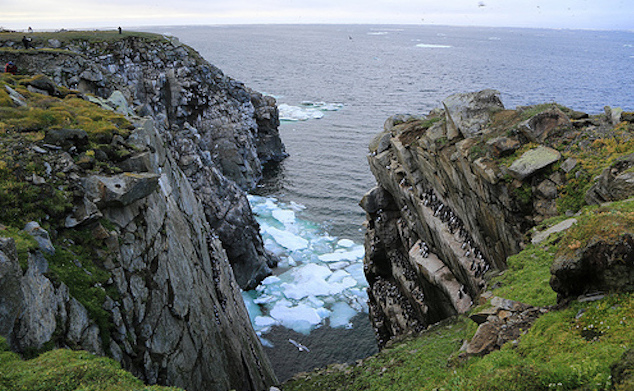
“Up there,” I said, pointing toward the top of the escarpment eight hundred feet above. Then I pointed at the steep slide of riprap, which had fallen through a cleft in the face.
The cleft angled upward, then switched back and went on. We all stared at the incline together. I could not see, from our bad angle, if the cleft made it all the way to the pine forest above. But I also realized that we had little choice. We wouldn’t last twelve hours on the brutal rocky shore. Not with the rain, the wind, and unknown surf conditions.
“We can’t make the climb wearing this stuff, and I don’t have any boots,” Dutch complained. I pulled out my knife.
“You’ve got that right. Let’s cut and paste!”
“We can’t destroy the equipment…” Don began, until I held up the knife and pointed it at him.
“We just saved the company almost a hundred grand, Don, and the First Mate his job. I think we can sacrifice a few thousand bucks to stay alive.” I began working on the bottom of my suit, cutting the booties free. Then I sliced around the waist. I tossed the knife over to Dutch. “Cut. We’ll do some better tailoring up on top.” I looked up then, to examine the likely course of our climb. I had sounded a lot more confident than I really felt.
“I’m getting wet,” Don whined. “You guys are waterproof, at least.” I sniffed, but said nothing.
I was wet to the bone, but it hardly seemed worth mentioning. Why belabor the obvious? Dutch finished cutting, then handed the knife back to me butt first, almost subservient in his manner. I was surprised, yet again.
“Forgot my own knife aboard,” he confessed, then climbed back aboard the Zodiac. He rummaged around for a few minutes before rejoining us. He held a folded knife out for us to see.
We moved toward the cliff face, Dutch carrying the outboard cover. Don hauled the canvas sack. I replaced the knife in my sheath, curious about why Dutch had felt it necessary to show us that he had found his knife. That was a ‘tell,’ in my business. The ‘tell’ was not in his going back for his knife. It was in displaying it to validate his public explanation.
People seldom do truly meaningless things. They rarely throw up evidence for things that appear to require none. I did not know what Dutch had been doing while he had been bent down on the boat. Almost certainly, though, it was not what he had purported it to be. I banked his insincerity, and started the ascent. I’d think about it later.
Although the dry suit booties were not the best climbing boots ever designed, they did the job. The riprap was easy, but tiring. Our feet sank deeply into the thimble-sized stones, which then rolled down the steep slope behind us. Step by slow, agonizing step, we made it to the area where the cleft changed direction. There was a small flat clearing there, with the first sign of vegetation covering it. Short wild grass covered rock and thick mud.
“Don, the sack,” I said, holding out my hand. I squatted while he settled onto his haunches. He tossed the sack gently to me. I pulled out the large chunk of tin foil wrapped sandwiches. “Eat. Fish. It’s protein. We need the warmth and the energy. Eat it all; we’ll find other stuff later.”
I handed out sandwiches. Two for each of us. They were gone in no time. I crumpled the tin foil into a ball and put it back inside. Don grabbed up the sack. We started toward the top. Looking ahead, I realized that we had lucked out. The cleft went all the way, at a much more gentle angle than it had started at, and the narrow surface was grass-covered rock. We might just be alive when the ship came back. If the ship ever came back, I thought sourly, hating Captain Borman without ever really having met the man.
We stepped up over the last ledge onto hard-packed earth, which was covered with pine needles all the way to the edge. The pine trees were so close together that they seemed impenetrable.
“White Pine,” Don said, in his professor’s lecture voice. “Circumboreal….some Black Spruce, the tall ones, which will have a lookout if they get real tall, are Black Spruce, and that’s about it.”
We stood in the rain, now coming down harder, and looked at the wall of pine branches. I broke the silence.
“Well, Botany Bay, it’s your call. What do we do?”
Don rubbed his chin.
“How you’re knees?” he asked, then sank and crawled forward on all fours, satisfaction on his face. Dutch and I looked at one another, agreeing to follow the big Canadian’s lead. Don burrowed in and under the lowest of the branches, moving faster than I thought possible. He snaked deeply into and under the bottom foliage. He finally stopped under what had to be a huge pine or spruce. There was enough room under the lowest branches for him to sit and lean his back against the trunk. It was thicker than he was.
“Check the needles,” he suggested, holding up a handful. I stuck my hand into the heavy layer of light brown needles. Right away I understood.
The needles were bone dry, even with rain falling heavily just above. None of it got to the base of the huge pine. Water ran down and off the waterproof living needles. It ran in runnels around the trees but not to the bases.
“Desiccation,” Don observed, smiling, “many of the pines here die of it, while it’s raining right overhead.” Dutch slumped down, lying on his stomach. “How the hell do we build a fire in here?”
Yes, it was dry, but it was still frigid.
I reached for the canvas bag and pulled out the tin foil. Carefully, I smoothed it flat on top of the dry needles, then began working it up under the bottom of the lowest hanging branch, about shoulder height.
“We’ll just clear the pines to ground below and then let the tin foil diffuse the heat above,” I said, pulling the knife out and handing it to Dutch. “Go cut some low-hanging limbs, dry ones, or find some dead ones while I get things ready here.”
Dutch crawled away, looking like a huge baby bear foraging for food. I pulled off my gloves, and then finished fastening the foil into the tree.
“That radio will work better from up here, I said, looking up.
“What’s the range?” I asked Don, as I worked, my mind more on getting warm than on his answer.
About five miles on the surface. Probably more like ten from up top here,” he replied. There was something in his voice that caught me, however.
“What’s on your mind?” I challenged him.
I watched Don think for a moment, bringing the radio out to set against the base of the tree. He pulled a pack of cigarettes out and looked at me, as if waiting. I shook my head in negation, then unzipped my thigh pocket and took out the used Bic. I tossed it over. Don flicked once. He got a strong flame, and then lit the cigarette.
“I know, I know, you don’t smoke,” I offered. He blew a big exhalation at me. “Didn’t myself, really, but then I met you. You’ve changed everything.” But he smiled when he said the words. It vanished with his next question. “Who did the anchor in?” It came out of him so softly, and out of place, that I did a double take. I didn’t say ‘say what?’ but I thought it.
“What’d ya see down there?” He dug deeper, pursuing the subject. I still said nothing. Instead, I cleared the pine needles in order to have a base for the fire’s foundation. When done, I relaxed back on one elbow and resumed my talk with Don.
“The link was sheared, but it wasn’t distorted, as if from being taken to its tensile strength and failing. The ends were shiny.
It appeared to have been filed or cut. But it would have taken a lot of work, and somebody with access to do that. The chain locker’s secured.”
I hesitated, and then went on. “It would’ve taken somebody with motivation. Somebody who understood where we might lay up, and what might happen to the ship if it broke loose from the anchor too close to this island. It was just a stroke of good fortune that the engines were still running when that link went. We’d have been on the rocks in a minute with that current.” I finished my analysis.
He stared back, inhaling a few more tokes.
“Somebody like maybe an Assistant Cruise Director who drinks too much?”
I thought about his conclusion with surprise. I could place everything but motivation. Drinking didn’t seem to be an issue, although I was dead sure that Dutch was out under the pines somewhere drinking from the bottle he’d reclaimed from his trip back aboard the Zodiac.
Right at that instant, the Easter Islander appeared back under our giant White Pine. He had no branches or firewood. In his hand was a half-empty bottle of Bacardi Light, the cap off. He crawled to the base of the tree, and then leaned his back into it, holding the bottle out, as if offering us a drink.
“I did it. I cut the chain,” he announced, and then started to cry.
The boat, however, was high and dry, wedged into a pliable rock base. I grabbed a hull line and climbed to my feet. Don and Dutch were doing the same on the far side. We looked at each other. Jokingly, in imitation of The Three Stooges, we all slapped our faces lightly, imitating one of the Stooges’ most well-known movements.
Dutch moved the bottle of Bacardi back to his lips, runnels of tears falling from his cheeks. I pried the half-empty bottle out of his clenched hand. I propped it back into a cleft between two nearby rocks.
“Stop blubbering and get back out there,” I pointed toward the direction he had crawled in from. “Go on, we’ve got to have some warmth no matter what you’ve done, or might have done.” Dutch looked at me in shock, wiped his cheeks, and got back to his hands and knees. He gave a glance over to Don before disappearing into the bracken.
“What the hell?” Don blurted, eyeing the Bacardi bottle. “He just admitted that he’d sabotaged the ship and you send him away before he can say anything else?”
I cooled to his words, but waited until his upraised hands sank back to the needle bed. I replied to him, in my best ‘Mission Commander’ voice.
“We’ve got to survive here for God knows how long. Let’s pay attention to that mission first. You take the knife. Go cut some of those smaller branches for protection from the wind.” I shuddered from the cold, as another draft of icy damp air penetrated through to our camp.
Our wet clothes had to be dried, and quickly, or our energy would begin to bleed away.
“What about a shot from that bottle?” Don replied, without moving.
I took the bottle in my hand, held it up, and drank down four long swallows. The Bacardi burned, but I didn’t cough. The fire of it revived me instantly. I handed the bottle over.
“I don’t drink,” I said.
Don mumbled without smiling, carefully cleaned the top with the palm of one hand, and then rubbed it on his sleeve before drinking. When he brought the bottle back down, there were only a couple of inches of liquid left in it. He handed it back.
“What if he doesn’t say another word about the anchor?” he asked.
I poured the rest of the rum onto the pile of dead dry needles I’d assembled for my fire pit base. Then I set it aside. I had plenty of experience in survival situations. One rule was to discard nothing. The prime rule, however, was to stop and think. Survival usually depended upon clear rational thought. More people died from bad decisions than from any other reason when lost in the bush. We were not lost, but we were completely cut off for an undetermined time. Don made no move to follow my previous instructions.
“Botany Bay, you want to lead this expedition?” I inquired. He shook his head. I sighed. “Alright, but this is the last explanation I give until you do your part. We’re trapped on a small remote island in the Bering Sea. What is the likelihood that Dutch is not going to tell us even more than we want to hear before we get off?”
He warmed to that, and then took the knife I had stuck into the ground in front of him. He crawled away.
Within two hours of both men going out to perform their assignments, we had a very comfortable fire going, clothing mounted on sticks around it, and a windbreak of intertwined pine branches encircling us. It was late in the day, according to my Breguet. I looked at the bezel of the expensive dive watch, turned to allow for the passage of eight hours, and dropped my arm back.
“We’ll sleep when the clothes are dry,” I stated, then turned the steaming pieces once again. I sat back. Dutch appeared to be ready to fall asleep or pass out at any minute. Don was fully alert, although strangely comical in only his undershirt and boxer shorts. We had the tops of our dry suits thrown over our shoulders. A warm fire heated only one side of a person at a time. Dutch had his undershirt on but leaned against the thick trunk of our sheltering pine.
I pointed at him.
“What about the anchor?” I asked. I put my hand down, then took a stick and poked the hot coals of our fire, not looking at Dutch. I waited in silence, reflecting on just how great it was to have gasoline and 80 proof booze as accelerants.
“I can’t go in,” Dutch forced out.
I waited again, but he said no more.
“Why can’t you go in?” I eventually asked, with some exasperation. Words rushed from the man,
“Immigration is waiting for me. I don’t have papers. I had forged papers. They know. They’re waiting in port for us to land.” I focused on the man, little more than a huge boy.
“In Russia? They’re waiting for you in Russia?” I could not believe what I was hearing. “Who the hell is waiting in Russia for you? We don’t need a Visa. The ship pays off the Commissar, and that’s it!” I tossed my stick into the fire to illustrate my disbelief. It threw bright sparks up as it hit. I had to quickly brush little hot embers from our drying clothes.
“Russia?” Don said. “Who said that we’re going to Russia?”
My mouth gaped wide.
“We aren’t going to Russia?” I asked, weakly, beginning to reflect again that I had thrown my lot in with the expedition ship from hell, wherein normal physics did not apply. Don found my unease humorous.
“No, but the world is round; we’ll eventually get there, but first we go to the Pribilofs further down South.” He pointed towards the direction from which we had come in on the Zodiac. “It’s just our tradition,” he offered, by way of logical explanation. I shook my head and turned to Dutch. “So, you think immigration is waiting for you in the Pribilofs, wherever the hell they are?” I grilled Dutch.
“Yeah,” Dutch replied. “Got a radio message from St. Paul, the town there, on one of the islands.” I thought long and hard about his motivation.
“And you believed by slipping the anchor, at just the right spot, you’d run the ship on the rocks, and everything would be okay?” I held up my hands in wonderment.
“Yeah,” he responded. “They’d get us all off and take us to the mainland. There’d be nobody there. Nobody who knew about my papers, anyway.” I just shook my head in utter disbelief.
“Who are you? Forest Gump? Like immigration doesn’t have radios? Like they wouldn’t know we’d wrecked and be waiting? Like they wouldn’t figure out that only one guy aboard had a likely motive for pulling such idiocy?”
I pointed out in the general direction of the anchor float we’d surfaced. Dutch simply wagged his own head slowly from side to side, his inebriation evident. I was afraid he’d start to cry again. I rotated the clothing on our vertical sticks before speaking.
“Here’s the deal. I have business in Russia. Important business. I also have certain powers with immigration. The kind of powers that will allow you to get a permanent Visa instantly. I’m presuming that the Pribilof Islands are in the United States.” I stopped to think
“You’d help me?” Dutch said plaintively.
“For a price,” I said.
Dutch deflated a little. “What’s the price? I don’t have any money at all.”
I snickered. “I don’t want money. That I have. I want you to become an assistant in my ‘business’ enterprise. You do what I tell you. And I don’t want you drinking another drop until the “Disco” picks us up, if you’ve got more stashed. When we hit Providenya, no drinking there either. That’s it.” I finished and sized him up.
“That’s it? That’s all? For a permanent Visa to the United States?” Dutch responded, in disbelief. “I’ll do it, whatever it is,” he said, with very little delay.
After a few seconds, he went on. “What about the Pribilofs and the immigration guys?” he asked. I snickered a second time.
“Leave them to me when we get there.”
“So, we’re back to who the hell are you, really?” Don chimed in. I hesitated before saying anything at all in response to his question. I responded as if I made believe he’d even asked such a cogent and accurate question.
“I’d be careful, Dutch. He’s probably going in to get a nuclear warhead, or something like that.” Don had tried the back door, but with the same result. But Dutch replied in a nanosecond.
“I don’t care what he’s after. I’m in. If they send me back to Easter Island, I’m a dead man walking. I’ll be a nothing for the rest of my life.”
Don stared first at Dutch, then back at me. His expression changed. My brow furrowed as I x-rayed him.
“Why that look, Don? Is there somebody else in immigration trouble?” Don grimaced ruefully back at me.
“The Basque?” I theorized.
Don spoke in a voice almost too quiet to hear. “You need two assistants?” I looked at Don, then back at Dutch, then at Don again. We laughed together. We laughed for a full minute.
“Alright, it’s a deal,” I agreed, holding out my hand. Dutch took it, but Don held back, his head going up to the side like he was listening to something faint in the distance.
“Winds changed. Which means the current has changed. Which means the surf’s changed.”
I took my hand back from Dutch’s huge grasp.
“So…” I said, tentatively.
“The Zodiac,” Don declared. “We never pulled it up. That’s no thousand-dollar item. We need to check it. Give me my clothes.” We moved fast, dressing, and then feeding the fire so it would be burning when we returned. In single file, on our hands and knees, we followed Don’s lead back through the bracken. We were establishing a hole-like path, I recognized. The needles were soft and pliable beneath our drumming hands and knees, but occasionally wet. We’d have to dry out our clothes again upon our return.
Don reached the edge of the cliff first, stuck his head over, and then promptly pulled it back. He held out one hand.
“Stay down, we’ve got company.” I tried to move forward, but he held me back. “Russians,” he warned, emphatically in a whisper.
“Don,” I said, patiently, “we’re eight hundred feet up with the wind in our faces. You can talk. Now what the hell difference is it to us who’s down there? Let’s accept their offer to assist us.” I liked my own conclusion. Don shook his head, and then Dutch shook his, which gave me a sinking feeling.
“Alright, give it to me…” I said, and waited for an answer that I knew I did not want to hear.
“These little islands are in Russia, not United States territory, hence their names. Five years ago, some idiot American intelligence agents infiltrated the Russian coast from one of these islands. The Russkies were irate. Now here we are. There are no identification marks on that Zodiac down there. It’s the black Zodiac we never got around to putting the ship’s name on. Get my drift?” My eyes got wide. We were in more trouble than I would ever have considered.
“What kind of Russians are down there?” I asked, a bit more subdued. I eased carefully to the edge of the escarpment and peeked over.
A mile offshore sat a white fishing trawler. A small boat from the trawler had landed below. A few men in crummy sailor-type clothes worked through the rocks to the bottom of the riprap pile we had ascended. I watched them get back in their own small skiff. They beat their way out through the now larger surf, looking rag-tag but formidable nevertheless.
“Combat Russians,” Don breathed out, “the Bless ’em All,” kind.






You write and it’s like we’re there with you! Thanks
Can’t thank you enough in these sparse times for reader return after reading.
Comments like your own help keep me going because there’s simply not the money to support
such efforts. Not like the old days. Means a ton to me, and thanks.
Semper fi,
Jim
Great read Lt. Finally getting caught up! Glad you got through your health problems!! Still working on mine! They say getting old is a b+><h. It's not! So many didn't! Sempre Fie!
Glad you are ‘getting older,’ as you put it, as the alternative? Yes, the other problem, and it is very real and for the first time
in the history of humanity, is becoming caretakers for those who do live on but not with full mental faculties. We, those of us given our remaining
clarity now, must take care of those of us who have not been so fortunate. It’s a hard, thankless task, but we must do it.
Semper fi, and thanks, my friend, for your long loyalty and friendship.
Jim
Very weird feeling of your rise with survivors out of the AhShau as you led your charges up the wall! The Leadership you learned from that experience looks like it enabled you to charge forth with the “Light Brigade”! Outstanding!
Homan
You are up in Denali Park, Alaska. Play and enjoy the animals but never forget that bears will eat you.
Thanks for the usual great and penetrating comment. Yes, PTSD and the visit to the A Shau and beyond has served to
help me on occasion, as I continued to push the outside edge of the envelope.
Semper fi, my great friend,
Jim
Jim,
You never disappoint in what you serve up to us.
Surprises and twists abound with scalimg of the cliffs, the “Who sabatoged the anchor?” confession (and the ‘why’)…, plus the Ruskies showing up to snoop about…, and now having to play cat and mouse with them, and the “we’re not going to Russia?” moment… I sure hope you do not have to kill a pile of Ruasians and that you don’t end up setting the forest ablaze…
Thank you, LT.
Peace, and out.
THE WALTER DUKE. It was not a non-violent mission, as you have guessed. Kept it to as minimum as I could,
not wanting to add to my already significant PTSD. Thanks for the great compliment. The island, a place never
to be forgotten, like the valley but different entirely.
Semper fi, great friend,
Jim
Another great read and great adventure.
One paragraph seems out of place. Right after Dutch admits to cutting the anchor chain there is a paragraph about the zodiac being secured, then we go right back to the bottle of Bacardi.
Can’t wait for the next chapter.
Christopher, I will look at chapter for edit. Thanks being an attentive editor. Thanks, as well,
for the compliment.
Semper fi,
Jim
Yikes!
Thanks a lot Phil, for the first comment on this interesting chapter and the compliment of
doing so, of course.
Semper fi,
Jim