
I learned from Don, my bunkie and fellow de-frocked PhD, that the ship was never referred to as the “MS World Discoverer,” which was painted in black across her white prow and in white across her black stern. Unlike most ships, because of seafaring lore about potential ill fortune, the ship had been named different things by different owners. Once it had been called the Lindblad. Hence, the name “Lindy,” which was announced, for unknown reasons, to everyone who came aboard, although the crew many times used a shortened version of the real name and called the ship “Disco.” I thought that a bit strange because the Land Rover automobile company in England referred to their step-down Range Rover as the Discovery, which was quickly called the Disco by most motor enthusiasts.
Don gave me the tour. Six decks in all, with a workout room, sauna, and steam bath on the bilge deck, which was the very bottom of the vessel. The workout area was closed up and never used, but since our empty bags were stowed there, we checked the room out anyway. The rest of the bilge deck belonged to the Filipino crew members who did all the cooking, cleaning, and general scut work of running an adventure cruise ship. They even did dry cleaning. The last place we went was up to a small blue door. It was the only metal hatch-type door I had seen aboard; the rest were all stained wood. A red cross was painted on the outside.
“Here’s one of your other career locations,” Don advised, with eyes brightened, as he opened the hatch and ushered me inside. An old man sat on a stool, checking a list.
“This is Doctor Murphy, the ship’s doctor,” Don stated, waving his hand toward him by way of introduction. The elderly gentleman looked around feebly. I realized that he was at least eighty years of age, maybe more. I could not help acting openly surprised.
“You’re the doctor?” I asked him, incredulously.
The old man blinked, then shrugged. He then answered in a deep, healthy voice, seeming to either ignore or not care about my surprised reaction to his aged appearance and advanced years.
“Not much of a doctor anymore, not since I lost most of my eyesight. I hope you’re my assistant, and that you can see well. I got the cat gut, anesthetic, and everything else, but can’t see to do the stitching anymore.”
I shrugged my shoulders. My surreal adventure just kept getting stranger and stranger. A funny feeling made itself present in the bottom of my stomach. I wondered why the doctor seemed to think that we’d be doing any stitching while on the voyage. But I said nothing, instead shaking the old man’s hand. I looked about his small quarters, and then left with Don, promising to return later in the day. I wondered, at what point, if someone’s life was on the line, would I have to surface as anything but a physician’s assistant? I wasn’t even a real Ph.D. doctor of anthropology, although neither the CIN nor the Society Expeditions Company that owned and booked cruises on the ship seemed to care.
The four decks up from the bilge were all identical. A long corridor ran from bow to stern on each side of the “Lindy,” with cabins dotted all along its length. The cabins on each side were all berths for the passengers. We, and the other “non-crew staff,” also berthed there among them in spare rooms as the ship was never fully booked. I knew the biggest problem was the twenty-five thousand dollars, or more, charge for the adventure. The top two decks were dedicated to meeting spaces, a dining room, bars, and open spaces. On top of all those decks was another, smaller deck. That was where the German crew, who actually ran the ship, had their quarters. Don told me that they rarely associated with the rest of the crew or passengers, and that that was a good thing. Most of them only spoke German. I did not mention that I could get along in Tagalog, the language of most Filipinos. I also did not mention that I spoke fluent German, with a developed accent from the southern part of that country.
As the passengers came aboard, Don and I returned to our cabin. He showed me the small hot shower in one corner of our tiny room and told me that it would be a lifesaver, as our expedition was going to be sunny but cold, with even colder water. I almost confided in him that I hadn’t brought my swimming trunks, but with the last few hours of experience, I decided not to attempt such humor. If, of course, it was humor. Trying to view must of any of the coming adventure, and even the ship itself as it was laid out with the Germans on top, passengers in the middle, and the Filipinos occupying the very lowest decks, as not being a bit humorous at the foundations, was difficult.
Finally, back in our cabin, we sat on our bunks across from one another. Don had a plug-in hot plate that ran off DC. We talked. He explained that this run was his sixth in as many years. He was a Professor of Botany at the University of Montreal. He revealed that he was fifty years old and married, but marriage did not count aboard the vessel. That added part of his description caught me off guard. My eyebrows arched up as I listened. When it was my turn, I told him what I could of my whole own history, although I had to leave out just about everything, including my rather vast world travels with the Agency. I went into some detail about the strange Santeria connection I’d experienced with Juan Trigo and his description of Yemaya, and how much that was bothering me. Don drank his instant coffee, looking over the lip of his cup at me. Big, bushy eyebrows on a big, bushy Canadian head. The guy seemed more like a giant Nordic Swede than a Canadian. His very appearance brought reassurance whenever I looked at him; however, as I was coming to feel that I could count on him, I had no idea what I was going to need from him.
“Why do you think the contract and bonds of marriage don’t apply when we’re on this ship and out to sea?” I asked, truly mystified.
“You’re an anthropologist. A scientist,” he said, his face serious. “Don’t give superstition and coincidence a foothold. Just reason on through it,” Don replied, before going on. “The ship has its own morality, so there’s no sense in trying rationality in explaining it. Everyone pretty much sleeps with everyone aboard this vessel, and I think that’s true of most adventure cruise ships. As an anthropologist, again, it should help you with that or at least give you a chance to study it first-hand, up close and personal.”
He took another sip of what had to be terrible coffee, looked at me, and then waited, cup held in his right hand, as if he knew I would have something to say.
I couldn’t say what was on my mind, the first thing when he’d blurted out his marital morality conclusion, and that was that Don was either sleeping with a woman aboard the ship or planning to. His photo on the small desks we were given in our cabins had what appeared to be a photo of his wife and children, although I wasn’t going to ask about it, at least for the time being.
Perplexed, I looked at him, wondering if the man had believed one word I’d uttered to him, which had included my revelations that I was neither a real doctor, physician’s assistant, nor a Ph.D. in anthropology, at least not yet, about the last thing.
“That’s a pretty damned solid obstacle of circumstantial evidence to blow right by,” I finally countered, sipping from my own hot coffee. The Canadian chortled and then set his cup down.
“Ever heard of Fatima?” he asked. I nodded, with reservation in the nod.
“You’re Catholic, right?” I assented again, wondering where he was going with that seemingly immaterial fact, and how he had assumed the first place.
“The story of Fatima. The appearance of the Blessed Virgin to three small children in Portugal. The close approach of the earth to the sun in 1917 and the letter the Blessed Virgin gave to the girls, who then gave it to the Pope, following Mary’s instructions.”
He looked at me expectantly. I knew the lore of the infamous story or “mystery,” but I gave away nothing.
“You believe any of it?” he asked, as he took his coffee back up to his lips. I didn’t know how to reply to his question. So I shook my head slowly after I considered it for a bit.
“Well, I never believed it either, and still don’t,” Don declared, “But then I went to this town in Bosnia called Medjugorje. Have you ever heard of that place?”
I shook my head, not revealing that I had been to the ‘space between the mountains’ only a year before.
Don went on, “While I was there, a small girl gave me a note. She just handed it to me at that square there in front of the huge white church steeples and then ran off. She didn’t tell me to give it to the Pope or any of that kind of thing, so I’ve still got it here in my journals.”
He pointed toward a small, heavy-looking kit at the end of his bunk. I looked at the kit, still not understanding anything, but kind of growing used to that in the strange universe into which I had been forced to deposit myself.
“The note, from three years ago, says that I’ll sail the seas until I meet the strangest and best friend I’ll ever know. That man will lead me into more trouble than I would ever experience on my own. Despite that, I should do whatever the man tells me, for the good of all, including myself.”
Don stopped, abruptly, put down his coffee, and reached into his kit.
“You want to see the note?” he asked, his face serious. I shook my head again, not knowing what to say. He retrieved his hand and then sighed slowly. He frowned deeply and examined me closely, with a questioning expression written across his large and open face.
“So, are you that guy in the note, or not?” I shook my head once more. We sat for a good minute, looking at one another but not speaking.
“Well then, do you get my point?” I just stared at him until he laughed, and his body lost its tension. He spoke again, after calming down from his laughter.
“Either you buy into the occult, in which case everything becomes explained by it, or a part of it, or you don’t. If you don’t, then you’re free to evaluate from the physics you see happening around you and make the necessary rational decisions. I believe in the former.” He stopped, appearing proud of himself. I shot a glance at his kit, wondering if he had been bluffing at me to make a point. But I didn’t call him. I was more afraid that the note was really in there than that he might be pulling my leg, and I was about full up with hopelessly strange superstitious circumstances.
“Where are we headed?” I said, changing the subject, as the ship had really begun to move around underneath us, which meant that we were out of the protected waters of the harbor and on into the main body of the Bering Sea.
“Diomede,” Don stated approvingly, then went on.
“Little Diomede, to be exact, which is an American island two miles away from Big Diomede, out in the middle of the narrow gap of the sea between continents. Little Diomede is U.S. territory, and Big Diomede, twice as large, is Russian, although it’s uninhabited. We’ll stop at Little Diomede and visit an Inuit Village, then head toward St. Paul and the other islands before we make landfall on the surface of Mother Russia herself.”
I pulled my earlobe, then asked:
“We’re still going to Providenya, though?” I blurted the words out before I could catch myself. My rapid education about adventure ships, morality, religion, and the rest seemed to move my focus from mission orientation to cruising the seas with such a strange assortment of people, and I hadn’t even met a single passenger yet. Don read something in the tone of my voice when I asked the question. I was quickly coming to understand that the man’s mind was as sharp as a razor.
“You have a particular interest in Providenya?” He asked, frowning as he spoke the words.
I shook my head and then quickly turned to unpack my own duffel and suitcase. I worked away getting everything I could unpacked, as the suitcase and duffle had to be stored below decks and not be lived from inside the tiny cabin.
“I’m going up top to check out our load of passengers,” Don finally said, not pushing his question any further. “I’ll see if they’re likely any big tippers. I’ll also examine the silver bracelet you mentioned surrounding Marlys’ ankle… like, real close!”
He closed the door as he departed, harrumphing as he did so. I was tempted to check his kit, just to make sure about the note, but shoved the thought aside. I knew from my dad’s Coast Guard experience that people’s things aboard ships, especially crew, were treated with great respect and privacy. It was simply not done to go through somebody else’s kit. I emptied my own duffel atop the bunk instead.
I pulled out the false section built into the bottom of the bag. A sheaf of precise satellite photomaps lay folded under where the panel had been. I checked the cabin door. I turned the dead bolt before unpacking the sheaf. I took the sheaf out and then placed a set of three leather-encased belts of Krugerrand solid gold coins under my pillow. I opened the sheaf of photos. The fourth shot was of Providenya and the surrounding region. I poured over the shot, memorizing every detail, before loading both the photos and the gold pieces back into the duffle, and not liking the fact that the supposed gulag I was headed for to get the kid out of only showed up as an old, worn Victorian-designed house. What was I really walking into? I then unlocked the door, grabbed the bag, and headed for the bilge area to stow it. Secrecy was the best form of security, I knew. I had heard that theft aboard ships was an uncommon crime, there being nowhere to go with stolen goods. Yet I didn’t want to take a chance on anyone even seeing what I possessed, much less taking it. Gold was gold. People reacted to gold in unpredictable ways. I knew that too.
I took the switchback stairs two and three at a time, as I made my way up to the Lido deck, which was the second highest on the ship. Only the German crew, who operated the ship, had a higher deck and status. I enjoyed timing my leaps with the strong movement of the ship under my feet. Little Diomede Island was somewhere out there, and Max Donner’s mission had commenced. Little Diomede was going to be my first landfall, and I knew I was a long way from being prepared or ready for it. My father’s Coast Guard experiences, especially of taking me occasionally aboard the ships he served on, were a long way from what was ahead of me.











I am struck by the Occult vs Scientific comparison! Coming from an “Agency” environment your entire experience is Occult when compared to our FNG mentality! But I guess that is all stored in the Bilge with the bags! Also the Germans & Filipino isolation strikes me sort of like the Companies in the Valley!
Good stuff
The Germans loudly hated the Filipinos. The Filipinos silently hated them back. Not physically. Not like the A Schau.
And it left that middle area between them for me to slip in and use both to the best of my ability to accomplish the mission.
Semper fi, great friend,
Jim
i thought, maybe, your cabin mate was arch patton
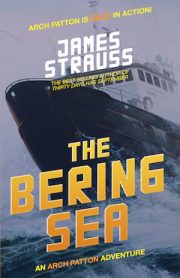
Arch Patton is from the novel Bering Sea which is a fictionalized story about the very reality of what
I’m writing about right now in this volume.
Semper fi, and thanks for picking up on that.
Jim
Jim,
wishing you a speedy recovery from your hospital visit.
Why would they require duffle bags to all be stores on the lowest deck?
THE WALTER DUKE. Ship’s have funny rules. The one was about the line not wanting passengers or crew to live out of their suitcases, as storage was at a premium and the cabin spaces very small. They could also then search baggage which they could not do with bags in the rooms by nautical rules.
Thanks for the interesting comment, great friend,
Jim