
The only ‘accidental’ discharge or ignition of an atomic device on U.S. soil in the history of nuclear weaponry had come to be blamed on me. Not the United States Navy, which was present; not ex-Navy Seal Marcinko, who was present; and not my control officer, who was also distantly present. The device was intended to be torn apart and destroyed, with ignition even being impossible, as it was supposedly not armed at the time. In the physics of nuclear weaponry, however, the word arming was not always something anyone could truly count on, as the mission had once again proven. If any separated nuclear elements were driven together fast enough, then the formation of an explosive plasma would result. In my last mission’s case, the only good news was that the detonation had been partial.
I sat patiently, sipping from a small espresso cup, unsure of how I’d come to be where I was, tucked into the back corner lobby of the Sheraton hotel in Crystal City outside of Washington D.C. I looked out a floor-to-ceiling window onto a well-kept courtyard. No, it was not my place to be there. Field work was what I did, not personal liaisons. I believed I was reduced to doing what I was currently doing following the supposed failure of the mission off the tip of Florida. The explosives I’d placed, or put down the tube, with no way of knowing how they’d set near the atomic device, had caused a sympathetic detonation of the charges meant to bring the enriched atomic elements together, and that’s what happened. Blaming me for placement, something I’d never been warned about, was ridiculous, but the results written up had to be lived through and with. My new calling in life was to make some sense, evidently, of someone needing special secret services from the Agency. A team of analysts, located four miles away at the CIA’s Langley complex, would evaluate and recommend any results or action that might be required to accommodate the source. I was a long way from having Kingsley, Nguyen, and Quincy at my side. They were, no doubt, impatiently awaiting my return to the kind of fieldwork I’d so hoped would be properly rewarded when accomplished.
Instead of proceeding to develop the insurance cover for more successive missions, I was sidelined, and the entire series of operations, from International S.O.S. to the connection with the Principal Financial Group, wasn’t put on hold but instead left to continue in the hands of subordinates who only knew brief parts of what they were all about. Even my advancing education toward a doctorate in ethnology was somehow temporarily put on hold. Everyone thought I was on a restful vacation break at home instead of heading just the other way, which was very likely Alaska. Tony only slipped one clue to me while instructing me to report to D.C. by asking if I’d ever been to that state.
Feeling diminished in importance and fidgeting over thinking about it, I sipped and fretted over the tops of my new prescription glasses I’d finally received from an optometrist visited months before. They had jet-black frames, for effect. I didn’t need them to read or drive. But they gave me a distinguished look, or so my wife had told me, and they did help when examining the tiniest details of photo intelligence results.
A big man entered the lobby near its grand front entrance. He wore an expensive blue suit. Its Italian cut did nothing, however, to disguise his morbid obesity. I flicked my eyes towards the man and then grimaced. The man’s florid complexion, bulbous nose, and other facial features gave his identity away. The Senior Senator from Iowa stopped in the center of the large foyer to take his place. No assistants or attendants of any sort accompanied him, which didn’t surprise me at all. The Senator noticed me sitting alone in the corner. I glanced up at him before looking down at the folder I’d placed on the table in front of me. The senator sat down in the opposing chair. A slight tremor passed through my left wrist. I quickly tucked my hand down between my thigh and the arm of the chair. Never had I encountered anyone representing myself as an agent, and certainly never a sitting senator, much less one who chaired the Senate Appropriations Committee. The last thing I needed to do was demonstrate some kind of physical or mental weakness in front of such a man.
I breathed in and out deeply as I took in the man across the table from me. I squared my shoulders imperceptibly, making my back ramrod straight. I had the weight and reputation of the entire Central Intelligence Agency behind me. I would neither genuflect nor grovel before anyone, even a powerful sitting member of the U.S. Senate.
“You’d be their man?” the senator inquired very calmly.
I started to raise my right hand. I quickly caught myself, however, pulling my hand down and trying to hold myself together. He was not there, at a clandestine meeting, to be social or to appear social, and the air between us was as hard and tense as titanium metal.
“You’ve been briefed,” the senator said, paternalistically, his voice soft and silky. He shifted himself with visible difficulty in the narrow chair I’d purposely placed directly across from my own.
“Got something for me?” the senator asked, glancing down at the folder. His tone this time was flavored with a likability that made me vaguely uncomfortable.
Before any reply could be made, the senator picked up the unmarked but highly classified file. Neither of us said anything while he read its contents. I noted that the lobby was empty, save for two clerks working registration near the entrance. The waiter, who’d brought his espresso to me, had never returned. I hoped he wouldn’t, for fear of having to hold the cup and possibly allow the senator to see my hand.
My hand was shaking. The valley had come back to greet me at a very inopportune time. Minutes passed. A bead of perspiration ran down my hairline behind my right ear. Fortunately, I could simply turn that side of my head slightly away from the senator’s position.
“Says here that you boys are gonna go ahead and help me out,” the big man in the blue suit intoned, before plopping the file noisily back on the table.
“The usual Agency drivel,” the senator went on acidly.
“You going to tell me how this plan is set to work?” he inquired.
I cleared my throat to steady myself and then answered his question.
“Your nephew is being justifiably imprisoned by a foreign government. His violations, meriting that imprisonment, are in keeping with what we normally associate with serious criminal behavior in our own country. The Agency does not normally involve itself in such matters, particularly where such deviant and anti-social behavior is involved.” I stopped, having delivered my own righteous version of the background information I’d been given during my briefing.
After a few seconds of silence, I realized that something was amiss. Without looking over, I felt the heat of tremendous anger flowing toward me from the direction of the senator’s chair. Instinctively, I dropped my left shoulder a millimeter or two in defense before I caught myself and tried to relax.
“Just cut to the chase, son. Don’t make me come after your career.”
The senator’s threat was issued in a low tone, more akin to that of an oversized cat purring than of a human. My throat froze, another tendril of fear coursing through me at the mention of my career. I finally cleared it by swallowing several times. The threat was very real, as the senator was very senior, and I was suffering from a mission that had gone amazingly well but was still looked upon as an abject failure. The bomb had exploded. It was not supposed to explode, even if armed. That I could be at fault for that, the planting of the explosives in a place where I had no visibility whatever, was not logical, but that didn’t seem to matter to those above my control officer’s position, whom I was not allowed to know about.
“We’re sending our best man,” I gasped. “He’s resourceful, violently equipped, and experienced. No expense will be spared for this operation. But we’re sending him in alone. We can’t afford, no matter what measures you may or may not take, to have this operation rise to the level of an international incident. Not now.” I didn’t come anywhere close to mentioning that the ‘best man’ would be me.
I averted my gaze from the direction of the man from Capitol Hill as I finished my memorized message. I waited for a response, again trying to fathom why I’d been selected for the role I was playing. I was in the dark, but I sensed the reason. It was about the fact that a small analysis group had provided the data, which sanctioned the mess-of-a-mission the so-called ‘best man’ had succeeded at, registered it as a failure, forced acceptance of that result, and then returned me home, alive against great odds.
I watched the senator rise from his chair. He glanced over at me, but was already walking away, a manufactured smile plastered to his politician’s face. He’d made no parting comment at all, not even in dismissal.
My shoulders pressed inward, and my head sank to the point that my jaw nearly touched my chest. My trembling fingers grasped the espresso cup handle. I took a shaky sip. I thought of the ‘best man’ the Agency was dispatching and then smiled weakly for the first time that day. That ‘best man’ had just come out of Murder Island under the worst of circumstances, having improbably accomplished the mission but being almost cursed because of the unaccounted-for result. The skewed manner in which his mission had been conducted would no doubt have the Agency looking like a stone-cold, heartless, uncaring beast over time. No one in the analysis was likely taking that lightly. My grip steadied as I pondered over what I’d just done. I was to be sent as a low-life field agent off to save a drug-dealing nephew of a corrupt scumbag senator. This time, not the remotest possibility of the mission’s success existed. I stood up straight, tucked the classified folder under my arm, and strode across the lobby. My mind was already lost in the formulation of the final mosaic, as it would have appeared when the details of an illegal and doomed mission crossed my control officer’s desk.
I caught the first flight I could find that went directly to Albuquerque, using the Agency American Express card since I was technically on a mission. It was more of a target than a mission, as all I had to go on was a location in Russia, a kid’s name, a docked ship waiting, and the location of Nome, Alaska, to get further direction. For some uncommon reason, Tony, my control officer, wasn’t available for anything more.
The Delta flight to Albuquerque in First Class took four hours. I knew I’d have to note that all the economy seats were sold out in my after-action report, but I was so overloaded and emotionally upset from the Florida mess, I didn’t want to think about it. I called my wife from the airport and then took a break to wait, drinking coffee at one of the airport restaurants since there was no coffee shop.
Mary was abnormally silent as we drove up the western flank of the Sandia Mountains to our home. I filled her in as best I could with what had happened on Murder Island, but left out the detonation and its effects. Being the great woman I’d married, I knew that she knew that things weren’t quite right.
“So, you’re home for, like, lunch, and then off to Alaska?” she asked, and I knew I was in trouble, but there was no help for it.
“Everything’s fine,” I replied, not knowing what else to say.
“I pick you up from the airport, and you don’t drive us home? What’s fine about that?”
Normally, I always drove whatever car we were in. It didn’t matter what car, but this time was different, and she picked up on that. She drove on in silence, which I knew couldn’t last too long.
Instead of communicating when we got home, I fell asleep lying across our bed. Mary, meanwhile, worked to prepare everything she could to send me off to Alaska as the anthropology lecturer I really wasn’t. I awakened in the afternoon, refreshed but not wanting to head off on a mission that seemed as unsupported as it was without a detailed plan. We didn’t really talk, even while I was driving us back to the Air Force Base to take a plane to the Coast Guard Station on Whidby Island, Washington, and from there to the Seattle airport and a flight on into Nome.
There would have to be a coming together when I returned, as both of us knew without anything being said. A brief hug, a smiling wave, and I was alone, off on another adventure that had more potential to be a misadventure than the one I’d had before.
The airport at Nome isn’t an airport at all. It’s a hangar at the end of a long concrete pad. In summer, the sun shines all the time. Twenty-four hours a day. There’s no luggage claim. They put everything in one big pile and then open the doors and let everyone at it. Like Bermuda was in the old days. I found that people fly into Nome when the weather clears. The summer’s a lot of fog and mixed rainy coldness. I flew in at three a.m. in the morning, yet it seemed like noon. The constant light has a truly strange effect on the human body, and I wasn’t ready for that, nor truly understanding that there were places on earth where for long periods, the sun never sets.
I took a taxi into Nome itself, which only has about a thousand homes, and maybe four times as many people. When I got out of the taxi on Main Street, I was deeply surprised. The town was something out of a Disney creation. For years, people built homes atop the permafrost layer (that’s about four to five feet of earth, which freezes in the winter and thaws in the summer, while under that it is always soft), so that many of them, those who’d more cheaply build above the level of the permafrost, had come to have a distinct lean. They tilted in every direction. Americans were so used to always seeing homes flat and level it was truly disconcerting to see homes leaning at weird angles, with none of those angles congruent to one another.
Wonderland. I’d arrived in a misty, cold, and jumbled winter wonderland.
I walked around the place for a couple of hours, hauling the duffel, taking in the town. The rain stopped, but the streets were wet. They bore the appearance of never having dried since they were poured many years before. I was supposed to check into the Nugget Inn after it opened at nine a.m. Even after all the walking around, it was only five. I went into the place anyway. There was no one at the front desk or in the lobby. Nobody anywhere. I checked the place out. A closed and locked restaurant was located at one end of the building. Running right down the center of the restaurant was a great bar. The bar stretched out toward the water and was glassed in on both sides. I peered through the windows of the double doors to see what I could. “The Gold Dust Saloon” was etched across the door glass.
I sat down, leaning my duffel against the locked door. I had little to go on with the closed bar and lack of any human contact. I tried to consider my options. I was working for the most powerful member of Congress who had control of the Agency’s finances. I was in a good position, but one plagued by dangerously potent results. What was I to do? There was no cell service, at least not for my cellular service, so I couldn’t call my wife, and I’d also not noted one telephone booth since coming to the town.
I accidentally leaned against the door, my weight causing it to give way and open. I looked back and then stepped inside. Nobody was around, so I dropped my bag behind a table and walked through the bar. Behind the long counter, booze bottles were set row on row while dirty glasses littered the polished flat surface of the bar itself. Dirty plates lay on most of the tables. There was also debris between them, littering the ancient hardwood floor.
I shrugged to myself. I’d happened to be in a weird spot in the universe, I realized, and, at a weird time. Instead of departing, I went behind the bar and searched around until I found the coffee ground container. I cleaned the urn out, brewed coffee, and then started cleaning the bar itself, working for an hour, making good headway, until an older man appeared, stepping through the now-unlocked door. I stopped what I was doing and prepared to introduce myself, but the man spoke first.
“The fryers need to be emptied and cleaned,” the man said in a low, gruff voice. “No drinking until noon. You get the usual breakfast later, when we get some customers. If you work to lunch, then you get lunch and two beers, no more.”
I examined the man as he delivered his short speech. His face was large and florid, decorated by a well-manicured handlebar mustache. The kind I’d always wanted to grow but had never been in the position to. The man was wearing a big yellow apron, which had the single word “Cochon” printed at an angle across its front. French, I knew, although he didn’t know the translation. It seemed to fit the surly man, though. He handed me a plain white apron when he was done talking. I took the apron and put it on. It seemed like the most natural thing to do in the strange universe I’d chanced upon.
I emptied the fryers, found large vegetable oil cans in the back, and refilled them. I used a hand brush to work on the floors (Cochon handed me the brush and pointed down), then applied stainless steel polish to restore all the industrial tables. The man stopped him when customers arrived. He handed me a small notepad and looked at me, standing in front of him, holding the thing in my hand. Cochon just walked off towards the stoves, located down at the end of the bar. I watched him light all three. He opened some egg packages he’d brought from the back. I wondered whether I should ask something or say something, but then it came to me about what had to be done.
I started taking orders, trotting out my own Mont Blanc pen to write with. I passed out menus, scribbled orders, and cribbed the notes as best I could, and then fastened the notes into clips on a small overhead turntable near the stoves. Cochon labored ceaselessly, never asking a question, and was somehow able to figure out my badly written instructions. The breakfast crowd abated by nine, so I stopped working and leaned with my back against the bar. I checked the big front pocket of my apron. Twenty-four dollars in tips, mostly change. “Cochon” slid a plate piled awkwardly with sausage, scrambled eggs, and white toast across the bar. There were no coffee cups in the place I knew. I’d looked.
“No booze, like I said, till afternoon,” he murmured again.
I nodded, then got another bowl of coffee, and ate breakfast, afraid of more customers walking in before I was done. But the run was over.
“Bus all the rest of the tables, and then get the dishes washed,” barked Cochon, throwing a towel in exchange for my empty plate.
I did the dishes. By eleven, the place was clean, and all the work was done. A few ‘coffee only’ customers slouched at the bar. They had the look of people waiting for the noon bell, when they could switch to booze. I’d been told, before I’d come here, that people drink a lot in Alaska. Cochon came around the end of the bar. He motioned toward the seat next to him.
“You work well. Do the lunch crowd, and you can then have a couple of beers, maybe a hard drink.”
I smiled, but said nothing, in keeping with the twilight world I’d stepped into. Both of us drank coffee slowly from the big ceramic bowls.
“The bowls are from the Navy,” Cochon stated, admiring his own. “On destroyers, you don’t drink from a cup. You drink coffee and hot chocolate from a bowl.” He looked out the window, toward the sea, his expression wistful. “I still keep my hand in. Got an old LCT from the war. Landing Craft. A hundred feet long with a beam of thirty. Only draws three feet, though. Should sell it or rent it out. A great rough water boat for running supplies between islands.”
I didn’t reply, although I well knew what a Landing Craft Tank was. Instead, I proceeded to check out the Navy bowl carefully and then drank from it again.
“You want a full-time job?” Cochon asked. My eyebrows went up. The question surprised him. I wasn’t sure how to phrase an answer, so I delayed for a few more sips.
“Well?” “Cochon pressed, rather forcefully, staring.
“Well, thank you, but I already have a job,” I replied.
Cochon examined him closely.
“Hell, you say? Job? I know every job in this town. You don’t have any one of ’em.” His thick bushy brows knit together.
I pointed out the window to the harbor beyond.
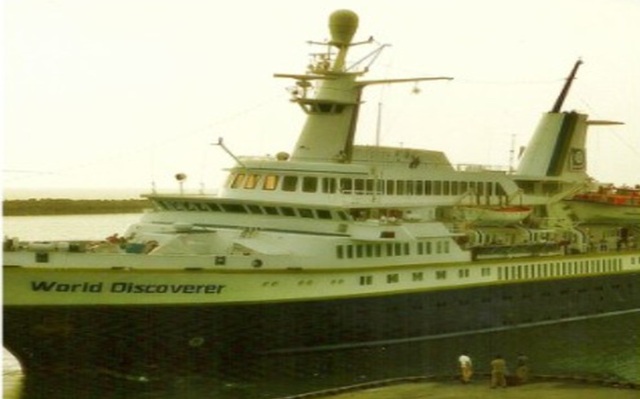
“I have a job aboard that expedition ship parked out there in the harbor. I don’t report aboard until three,” he said.
Cochon looked at him in obvious disbelief.
“You?” Cochon inquired. He eyed me up and down. “You don’t look like any seaman I ever saw,” he added, after a few seconds.
I grinned. I was wearing Polo trousers, a Paul and Shark shirt, and my Dunhill jacket lay atop the bag that still sat near the front door. I didn’t look like any seaman anyone had ever seen in any port of the world. I looked much more like I belonged in a D.C. sports bar where I’d been only hours before.
“I’m the anthropology lecturer for the coming cruise,” I said, assuming education I didn’t yet fully possess while sticking out my right hand.
Cochon didn’t take the offered hand. He didn’t smile. I allowed my arm to drop.
“Shit,” he said, instead. “I thought you were one of those goddamned alcoholics who roll in here all the time. They work and move on. I give ’em food and booze for the work.” He stared at me intently.
“If you’re some hotshot professor, then why’d you do all that work for me?” he asked, one meaty hand going up to rub his right temple.
I grinned, not looking at him. He finished the dregs of his coffee. “I’m not sure. To have some coffee, I guess, and later because you needed the help.”
I extended my hand a second time. “You needed the help,” I repeated flatly, staring straight into Cochon’s eyes.
Cochon gingerly extended his thick hand. I made sure not to squeeze too firmly. I had no grudge against the grouchy bear of a man.
“Besides, the breakfast was great,” I added.
I got up and headed for the door to get my bag and coat. I looked back. Cochon was standing, motionless, with the Navy coffee bowl in his left hand.
“No, c’mon… who’re you really?” he asked, his right hand held out with palm turned up.
“Who was that masked man?” I whispered to myself as I stepped out through the glass door and headed for the only ship docked in the harbor.
I intended to get aboard that ship, but my primary objective was to get in touch with my control officer so I would have a better idea about what I was supposed to do and what I was supposed to do it with.






LT, I don’t understand why there can be no comments when I posted a comment on here.
Hey my friend, I am sorry about the delay here, but I was in with a heart problem. Looks like they got it though, and I’m going to live. Echo is at 55 percent, and my blood pressure way down. Whew. Hate being in the hospital, even if the VA here is great. The comments had to wait until I was navigable again and I am . The next chaper will be up tomorrow.
Finally, chapter III of the seventh volume. Thanks for bearing with me my good friend,
Semper fi,
Jim
The bar segment was hilarious!
Yes, Harry, and the bar sequence was written exactly the way it happened, and the second visit there, later on, is just
as entertaining. Finished chapter III this night, thank God. I am sorry about the delay here, but I was in with a heart problem. Looks like they got it though, and I’m going to live. Echo is at 55 percent, and my blood pressure way down. Whew. Hate being in the hospital, even if the VA here is great.
Semper fi and thanks for sticking with me thorugh thick and thin.
Jim
Jack of all trades! You can blow up an island, take someone out of the equation, direct a company at night under fire, and clean up a bar/restaurant!
Still enjoying those descriptive paragraphs that make one feel a part of the action.
Got some weird blood disease (no, not social!) that is keeping me both tired and unable to sleep well. The ex-wife is going to come join me (from Brazil) and assist in my care. And the VA has somehow messed up my disability pension. Sent it to a stranger’s bank account. “Oh, we’re investigating, will only take 6-12 weeks. Meanwhile there are little things like mortgage, insurance, utilities, food. About to contact my Congress person, Jim Jordan.
Very anxious to read the next few chapters, where I expect you to slay the dragon, balance the budget, and go off to visit Mars or Saturn….
Wilcox, you great guy you. I remain worried about you and your situation all the time, of course.
Thanks for hitting the keys here and letting me know you are still around and also what is going on in your
life. The ex from Brazil sounds frightfully interesting. Is she bringing toothpicks to help your nails get
a bit of air and “freedom”
Semper fi, great friend,
Jim
Outstanding transition! I like Arch better now. And your window into Congressional power is revealing! 👍🫡
Colonel Homan, the guy who still flys cover for me after all these years. No plane but such a giant of a heart.
Thanks for the comment. You know I’ve been sick of course but I’m back in the saddle again. New chapter out tomorrow, not a short story which just got published today too.
Semper fi, my great friend,
Jim
Jim,
Love it that you are back in the saddle again. Great transition chapter. Now how in the bloody hell are you singlehandedly going to get into Russia, conduct a successful extraction of some goofball that got himself a prison sentence and then successfully exit there?
Keep on putting pen to paper,LT.
THE WALTER DUKE. The kid got no sentence. It is Russia. There was just incarceration in a gulag. Our kind of law does not exist there
for many, especially any American carrying drugs, etc. The only thing worse is to be considered a spy. That someone knew where he was
is remarkable and I never got to know who that was.
Semper fi, my great friend,
Jim