
Two Filipinos came into the locker. They began to haul our tanks, and B.C.’s down to the waiting Zodiac. Dutch started to follow, but I stopped him by putting my arm across the door.
“Dutch, this is the kind of dive that guys get killed doing. Pay attention. You do everything, and I mean everything I tell you, we may live through this.” He looked back at me with bloodshot eyes. His breath smelled of booze.
“Okay, Indy,” he exhaled.
I turned my head away at the 80-proof stench.
“Your job is to watch me and come to my assistance if I need help. That’s it. No looking for anchors, exploring, or any other nonsense. Just me. You watch my ass. And don’t call me Indy.”
I pulled my arm back. “You know how to buddy breathe?”
He shook his head, as I sighed again, deeply. “Final question. How deep is the water?”
Dutch knew that one.
“Sixty-one feet,” he answered, proudly.
“Some good news,” I said to his back as he went through the hatch.
Two atmospheres. A bit less. We could safely stay on the bottom for almost an hour without worrying about the bends. Half an hour to be on the safe side. The Filipinos had taken extra tanks, but we would not be using them. I headed for the Filipino mess. When I got there, I scrounged around and found a plate of fresh-caught fish. It was cooked in the usual Filipino manner. Ungutted and uncleaned. I pried some flesh off, made six large sandwiches with a loaf of French bread, and half a jar of mayonnaise. I wrapped it all in reams of aluminum foil. The biggest defense against cold weather fatigue was fuel, as Benito had aptly demonstrated earlier.
Returning to the dive locker, I put the sandwiches and the gear from my ditty bag into a small canvas sack. I’d used the Vaseline and the socks but also took my Stryker flint. It was so powerful that you could ignite bare wood with its sparks, if necessary. I found a big dive knife with a screw-top hollow handle. I hunted around, unable to find matches. I did locate a used Bic lighter on the floor, so I placed that inside. I screwed the handle back on hard.
“Insanity,” I cried, and then went down the stairs and into the open corridor until I faced the open hatch to the sea.
The Zodiac was nosed into the steel hull. Filipe held it fast with a bow rope, but it bucked and weaved about anyway.
Don stood at the stern, his hand on the tiller of a big running outboard. Dutch sat among the gear, smoking a cigarette. I leaped and settled down next to him. Then I looked around, while Don shot us out from the side of the ship. Passengers lined the deck to watch the operation. I saw Marlys peering down. I looked up her dress. It was just a glimpse. I looked away, a bit embarrassed. Then I looked at the Island. It was the water that stunned me, however. It had to be moving at least fifteen knots. As fast as a sprinter could run. The ship was under power, holding itself exactly against the current. No wonder the anchor chain had snapped…unless it had some other reason to, I thought.
“What’s the island?” I asked Dutch, over the whine of the outboard.
“The Isle of the Tsar of Russia,” he explained, between puffs of a cigarette.
We were moving up ahead of the ship, as I had instructed Don. A second island was visible, less than a mile from the first.
“And that one?” I pointed at the other island. Dutch laughed.
“That one’s also the Isle of the Tsar of Russia.”
I screwed up my face.
“Like Daryl in the Bob Newhart Show?” I shot back.
Dutch looked at me quizzically, the allusion lost on him. I presumed that he had never seen the TV show, which had had two brothers with the same first name. I stood and directed Don to a spot in the water. He throttled back, and we came to a sliding halt, but I could observe that the current was carrying us fast back toward the ship, now a half-mile away. Dutch and I suited up, each helping the other with tanks and weight belts.
My belt held twenty-two pounds, which I knew to be about right. But I didn’t really care that much, as I wasn’t planning on doing anything but going down, and then coming back up on the other side of the ship. Declaring the dive a failure was, after all, the unspoken mission.
We put our fins on, tested our regulators, adjusted our masks, and got ready to go backwards over the rubber gunwale tube. Don then tapped me on the shoulder.
“Where’s the pickup?” he asked. I pointed behind the ship in the distance.
“Go about a mile astern of the ship, then pull up,” I instructed. “It’s damn close to the island, but it should be about where we surface. I opened my canvas sack and took out the dive knife with its scabbard. I attached it to my left thigh with the straps. I gave the sack back to Don.
“Guard that with your life.” I smiled as I said the words.
At the bottom of the Zodiac was a hefty coil of rope, with a CO2 inflatable canister to operate the float. Our immediate mission was to run the line through the last link of the anchor, tie the ends to the canister, and then pop the CO2 cartridge. The ship’s cables, chains, and winches would do the rest. I attached the coil to my shoulder with a strip of Velcro. I handed the canister to Dutch. His face looked white, almost alabaster.
“You have dived the Bering Sea, have you not?” I asked.
He shook his head.
“Great, just great,” I exploded aloud.
I sat down next to him, depressed and with a bit of fear. We reset our masks, re-inserted the regulators into our mouths, and gave each other a standard ‘thumbs up’ signal.
I’d rinsed my mask over the side before I’d tried it on to adjust the strap, so I knew the water was cold. The wetsuit headpiece was essential, as were the wetsuit gloves. But all of it made things difficult to manipulate or touch. Underwater, I oriented and hung head up at about ten feet.
Dutch appeared before me no more than six feet away. I checked everything of mine, giving him another thumbs up. He gave it back. I pointed directly down. We were going to go down to the bottom, stay there, and let the extreme current carry us right under the ship.
Down I went, my weight belt providing plenty of negative buoyancy. The bottom was a shock. I had noted something odd, even at the surface. But at the bottom, which registered at sixty-on feet on my gauge, the seabed was white. White sand. Glaring white sand with waves. The current was stirring the sand and driving it over the tops of small and endless rivulets, like waves of powdery air over the tops of miniature dunes. It was stunningly beautiful. It was also totally unexpected. I had presumed that the bottom would consist of rock. Dark, harsh and jumbled rock, to be precise. It was anything but. We sailed over the sand, side by side.
There were no more thoughts of Dutch following or watching my back. There was no threat. No sharp edges. No clefts to get caught in or lost. Just white sand everywhere. The ship glided over us, the thrum of its two great propellers beating and thrashing above. It seemed too close. The “Lindy” drew twenty-five feet, so we had a little less than forty feet of water over us when we went under her. It seemed more like five feet.
The stern passed over us, but we were still in her shadow, and jostled by the twisting unseen currents, stirred by her power. I nearly panicked, as a huge black snake reared its head out of the sand.
A thrill of fear went through me.
I sucked deeply on the regulator. Then I noted a large hole in the snake’s head. The ‘head’ was the broken end-link of our anchor chain. We were moving so fast we almost blew right by it. Dutch caught the link with one gloved hand, and then grabbed my weight belt until I could get a handhold. The current was unbelievable. You couldn’t face sideways into it while stopped. I lost my mask twice and had to clear. My eyes and nose were near frozen with exposure to the freezing water. But there was nothing to be done. The sharp shiny edges of the link break had to be avoided. Any damage to our dry suits while in 40-degree water could be quickly fatal before we could get back to the Zodiac.
Commercial dives were much harder than sport dives. Commercial divers worked harder. Dutch and I scrambled to hang on, attempting to thread the uncoiled rope through the second, unbroken link. It was much, much more difficult than can be imagined. Finally, we achieved it. We next attached the canister. Tying the line was nearly impossible with the gloves on. I had to remove mine. Then it was easy, but there was no putting the tight rubber gloves back on after I finished. I tucked them into my belt instead, and pulled the cord on the CO2 cartridge. It zoomed to the surface while the doubled line played out.
We didn’t have to guide it. We saw the float canister plunge up through the surface. We looked at each other and smirked, using the thumbs-up gesture at the same time. We let go and began our ascent to our pickup. For some reason, the current had dragged us closer to the island than we had calculated. Stalagmites appeared, jutting out of the sand.
I knew it was time to surface and pointed up. We inflated our B.C.’s together and headed up. Don was far back, but finally waved back, having spotted us. I could see people on the fantail of the ship waving, as well. I looked for Marlys without success.
“Where the hell is Yemaya when I need her?” I implored the wind.
Don motored up. By this time, Dutch and I were only yards from a great high cliff face. I waved Don back, but he came towards us anyway. He got close, then turned and gave us the side of the hull. Ropes were extending all along the rubber tubes of the Zodiac. We grabbed and held. My frozen fingers had no feeling, but I held on anyway.
“Cut the engine,” I yelled, trying to give him a slit-throat gesture, knowing that he was unaware of the up-thrusting stalagmites. He cupped one ear without benefit. I thought we could just float past the island, and then restart the motor on the far side.
There was a huge bang. At the same time, I felt a heavy impact penetrate right through the boat. Almost immediately, the top of an upward stabbing stalagmite struck me. My suit ripped, as ice water instantly poured in. Don pulled Dutch aboard, but even he and Don, tugging together, were nearly unable to bring me, with a full dry suit of water, aboard.
I lay on the bottom of the boat, exhausted and cold to the bone. When I sat up at last, Don delivered the bad news.
“Prop washer’s busted at the shaft,” he said, in resignation. I then looked to the fantail of the ship, but it was gone. I clambered to my feet in shock, only to see the “Disco” far away. Very far away, and moving farther away fast.
“What the hell?” I cursed into the strong wind.
We were past the island; the current was abating; yet the wind and huge swells were building. Don put his palms out and up, his forehead wrinkled in question, then pulled a hand-held radio out of his suit.
“I’ve got communication. I’ll just call ’em,” he assured me. He pushed the button on the radio down.
“Dive One to the Captain”, he repeated, over and over. A Germanic voice answered on the fifth try, although the reception was too scratchy for me to understand the words.
“Almost out of range,” Don said, a worried look on his face. He talked for several minutes; his back turned away from the wind. Finally, he put the radio back into his coat. His face was white.
“What is it?” I demanded.
“It seems that there’s a cruise ship on fire. An emergency. The Disco’s bound to race to their assistance. They’re the closest. It’s the Law of the Sea, and all, but the burning ship’s only fifty miles away. They’ll be back for us in a few hours.” He smiled, weakly, when he finished.
“Jesus Christ, Don,” I blasphemed, “with this current we could be on the Russian Coast in a few hours.” I thought hard and fast. “Oars?” I asked, looking at Don.
He shook his head.
“Paddle?” I asked.
Don said nothing. I moved closer to the inebriated Assistant Cruise Director.
“Dutch, get your snorkel and get in the water. You’re our only hope. We’re in the lee of the island. Swim us in. We can wait this out behind the island, if we can find a place to land. My suit’s full of water, or I’d be in there with you.”
Dutch scrambled to get his snorkel and mask back on. I hoped that his level of alcohol would not prevent him from swimming the boat in. I looked into the distance at the Isle of the Tsar of Russia. The Bering Sea was a brutal, punishing beast at any time, much less in a storm. The ominous clouds to the North, beyond the island, did not look tropical at all. Nor did they look like they would be long in arriving.
The slow stuttering trip out of the current and into the island’s lee took less time than it seemed it should because of the back current. Dutch had held to a dogged, steady pace, stroke after slow stroke, swimming out in front of the Zodiac. Without warning, the boat had run right up over his shoulder, as the wind, in concert with the current, exerted a suctioning pull back into the lee of the island. I had replaced the wetsuit gloves on my hands, and, as with the water-filled dry suit, they responded warmly to the insulating properties of only a thin layer of liquid.
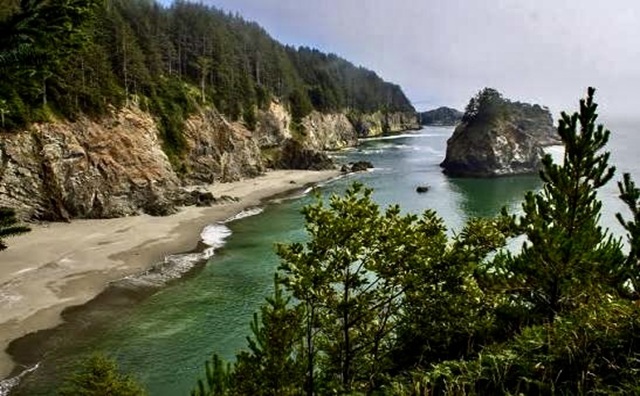
I wasn’t warm, but I had feeling. We pulled Dutch aboard as the Zodiac moved sideways toward the cove, which served as the innermost point of the lee of the island. Waves pounded onto the small rocks, appearing to run in on swells only four to five feet in elevation. I looked up at the small chunk of water-isolated land. It was a kidney-shaped piece of rock about eight hundred feet high. The only landing spot possible, at the base of the cliff, was a narrow cove the boat was being sucked into. Huge pines appeared to cover the flat top of the quarter-mile-wide body of gray rock, high above.
There was no attempt on our part to manage the Zodiac’s direction or lessen its impact when we went over the falls of a wave. The boat’s soft-bodied hull was made of a hard rubber called Hypalon. When the hull struck, the resulting sound was of a huge flat crack. The twenty-foot vessel bounced and flew.
I flipped out in mid-air, landing on the rocks, my back down. The rocks, which had appeared so substantial from a distance, proved slippery and full of give. The dry suit, in its water-filled state, protected me. I was uninjured.
The boat, however, was high and dry, wedged into a pliable rock base. I grabbed a hull line and climbed to my feet. Don and Dutch were doing the same on the far side. We looked at each other. Jokingly, in imitation of The Three Stooges, we all slapped our foreheads in unison. The reaction was automatic. It had happened to me many times before. The elation of survival, under difficult or impossible circumstances, forced an appreciation for simply being alive. That feeling overcame all other emotions.
I understood what it was. It’s a rare emotion, not experienced or understood by ‘normal’ people.
Nothing was said for a full minute as we stood by the Zodiac, breathing hard. It had been a close call. I reengaged with both men and waited, but neither wanted to be the first to speak about the ordeal. And what was coming next.
I leaned back and tried to recover myself while not letting on that I was doing so. Cold and miserable, with more trouble of the likely terminal kind, I was taken back to the hot, steamy valley. My crucible in life that I could never really escape. I had artillery then but nothing now. I had come up with plans that were only popular after they worked and because of the rock and roll lyrical names I gave them.
We needed a plan. Sitting in a damaged zodiac waiting for a storm that would bring waves that would no doubt crush or in some other way destroy the craft was not a plan. I craned my head around and looked up at what seemed to be an unclimbable wall. The pines hanging over the top edge, blowing gently in the wind, called to me, not like the cliffs that were on both sides of the A Shau, but like the pines I’d camped under when at Bellows Beach on Oahu in my childhood.
There, one night, after a disastrously humiliating ‘snipe’ hunt, Mr. Torres, before his tent ‘accidentally’ burned down with all his belongings, taught the troop surrounding the campfire a WWI song, supposedly sung by surviving flyers when they came back and waited in a hangar drinking and trying to appear unafraid and happy-go-lucky as best they could. Dutch and Don were both tall. I was short by comparison. Dutch was thin, while Don was full-bodied to say the least.
I turned back to Dutch and Don.
“We’re going up that cliff since we have no choice. The mission’s simple, but the application of it is dangerous and complex, especially for me because I can’t stay in this suit; It’s called ‘Bless them all.” I stopped and looked at the two men.
I smiled at their questioning looks. I started to sing, softly.
“Bless ’em all, Bless ’em all, the long and the short and the tall…”
Both men laughed and then started singing with me.








Where did my comment go ??
I think I just am now answering it, SgtBob, but if not so then let me know so I can try to track down what happened to it.
Chuck Bartok does a masterful job keeping the site up and fixing problems.
Thanks,
Semper fi,
Jim
registered at sixty-on* feet on my gauge, (*one) is the only typo I noticed James.
I have never put on a wetsuit but as you’ve described it, I can only imagine what it must feel like having been filled with such cold water in addition to the additional weight !!
“Bless” them all ?? Sure OK Marine LOL… But I understand ,no need to get into censor issues.
“This another fine mess you’ve got us into” Laurel & Hardy, sure comes to mind !!
Well it’s beginning to look like ye olde Boy scout camping training is about to come into play too ?!
Sure hope your ship is able to return shortly. Oh do either of you have any flares ??
Good read on this chapter.
Glad your health is on the upturn James, keep ‘Em coming !!
Semper Fi
The Zodiacs were not equipped with emergency supplies at all because they were never
intended to be used far from view of the ship, although they frquently were.
Appreciate the depth of your study about how the story is going and love the Laurel and Hardy
quote. Real life portrayed by fictional writing and performing.
Semper fi, my dear friend,
Jim
Thank you for another chapter, I enjoyed it very much!
Thank you Bill, interesting times for certain. Thanks for the compliment as well.
Semper fi,
Jim
LT, great read this week. Thank you.
My great pleasure JT, as usual, now that I’m healthy and filled with my old energy. Nothing like a
heart issue to sap that energy almost entirely! Thanks for the comment. Hope to get a lot more of
my commenters back whom I lost when I went down for a bit.
Semper fi,
My friend,
Jim
Another great read. Get well & keep them coming.
The dangers of real missions were pretty extreme or not at all. No Seal Team or Mission Impossible perfect planning and then
execution. Flying by the seat of your pants means just that and, back then anyway, running like a lone wolf was not encouraged
except exceptionally, if the cloaked and secret leaders became convinced that you were really a wolf.
Semper fi, and thanks, Phil.
Jim
You revered to an earlier time and having a plan and a song! But that was structured arround a set of rules and group Marine training. Here it appears to be only the song and action ruled by survival. The Valley was existentialy only about survival but in the presence of the Marine thing. It is funny as we read here we are reading True, which like in the Valley we can rely on you surviving!
Homan
My dear friend, the training of my Marines in the A Shau was long gone by the time I had to lead them. We were all
in survival mode, just like in certain incidents dealing with CIA missions. Humans are emotional…not totally, but way more
than most want to admit. I used that on my men and on myself. Yes, I survived, as many of them did, a lot more than in the valley,
but then I was better experienced, equipped, and yes, trained.
Thanks for the usual great comment of depth and perception.
You are amazing, as you always were for me.
Semper fi,
My great friend,
Jim
Given your propensity to cheat death, your occasional spontaneous prayer “Jesus Christ” are obviously effective.
I did pray. I just cannot do so using a religion or preacher, a priest, or any of that. I have to go
directly. Then, I wait, not expecting any display of revelation, but for a result that seems guided, and
many times I do not understand why or how…but amazingly, it works out in the end…as you have observed in
reading my writing. The hand of God was in all of this, but not appearing as a hand.
Thanks for the great comment, Harry, and spot on.
Smepr fi, my friend,
Jim
Thankfully, my diving was limited to south Florida and the Bahamas. Really dislike cold water!
Great chapter, Jim – thank you
But you would have gone down. Just the way you are built. Like me. The right stuff as so described about the first astronauts.
A great pleasure to read your comment, but long for those long ones.
Thanks, my great friend,
Semper fi,
Jim
Jim,
I deeply and genuinely thank you for a new chapter, and wish you continued recovery from your recent medical issues so you can continue to plop down more chapters allowing us the adrenalin rushed opportunity to
tag along with you to conclusion of this current volume of TCL.
But I have to admit this WV boy is a landlubber. MY adventues on small creeks, ponds and lakes never have involved dealing with the depths, currents, cold, and other obstacles you were facing on this merry jaunt.
I have a fear and respect for the wide open sea-upon which a person is at its mercy–and I would take 100 ungodly misadventures with you on land over just one at sea.
So I am out of my element as I struggle by your side in this chapter/episode. I WILL reread this chapter at least once more to fully digest it and better understand.
1. Shouldn’t the mother ship have at least launched another Zodiac to come to your assistance before bolting off to assist the big ship with a fire?
2. How the hell will you get OFF this island? On his 3-hour tour, Gilligan, the Skipper, etc. were stuck of GIlligan’s Island for years.
Can the Mother Ship shoot you a rescue line? Will you somehow secure a chopper (piloted by Col. Homan)?
3. Even though the anchor weighs a gazillion tons, can floats be used to help reduce the weight needed for a mechanical winch it haul it up?
4. Did your mother ship at least issue a distress call to whoever MIGHT be within distance to provide YOU help (U.S. asset? Russian?) until they are finishing lolligagging around on other missions?
I can’t imagine this could get any worse, but I suspect it will…
Your precarious situation at the end if this chapter will cause me to have a lot of worry, and trouble sleeping, until you bless us with the next chapter. I gained some comfort in knowing you survived since you are currently trodding the surface of the planet Earth
God bless you LT.
THE WALTER DUKE. The ‘mother ship,’ the World Discoverer, was captained and run by the Germans. The captain was remote while the 1st Mate hated me. The ship was not populated by former rescue workers, cops or EMT persnnel so did nothing except to say they’d be back for us. Did they think of provisions? Our safety? Any of that? No. They could not even see us from their position and the rough seas. We were on our own for a few hours, from their prospective, or what I thought was their prospective. If became a bit more than that, of course, and lives ended up on the line in several different ways. My A Shau ‘training’ proves invaluable…mostly because I always rate every situation as being much better than when I was there and that settles me down to ‘Bless them all,’ and proceed with a plan. Thanks for the usual depth of your analysis and the compliment it showers down upon me. Another part of my truly unbelievable life.
Semper fi, my great friend,
Jim